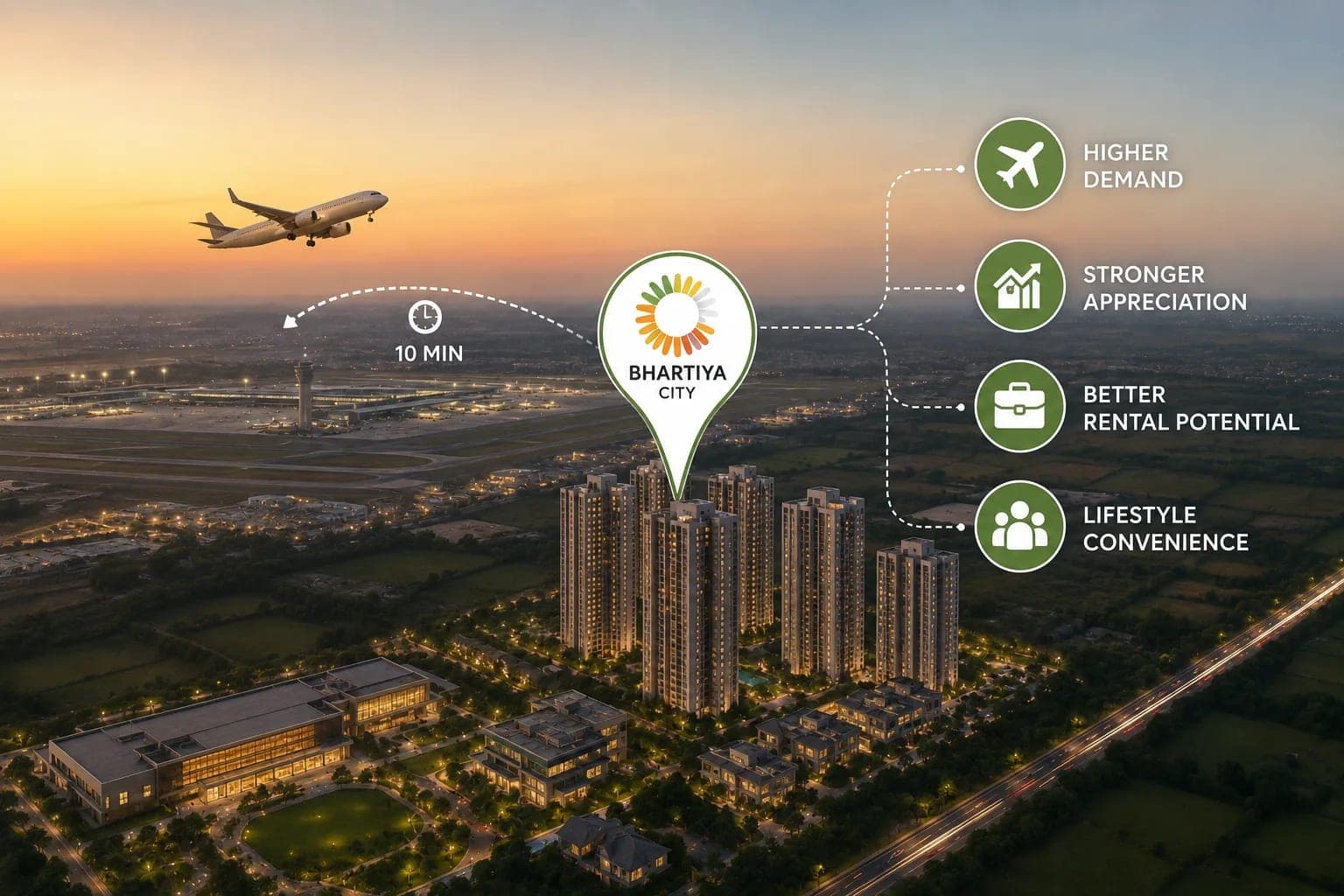
Here is a pattern that repeats around the world: when a major airport opens, the land and homes near it tend to rise in demand and value over time. It is one of the most reliable trends in real estate. This guide explains why airport proximity drives property demand — in simple terms — and then looks at how Bhartiya City KIADB in Devanahalli fits that very pattern.
You can review the project itself on the Bhartiya City KIADB project page at Perfect Neighbourhood. First, the reason airports matter so much.
An Airport Is an Economic Engine
Most people think of an airport as just a place to catch a flight. But a big airport is far more than that — it is an economic engine that reshapes the whole area around it.
When a major airport is built, it does not sit alone. Businesses want to be near it. Hotels open to serve travellers. Warehouses and logistics companies set up to move goods. Offices and industries choose the area for its connectivity. Over time, a whole economic zone grows up around the airport — sometimes called an "airport city." This is exactly the kind of zone forming around Kempegowda International Airport in North Bangalore.
How Airport Proximity Drives Property Demand
The link between airports and property demand is a simple chain. Let us walk through it step by step.
Step 1: The airport brings jobs. Airports create huge numbers of jobs — not just at the airport itself, but in the hotels, logistics firms, offices and industries that cluster around it.
Step 2: Jobs bring people. All those workers need somewhere to live. The closer they can live to their jobs, the better.
Step 3: People create housing demand. More workers wanting to live nearby means more demand for homes — both to buy and to rent.
Step 4: Demand lifts value. When many people want homes in an area, prices and rents tend to rise over time. That is basic supply and demand.
So the airport does not just add convenience — it sets off a chain that creates lasting demand for homes nearby. That is why airport proximity is such a powerful driver of property value.
Why Airport Areas Keep Growing
There is another reason airport zones do well: they tend to keep improving. Because so much money and activity gathers around an airport, governments and companies keep investing in the area — better roads, new metro lines, more businesses, more services.
This creates a positive cycle. Better infrastructure attracts more businesses. More businesses bring more jobs. More jobs bring more people. More people justify even more infrastructure. Round and round it goes, and property values tend to climb along with it. Airport corridors are often among the fastest-growing parts of a city for exactly this reason.
The Bhartiya City KIADB Case
Now let us see how Bhartiya City KIADB fits this well-known pattern. It fits it almost perfectly.
It is close to the airport. Bhartiya City KIADB sits roughly 15 minutes from Kempegowda International Airport — right in the growth corridor where the airport effect is strongest.
It sits in the employment zone. The project is in the KIADB Aerospace Park belt, surrounded by aviation, business and knowledge industries — the very jobs that the airport effect creates. Nearby hubs like Embassy Knowledge Park, IFCI Financial City and Manyata Tech Park add even more.
It is riding the infrastructure wave. NH 44, the Airport Expressway and the upcoming Namma Metro Blue Line are all part of the investment that flows into airport corridors — and all serve this area.
It is a growing corridor. The area around the project is still developing, which means it is earlier in the growth cycle — the stage where the airport effect still has room to play out.
In other words, Bhartiya City KIADB is not hoping the airport effect will happen someday. It is already sitting inside it.
What This Means for Buyers
Understanding the airport effect helps you see why the location matters for your own decision.
For people who will live there: you get the convenience of airport proximity today, plus a home in an area with strong reasons to grow in value over the years.
For investors: the airport-driven job base means real, steady demand from tenants who want to live near work — which supports rental income. And the growth cycle of an airport corridor supports long-term appreciation.
Both benefits come from the same source: the airport pulling jobs, people and investment into the area.
An Honest Perspective
Balance matters, so a few honest points. The airport effect is a strong and well-known pattern, but it is not a guarantee — it plays out over years, not overnight, and it needs patience. The area around Bhartiya City KIADB is still growing, so a buyer is partly betting on that continued growth. And the airport effect supports the location, but you must still check the project itself carefully — its pricing, its approvals like RERA, and its possession timeline — before you commit. A strong location does not replace good due diligence.
Who Should Value Airport Proximity Most
Airport proximity as a demand driver matters most to a few kinds of buyers. Long-term investors should value it highly, because it is exactly the kind of durable demand driver that supports rental income and appreciation over time. People who travel often — frequent flyers, aviation workers, NRIs — get the double benefit of convenience plus a strong location. And anyone buying for the long term benefits from being in an area with real reasons to keep growing. For a buyer who only cares about today and never flies, the demand driver still helps their home's value, even if the convenience matters less to them personally.
Final Word on Bhartiya City KIADB and the Airport Effect
Airport proximity drives property demand for a simple, powerful reason: airports create jobs, jobs create people, people create housing demand, and demand lifts value — all supported by a steady flow of investment into the area. Bhartiya City KIADB sits right inside this pattern, close to Kempegowda International Airport, within the employment corridor, and early in the growth cycle. For buyers and investors who understand this well-known effect and are willing to be patient, it is one of the strongest reasons the location deserves a serious look — as long as the usual project checks are done with care.
To explore the project in full — with current pricing, floor plans and RERA help — review the complete details on the Bhartiya City KIADB project page.
Labels: Airport Proximity Property Demand, Bhartiya City KIADB, Devanahalli Investment, Airport Corridor Real Estate, North Bangalore Property