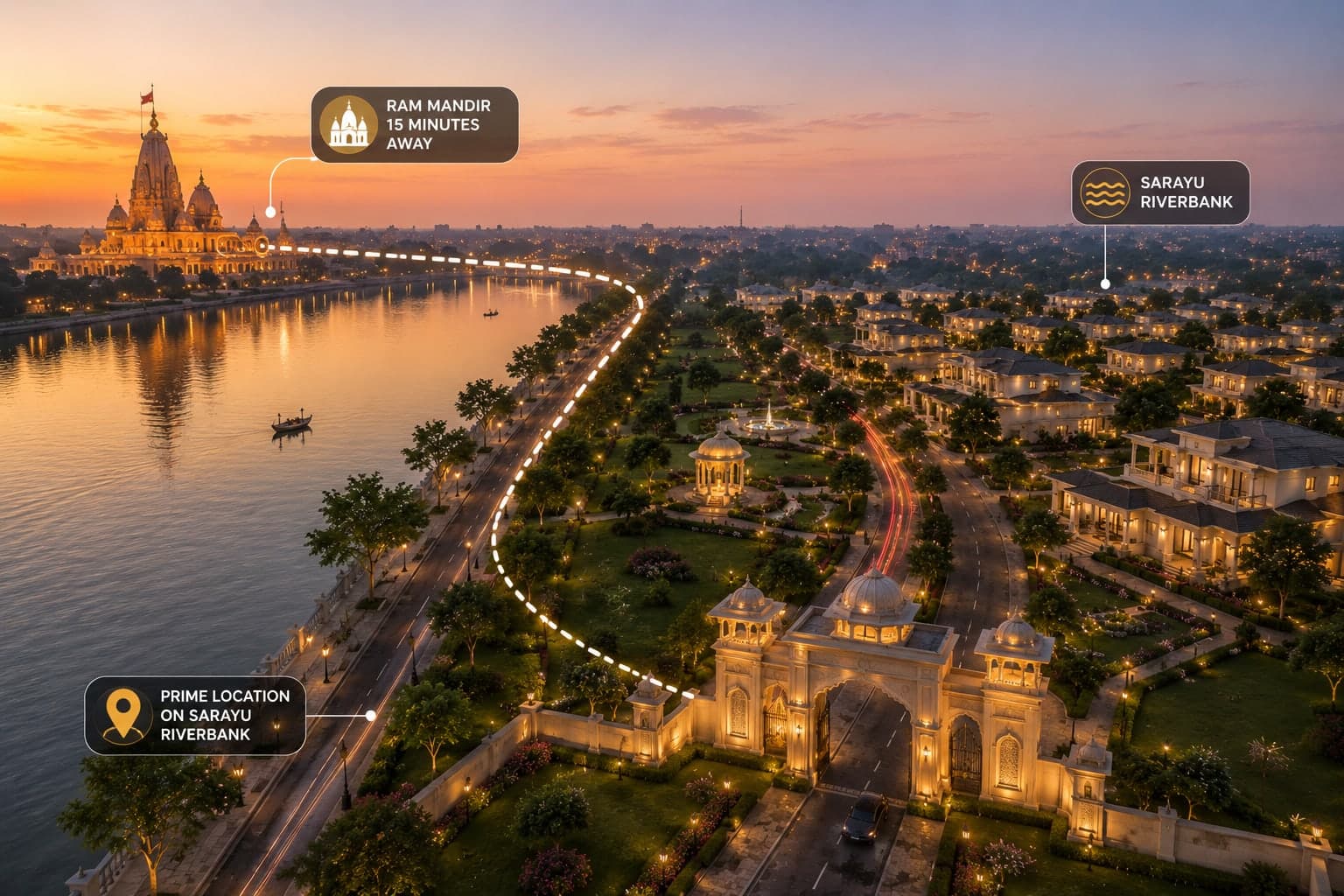
In plotted real estate, location is not a feature — it is the asset. Everything else is depreciating superstructure. That is why the address of The Sarayu Ayodhya by House of Abhinandan Lodha deserves closer scrutiny than any other single attribute of the project. Positioned near the sacred Sarayu River and roughly fifteen minutes from Shri Ram Mandir, the site sits at the intersection of spiritual significance and infrastructure-led growth.
The Connectivity Profile
| Landmark | Approximate Distance |
|---|---|
| Shri Ram Mandir | 15 minutes |
| Sarayu River and ghats | Nearby |
| Ayodhya Dham Railway Station | 20 minutes |
| Maharshi Valmiki International Airport | 30 minutes |
| NH-27 | Nearby |
| Retail and community spaces | Nearby |
Fifteen Minutes to Shri Ram Mandir
This is the number that defines the project, and it is worth understanding why it matters commercially rather than only emotionally.
The Ram Mandir has fundamentally restructured Ayodhya's economy. Visitor volumes have moved into a bracket that places Ayodhya among India's most-visited religious destinations, and that visitor flow drives hospitality demand, retail development, transport infrastructure and, ultimately, land values in a concentric pattern radiating outward from the temple.
Fifteen minutes is a genuinely useful distance. It is close enough that the temple is part of daily life for a resident and part of every visit for a second-home owner. It is far enough that the site is not inside the pilgrim congestion zone, where traffic, crowd density and commercial encroachment make residential living difficult. Prime residential land generally sits in exactly this band — proximate to the demand driver, insulated from its externalities.
The Sarayu Riverbank Position
The Sarayu is not incidental geography. It is central to the Ramayana, to Ayodhya's religious life and to the daily ritual rhythm of the city — bathing at the ghats, the evening aarti, festival immersions. Land near the river carries a significance no amount of built infrastructure can manufacture.
From a purely commercial standpoint, riverfront and river-proximate land is finite in a way that inland parcels are not. The river fixes one boundary permanently. As the city expands, land within the river corridor becomes progressively scarcer relative to demand, which is the structural condition under which land appreciates most reliably.
There is also a liveability dimension. River-adjacent locations enjoy better ambient conditions, stronger landscape potential and outlooks that inland layouts cannot replicate — which is why plots with the best orientation within the layout attract preferential pricing.
Airport Access: The NRI Variable
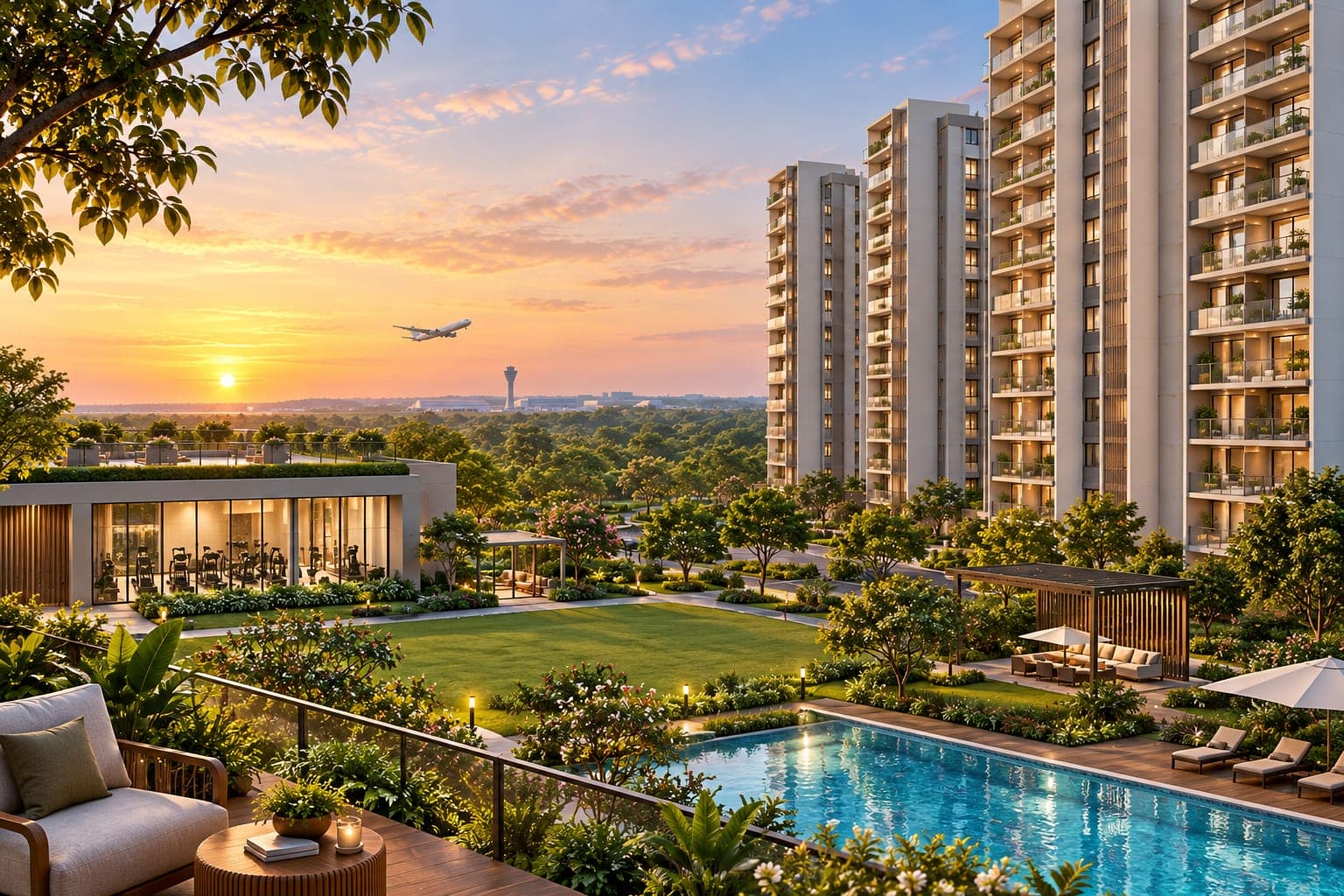
Maharshi Valmiki International Airport sits approximately thirty minutes away, and it is arguably the single most important piece of infrastructure for the buyer profile this project targets.
Before the airport, Ayodhya was a domestic pilgrimage destination reachable by road or rail from Lucknow. With international airport infrastructure, the city becomes accessible to the global Indian diaspora — buyers in the Gulf, the United Kingdom, North America and Southeast Asia for whom a direct or single-connection journey changes the practicality of owning a second home entirely.
A thirty-minute airport transfer is the difference between a property you visit annually and one you visit several times a year. That usage frequency is what makes a second home worth owning rather than a burden to maintain, and it is a major reason NRI interest in Ayodhya plots HOABL inventory has been strong.
Rail and Highway Connectivity
Ayodhya Dham Railway Station, approximately twenty minutes away, has been substantially upgraded to handle the city's transformed passenger volumes. For domestic buyers travelling from Delhi, Lucknow, Varanasi or further afield, rail remains the dominant mode, and a modern station within a twenty-minute drive is a meaningful convenience.
NH-27 provides the regional road spine. Highway proximity matters for three reasons: it determines how quickly the surrounding micro-market develops commercially, it governs construction logistics during the building phase, and it supports the drive-in tourism that forms a large share of Ayodhya's visitor traffic. Highway-adjacent catchments typically capture commercial spillover — hospitality, retail, food and beverage — earlier than interior locations, which supports land values in the surrounding area.
The Growth Corridor Logic
The reason the location argument holds is that Ayodhya's infrastructure build-out is still in progress rather than complete. The pattern is consistent across Indian growth corridors: infrastructure is announced, then constructed, then commissioned, and land values respond at each stage with the largest movements typically occurring between construction and commissioning.
Ayodhya currently has an international airport in operation, an upgraded railway station, highway improvements, sustained state government investment in urban development, and a visitor economy that has expanded dramatically. The residential supply response is still catching up, and organised, RERA-registered, amenity-backed inventory remains a small fraction of the total market.
That supply-demand asymmetry is the core of the investment case, and location is what determines which projects capture it.
What Location Means for Different Buyers
For the devotee-buyer: fifteen minutes to the temple and immediate access to the Sarayu ghats means the spiritual purpose of the purchase is genuinely served, not merely referenced in marketing.
For the second-home buyer: the airport and station access determine how often the home actually gets 54 used, and gated security plus hospitality-led maintenance handle the periods when it does not.
For the investor: proximity to the primary demand driver, river-corridor scarcity, highway access and an under-supplied organised segment together form a defensible appreciation thesis.
For the NRI: international air connectivity, RERA registration under UPRERAPRJ311468, and a professionally managed gated environment address the three concerns that historically deterred overseas buyers from tier-2 Indian real estate.
Location Due Diligence Checklist
- Visit the site and drive the routes to the temple, station and airport yourself, at a realistic time of day
- Confirm the approach road width and its current condition
- Check the status of any planned road widening or infrastructure work adjacent to the site
- Assess the surrounding land use and what is likely to be built on adjoining parcels
- Verify water table, drainage and flood history for river-proximate land
- Confirm the plot's orientation and its position within the layout
- Review the RERA-filed layout to confirm road and common-area allocations
Summary
The location combines the three things that reliably drive plotted land value: proximity to a powerful and permanent demand driver in Shri Ram Mandir, a scarcity boundary in the Sarayu River corridor, and multi-modal connectivity through NH-27, Ayodhya Dham Railway Station and Maharshi Valmiki International Airport. For a market at this stage of its infrastructure cycle, that is close to an ideal address.
For a detailed location map, site visit coordination and current plot availability, review the complete project profile for Sarayu Ayodhya or speak with the Perfect Neighbourhood advisory team on +91 93796 27377.
Frequently Asked Questions
How far is The Sarayu Ayodhya from Ram Mandir?
Approximately fifteen minutes. That distance is close enough for the temple to be part of daily life, and far enough to sit outside the pilgrim congestion zone where traffic and crowd density make residential living difficult.
How do I reach the project from the airport?
Maharshi Valmiki International Airport is approximately thirty minutes away. Ayodhya Dham Railway Station is roughly twenty minutes away, and NH-27 provides the regional road spine for drive-in access from Lucknow, Varanasi and beyond.
Is the location prone to flooding given the river proximity?
River-proximate land warrants specific due diligence. Buyers should verify the water table, the site's drainage design and the flood history of the immediate area, and should review the storm-water drainage provisions in the RERA-filed layout. This is a standard check rather than a specific concern, but it should not be skipped.
Will the surrounding area develop further?
Ayodhya's infrastructure build-out is still in progress rather than complete, with continued state investment in urban development, transport and tourism infrastructure. Buyers should assess adjoining land use and any planned road widening near the site during a physical visit.