There are cities built beside rivers, and there are cities that exist because of them. Ayodhya belongs firmly to the second category. The Sarayu is not scenery here — it is the reason the city stands where it does, the setting of its founding stories, and the stage on which its daily religious life still plays out. For buyers considering The Sarayu by House of Abhinandan Lodha, Ayodhya, understanding the river and its ghats is not cultural background reading. It is the substance of what the address actually offers.
Why the Sarayu Is Sacred
The Sarayu River Ayodhya connection runs through the Ramayana from beginning to end. Ayodhya is described as standing on the banks of the Sarayu, and the river frames the epic's most significant moments — the city Lord Rama ruled, the water his subjects drew from, and the place tradition holds he departed the mortal world. Few rivers in India carry a narrative association this direct and this specific.
The consequence is that the Sarayu is treated as a living presence rather than a geographic feature. Pilgrims bathe in it, pray to it and mark the religious calendar beside it. Land near the river is understood locally as land near something continuously sacred, not land with a pleasant view.
The Ghats: Ayodhya's Ritual Landscape
The ghats are the stepped stone embankments where the city meets the river, and they function as Ayodhya's true public square. The riverfront carries a series of them, each with its own character and its own following.
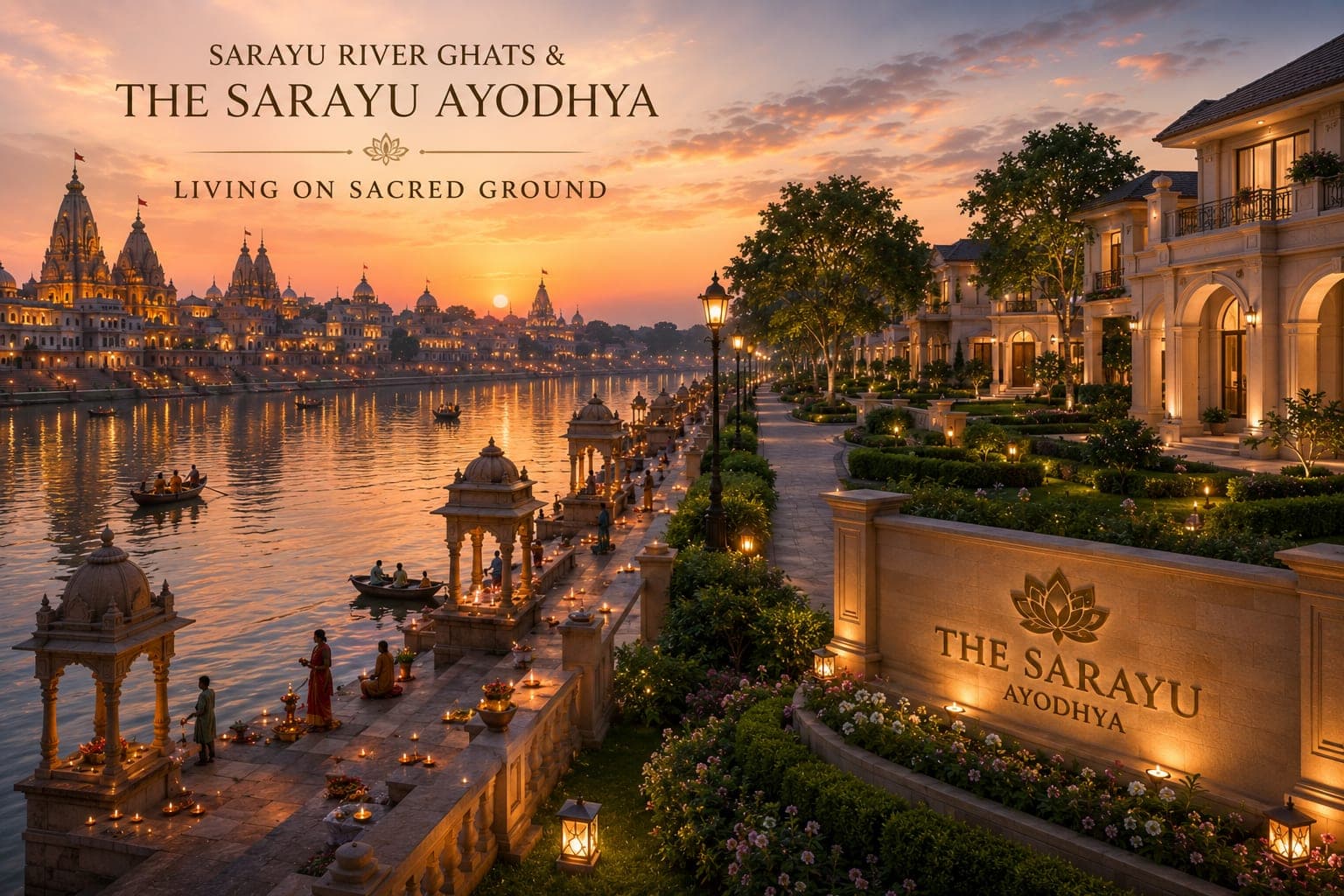
Ram ki Paidi is the most visually recognised stretch — a long, tiered sequence of steps and platforms that has become the visual shorthand for Ayodhya in photographs and broadcasts, particularly during festival illuminations. Naya Ghat sits at the heart of the pilgrim circuit and handles the heaviest daily footfall. Guptar Ghat, further along the river and quieter in temperament, is associated in tradition with Lord Rama's final departure and draws visitors seeking a more contemplative setting.
What unites them is rhythm. The ghats are busiest at dawn, when pilgrims descend for the ritual bath, and again at dusk, when the aarti begins. Between those hours the steps serve as ordinary public space.
Deepotsav and the Evening Aarti
Two recurring events define the ghats in the popular imagination.
The evening Sarayu aarti is the daily one. Lamps are raised, bells sound, and the ritual moves along the water's edge as light fades. It is a fixed point in Ayodhya's day, and residents who live nearby describe it less as an event to attend than as a sound and a light that mark the close of the afternoon.
Deepotsav is the annual one. Around Diwali, the ghats are lined with earthen lamps in enormous numbers, transforming the entire riverfront into a continuous band of light. It has become the single largest draw in Ayodhya's cultural calendar and the moment the city is most visible to the rest of the country and the world.
For a homeowner this matters concretely: the calendar has a genuine peak season, and a home near the riverfront is most valuable and most used precisely when accommodation anywhere in Ayodhya is hardest to find.
What "Living on Sacred Ground" Actually Means
The phrase can sound like marketing, so it is worth translating into daily terms.
It means the ritual calendar is not something you travel for but something you live inside. Ram Navami, Deepotsav, Kartik Purnima and the monthly observances are ambient rather than scheduled.
It means the river is available on ordinary days as well as significant ones — a walk to the water in the early morning, an evening at the ghats without a plan, the option of a bath at the ghat before a family occasion rather than only during a formal pilgrimage.
It means guests arrive for reasons beyond seeing you. A home here becomes the base from which family and friends undertake a journey they were always going to make, which is why second homes in Ayodhya get used far more than those in purely recreational destinations.
And it means a continuity that most property cannot offer. Coastal views change with development, hill stations get built out, city skylines are rewritten every twenty years. The Sarayu has been where it is, doing what it does, for as long as the story has been told.
The Project's Relationship to the River
The Sarayu by House of Abhinandan Lodha is a premium freehold plotted development in Ayodhya, Uttar Pradesh, designed as a gated community that pairs modern planning with the city's cultural setting. It offers freehold residential plots intended both for buyers who want to build a home and for investors positioning in Ayodhya's growth corridor.
Two plot sizes are indicated: 1,248 sq.ft. at Rs 1.89 Cr* and 1,507 sq.ft. at Rs 2.16 Cr*, with pricing starting from Rs 1.89 Cr* onwards. Connectivity is anchored by Shri Ram Janmabhoomi, Maharishi Valmiki International Airport, Ayodhya Junction Railway Station and the major road networks serving the city.
*Pricing and specifications are indicative and subject to change.
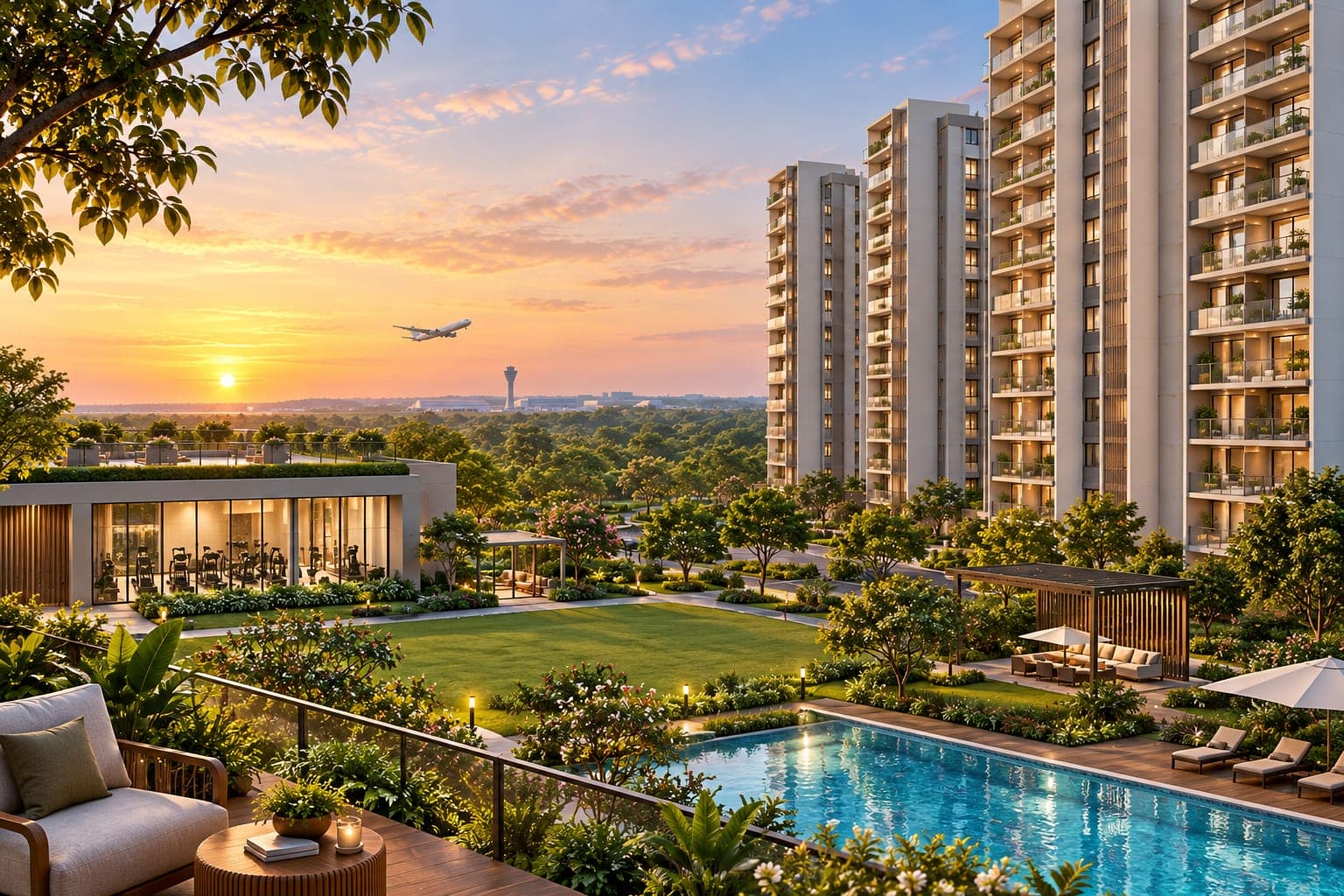
The amenity and infrastructure package is built around clubhouse facilities, landscaped gardens, open green spaces, wide internal roads, an entrance plaza, street lighting, utility infrastructure, gated access and security monitoring. In a plotted development, this is the layer that determines whether a home near the river is comfortable to live in rather than merely well located.
The Scarcity Argument
The commercial case for river-proximate land in Ayodhya is a supply argument rather than a sentiment one. The Sarayu fixes one edge of the city permanently. Land within its corridor cannot be extended, reclaimed indefinitely or replicated further out, because the thing that makes it valuable is the river itself.
Meanwhile demand has expanded in every direction at once — pilgrims, tourists, domestic high-net-worth buyers, and the global Indian diaspora now reachable through Maharishi Valmiki International Airport. Fixed supply meeting broadening demand is the cleanest structural setup for land appreciation that exists, and it is why freehold ownership in this catchment is treated as a long-horizon holding rather than a trade.
Practical Due Diligence Near a River
Sacred ground still requires ordinary checks. Verify the water table and seasonal variation, the layout's drainage and storm-water design, and local flood history; confirm foundation requirements with a structural engineer before finalising a design; and satisfy yourself on title, land-use conversion and encumbrance through an independent advocate. None of this is unusual — but skipping it is.
Who This Suits
This suits families with a devotional connection to Ayodhya who want a base rather than a hotel booking, NRIs seeking a meaningful Indian asset with freehold title and airport access, and long-horizon investors who recognise that a permanent demand driver beside a permanent river is a rare combination. It suits less well anyone seeking short-term liquidity or rental yield, since Ayodhya's secondary and rental markets are still maturing.
Frequently Asked Questions
What are the main ghats on the Sarayu in Ayodhya?
Ram ki Paidi is the most photographed stretch and the focus of festival illumination, Naya Ghat carries the heaviest daily pilgrim footfall, and Guptar Ghat is the quieter, more contemplative ghat associated in tradition with Lord Rama's final departure. Together they form the city's riverfront ritual landscape.
Why is land near the Sarayu River considered valuable?
Because supply is structurally fixed. The river bounds the city on one side and cannot be moved, so land within its corridor cannot be manufactured. Set against demand that has broadened from local buyers to national and international ones, that fixed supply is what underwrites long-term appreciation.
Is The Sarayu by HoABL a freehold property?
Yes. The project offers premium freehold residential plots within a gated community, which means outright ownership of the land rather than a leasehold interest, and full flexibility over when and what you build.
The Takeaway
Ayodhya's value does not rest on a single building or a single announcement. It rests on a river that has anchored the city's identity for as long as the story has been told, and on ghats where that identity is renewed every dawn and every dusk. A freehold plot within that setting is a claim on something that does not depreciate and cannot be replicated.
For current pricing, plot availability, the complete amenity list and legal verification support, review the full project profile for Sarayu plots Ayodhya and register your interest with the Perfect Neighbourhood advisory team.
Sarayu River Ayodhya, Ayodhya ghats, Ram ki Paidi, riverfront plots Ayodhya, The Sarayu Ayodhya