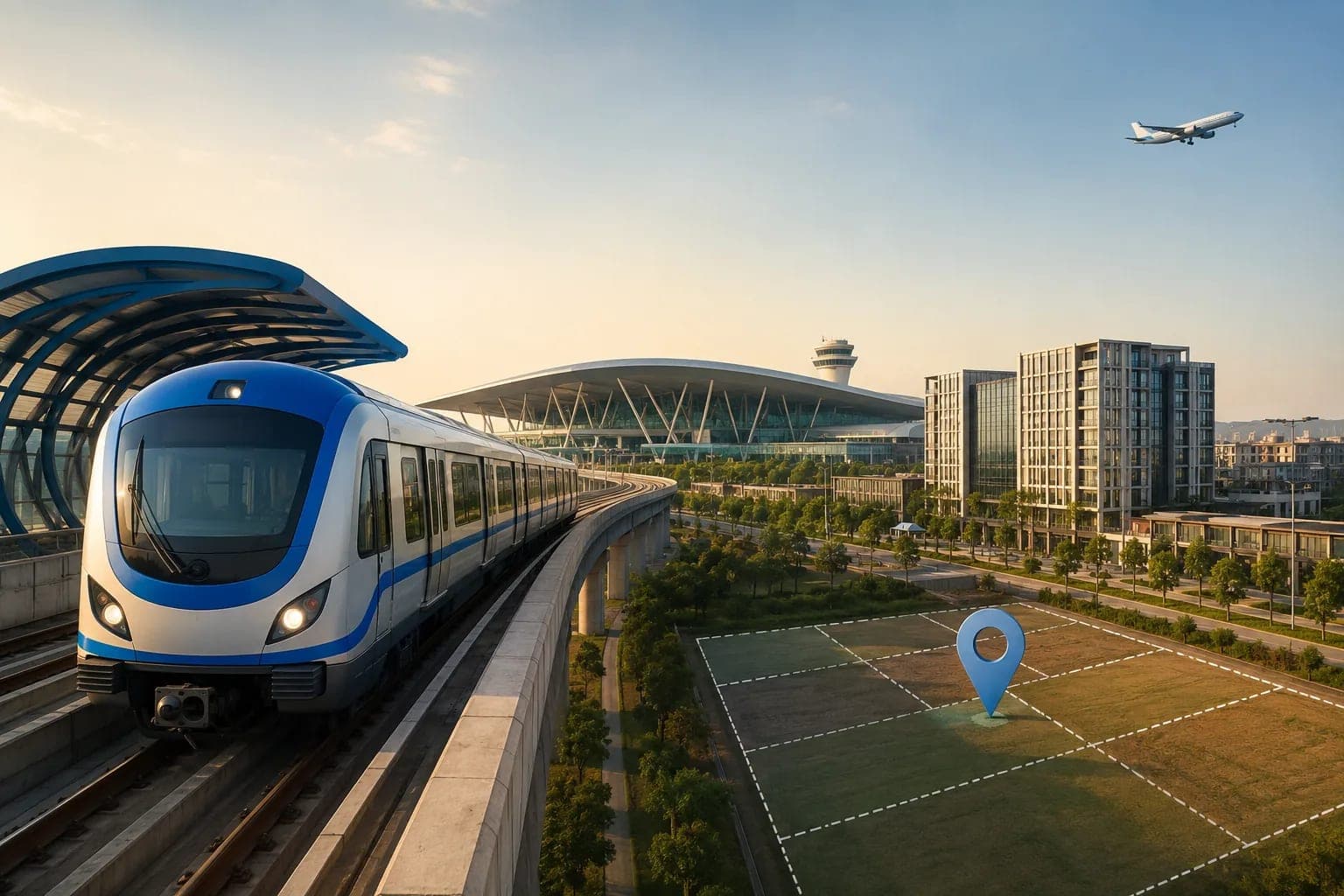
Infrastructure is what turns a promising location into an established one — and few pieces of infrastructure carry more weight for North Bangalore than the Namma Metro Blue Line. For buyers evaluating Bhartiya City KIADB in Devanahalli, understanding what this airport-corridor metro line means — and when it arrives — is central to judging the project's long-term value. This guide explains the Blue Line clearly, what it will do for the corridor, and how it fits the project's own timeline.
You can review the full project on the Bhartiya City KIADB project page at Perfect Neighbourhood. Here, the focus is the metro and its impact.
What Is the Namma Metro Blue Line?
The Blue Line is Bengaluru's airport metro corridor, connecting Central Silk Board in the south to Kempegowda International Airport in the north, running via the Outer Ring Road and Hebbal. Spanning roughly 58 kilometres with around 30 stations, it is one of the most strategically important corridors in the city's metro expansion.
Its significance is twofold. First, it links the airport directly to the metro network for the first time, replacing a road-only journey with a reliable rail option. Second, it threads through the Outer Ring Road — the city's densest technology-employment stretch — connecting hundreds of thousands of IT workers to a mass-transit spine. For a corridor like Devanahalli that sits at the airport end of this line, both effects matter.
The Blue Line Timeline: An Honest Picture
Because timing is what buyers most need to understand, it deserves a clear and honest account. The Blue Line is under construction and being delivered in phases.
| Section | Route | Target |
|---|---|---|
| Phase 2A | Central Silk Board – KR Puram (ORR stretch) | Late 2026 (subject to shift) |
| Phase 2B | KR Puram – Kempegowda International Airport | Around 2027 |
The airport stretch — the section most relevant to Devanahalli — is targeted for around 2027, delivered after the initial ORR section. As with all large infrastructure projects, these timelines can move, and it is prudent to treat them as targets rather than guarantees. But the direction of travel is clear: metro connectivity is coming to the airport corridor, and the construction is well advanced.
Why the Timing Aligns Well With Bhartiya City KIADB
Here is where the metro timeline becomes genuinely relevant to a buyer's decision. Bhartiya City KIADB is under construction, with possession expected around the end of 2028. The Blue Line's airport section is targeted for around 2027.
That alignment is favourable. It means the metro is expected to be operational, or close to it, around the time residents move in — so buyers are not waiting years beyond possession for the infrastructure to catch up. Rather than buying purely on a distant promise, they are entering a corridor where the key infrastructure milestone is broadly synchronised with their own occupancy horizon. For an under-construction purchase, that is close to ideal timing.
What Metro Connectivity Means for Residents
Once the airport section is operational, the practical benefits for Bhartiya City KIADB residents are substantial.
A Rail Link to the Airport Node
The line terminates at the airport — the gateway node roughly 15 minutes from the project. This gives residents access to the metro network at the northern end of the corridor, opening up rail travel toward the ORR tech belt and the wider city without depending solely on road travel.
Access to the ORR Employment Belt
The Blue Line runs directly through the Outer Ring Road IT corridor. For residents working in that belt — or for tenants who do — a rail connection offers an alternative to the congested road commute, widening the practical employment catchment of the project.
Reduced Road Dependence
A metro option means residents are less exposed to peak-hour road traffic for major journeys. For a growing, airport-adjacent corridor, that resilience is a meaningful quality-of-life upgrade.
Why Metro Lines Drive Property Value
Beyond daily convenience, metro connectivity has a well-documented effect on property values — and this is central to the investment case.
Across Bangalore, corridors served by operational metro lines have historically seen commute times fall and property values rise as the infrastructure matures. The mechanism is straightforward: a metro connection makes a location more accessible, more desirable and more liveable, which lifts demand from both buyers and tenants. Areas that were once considered peripheral are re-rated upward once they are firmly on the metro map.
For buyers entering Bhartiya City KIADB before the Blue Line's airport section is operational, this represents a classic positioning advantage — buying into a corridor ahead of a value catalyst rather than after it, when the benefit is already priced in.
An Honest Note on Expectations
Balance matters. Two caveats are worth stating plainly. First, infrastructure timelines can and do shift; the metro should be treated as a strong probability on a broadly aligned schedule, not an absolute certainty on a fixed date. Second, the metro is a corridor-level benefit — it complements, rather than replaces, the project's existing road connectivity via NH 44 and the Airport Expressway, which already deliver a short airport commute today.
In other words, the road connectivity gives the corridor its strength now; the metro is set to strengthen it further over the coming years. A buyer benefits from both the present reality and the future upgrade.
Who Should Weight the Metro Most Heavily
The Blue Line matters most to long-horizon investors and owner-occupiers who value the appreciation runway that comes with entering a corridor ahead of a major infrastructure milestone. It also matters to residents who anticipate commuting toward the ORR tech belt, for whom a rail alternative to road traffic is genuinely valuable. For buyers whose lives centre entirely on the immediate airport zone, the road connectivity already meets their needs, and the metro is a welcome addition rather than a decisive factor.
Final Word
The Namma Metro Blue Line is one of the most consequential infrastructure developments for North Bangalore's airport corridor, and its timeline aligns favourably with Bhartiya City KIADB's own possession horizon. For buyers, it strengthens both the everyday convenience of living in the corridor and the long-term investment case — offering the advantage of entering ahead of a proven value catalyst. Treated honestly, with realistic expectations about infrastructure timelines, the Blue Line is a genuine and compelling part of the reason this corridor continues to attract serious, forward-looking buyers.
To explore the project in full — with current pricing, floor plans and RERA-verification support — review the complete details on the Bhartiya City KIADB project page.
Labels: Bhartiya City KIADB Metro, Namma Metro Blue Line, Airport Metro Bangalore, Devanahalli Metro Connectivity, North Bangalore Real Estate