Godrej Whitefield Villas: Why Low-Density Projects Command a Premium
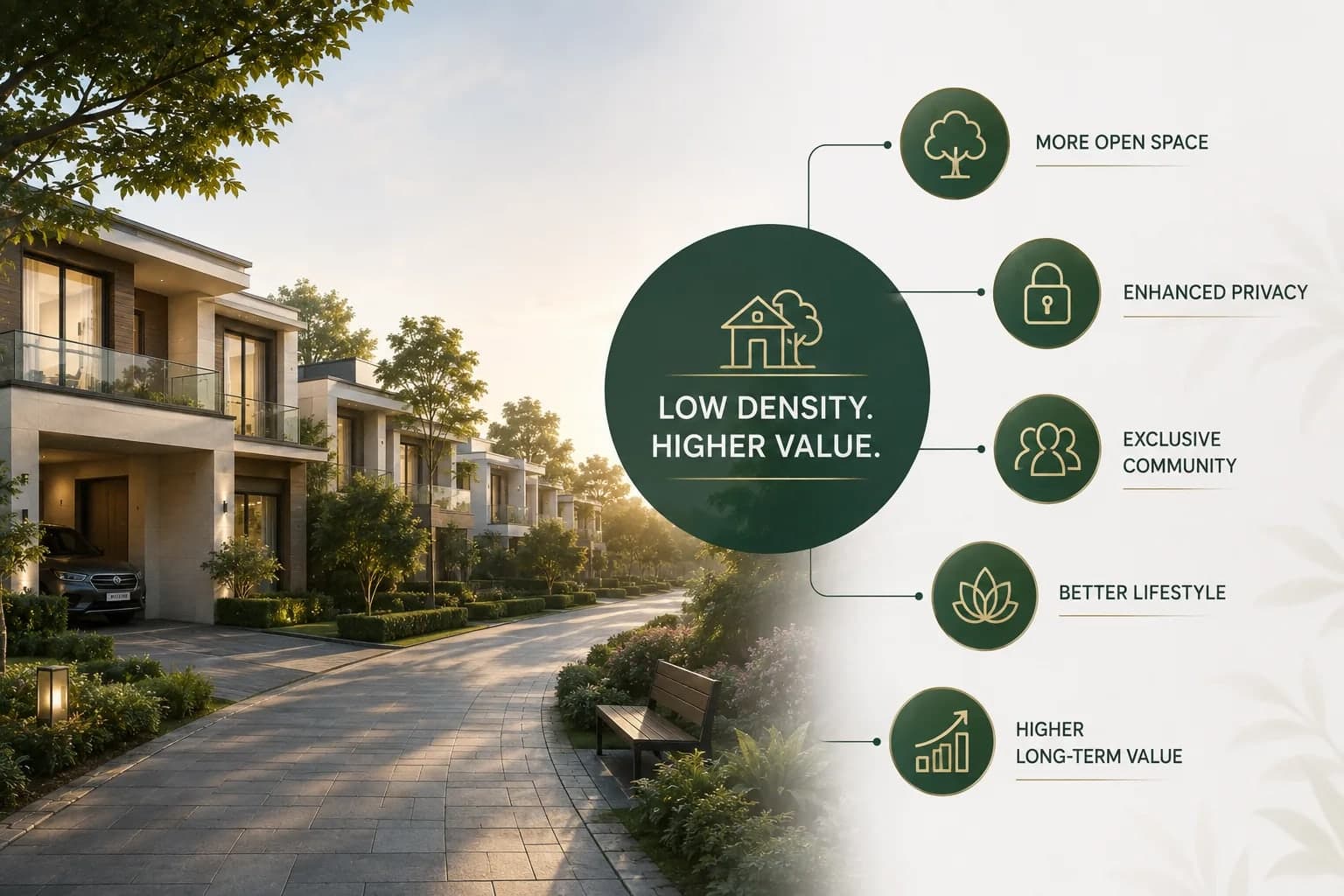
"Low density" appears on almost every premium project brochure in Bangalore, usually beside a photograph of a tree. It sounds pleasant and means very little as marketing language.
It does, however, describe something real — and the reason it carries a price premium is not aesthetic. It is arithmetic, and understanding it explains both why these projects cost more and why fewer of them get built each year.
If you are weighing this in East Bangalore, the Godrej Whitefield villas project page carries the current position.
What the number actually is here
The community spans approximately 20 acres with around 242 homes. That works out to roughly 12 homes per acre.
For comparison, a mid-rise apartment development on the same 20 acres might hold 1,500 to 2,000 units — somewhere between 75 and 100 homes per acre. A high-rise development can exceed that considerably.
So the density difference is not marginal. It is a factor of six to eight.
Each home sits on a 3,715 sq ft land parcel with a G+2 structure and private terrace, in configurations of 4 BHK at 3,715 sq ft, 4 BHK with staff room at 4,000 sq ft, and 5 BHK with staff room at 5,500 sq ft, from Rs 5.40 Cr onwards.
The economics that create the premium
Here is the mechanism, and it is worth following because it explains everything downstream.
A developer buys land at a given price. That land cost then divides across however many saleable units the plan yields.
Put 2,000 apartments on 20 acres and the land cost per home is small — a modest fraction of each unit's price. Put 242 villas on the same 20 acres and the land cost per home is roughly eight times higher.
That difference has to appear in the price. It is not a margin decision; it is a structural consequence of the plan.
Which leads to the point buyers should actually take from this: you are not paying a premium for fewer neighbours. You are paying for the land underneath your home. The low density is what the land share looks like from the outside.
Why the format is disappearing
The same arithmetic explains why these projects are becoming rarer, and this is the part that matters over a fifteen-year hold.
As land values in a corridor rise, the low-density plan stops working. A developer holding land at a low basis can afford 242 villas on 20 acres. The same developer holding the same land at triple the price cannot — the land cost per villa becomes indefensible, and the only rational response is to build vertically and spread that cost across far more units.
This is the transition every successful Bangalore corridor undergoes. Villas first, when land is affordable. Then row houses and villaments as land tightens. Then mid-rise. Then high-rise.
Each step is a one-way door. Land fragments through inheritance and small sales and never reconsolidates — there is no price at which you rebuild twenty contiguous acres from a hundred built-out plots.
Whitefield's core passed that threshold years ago, which is why villa stock there is largely older resale. The Soukya Road stretch is passing it now.
What the premium actually buys, day to day
Beyond the land economics, the density ratio changes daily life in ways that are easy to underestimate before you experience them.
Amenities become usable on impulse. Fewer than 250 households sharing a clubhouse, swimming pool, gymnasium, jogging track, yoga deck, sports courts, indoor games and children's play area means no booking system for the pool and no queue on the track at 7am. In a thousand-unit tower, the same amenity list is technically available and practically congested.
Internal traffic collapses. Twelve homes per acre generate a fraction of the vehicle movement, parking pressure and lift-lobby congestion that seventy-five per acre produce.
Soft landscape survives. A high proportion of the site stays permeable and planted rather than paved, which supports tree canopy, moderates local temperature and holds dust. In a city where pollution is largely traffic-generated and localised, that geometry has a genuine effect.
Recognition becomes possible. In a community of fewer than 250 households, residents know each other's faces and vehicles. That produces an informal security effect and, for families with children, friendships that persist because households do not churn the way apartment tenancies do.
The costs the premium also buys
Honest advisory means stating the other side, because the same arithmetic that creates the benefit creates the bill.
Maintenance charges are structurally higher per household. The cost of maintaining a clubhouse, pool, sewage treatment, power backup, landscaping and round-the-clock security across roughly 20 acres divides across fewer than 250 contributing households. A tower splits comparable costs four times further, on a fraction of the footprint. Both halves of the fraction work against the villa owner.
Rental yields are weaker. Purchase price scales faster than achievable rent, and the tenant pool at this level is high-value but genuinely shallow — senior technology leadership, expatriate management on corporate housing allowances, returning NRI families. Longer void periods are the norm.
Liquidity is thinner. Fewer households can write a five-crore cheque, and those who can are selective. Sales happen on the market's timeline rather than yours.
Infrastructure costs more to run. Longer pipe runs, longer cable runs, more internal road, more perimeter to secure. Horizontal development is simply more expensive per home to service than vertical.
Does the premium hold its value?
The honest answer is that scarcity establishes a floor rather than guaranteeing a return.
Land can be scarce and still stagnate if the surrounding economy weakens or employment migrates. The thesis here rests on the eastern IT cluster retaining its gravity — ITPL, the EPIP Zone and Prestige Tech Park anchoring demand, with schools, hospitals and retail already built out rather than promised. That looks robust, but it is an assumption rather than a certainty.
Scarcity also does not protect against overpaying. If current pricing already fully reflects future scarcity, the buyer captures nothing. Judgement on entry price still matters, particularly in a market where premium-segment inventory has been building.
And it only pays out over long holds. A buyer needing liquidity in three years will find scarcity and liquidity pull in opposite directions.
How to assess whether the premium is fair
Do not accept "low density" as a claim. Ask for the numbers.
Total acreage, total unit count, and the resulting homes per acre. The land parcel per home, stated with survey numbers in the schedule of property. The proportion of the site that remains open and planted. And the projected monthly maintenance charge, in writing, since that is where the density premium recurs every month for as long as you own the home.
Then compare against other villa projects on price per square foot of land parcel rather than blended per-square-foot rates, which conflate land and building.
The project's RERA status is currently listed as to be verified. Under Karnataka RERA, no booking amount should change hands until registration is complete and verified independently on the state portal.
The same assessment applies at the Godrej Row Houses Soukya Road project page.
Pre-launch pricing and specifications are subject to revision. Density comparisons are illustrative. RERA registration should be independently verified before any booking amount is paid.