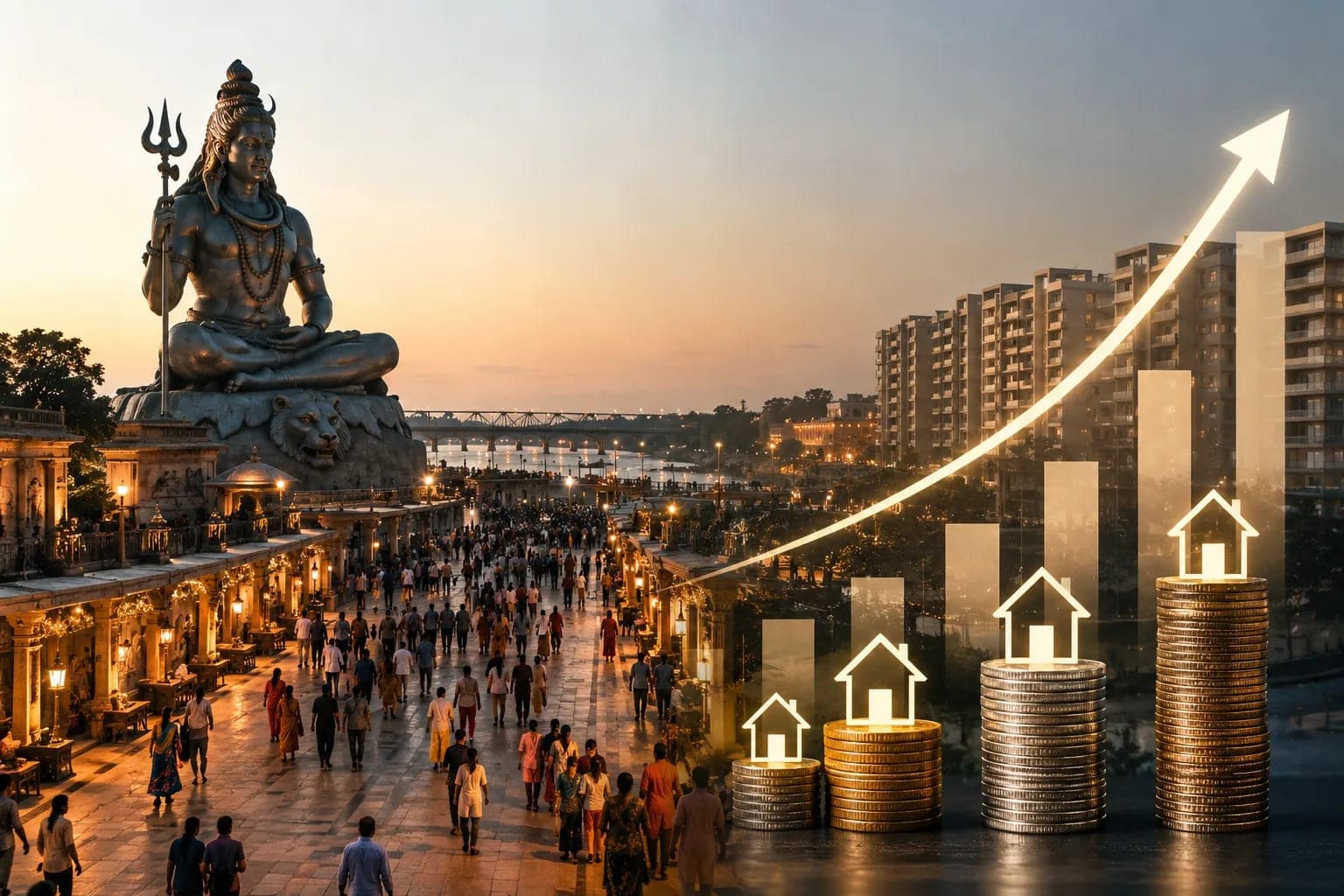
If you want to know what will happen to Ayodhya over the next ten years, look at Varanasi. The two cities are about 200 kilometres apart. Both are old holy cities. Both got a huge temple project. Varanasi just got its one first, which makes it a real-life test case — and the results are already visible. Here is what changed there, and what it means if you are considering The Sarayu by HoABL — RERA-registered villa plots from 1,248 sq.ft. or any other land in Ayodhya.
What the Kashi Vishwanath Corridor Actually Is
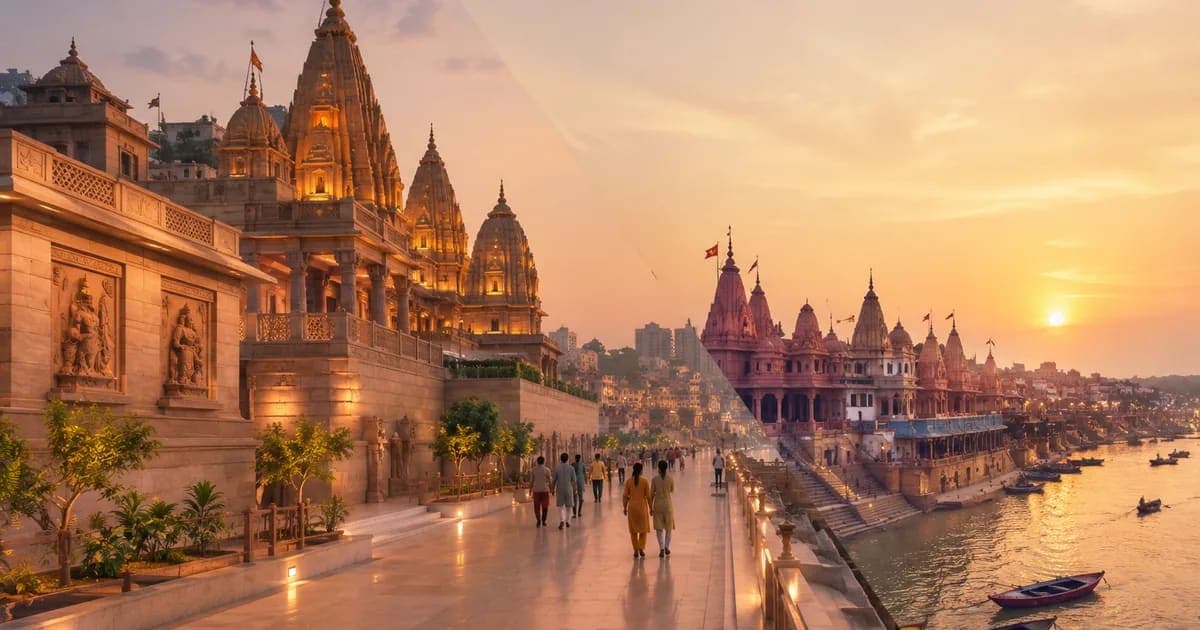
The Kashi Vishwanath temple in Varanasi is one of India's most important Shiva temples. But reaching it used to be hard. It sat hidden inside tiny, crowded lanes, and the temple area was only about 3,000 square feet — smaller than many houses.
The government decided to fix this. The foundation stone was laid in March 2019 and the first phase opened in December 2021, at a cost of around Rs 339 crore.
They built a wide walkway, about 20 to 25 feet across, joining Lalita Ghat on the River Ganga straight to the temple courtyard. So a pilgrim can now take a dip in the river and walk right to the temple. They also added 23 new buildings for visitors, and while digging, workers found and restored more than 40 old temples buried inside the crowded lanes.
The temple area went from about 3,000 square feet to about 5 lakh square feet. That is roughly 160 times bigger.
What Happened to Varanasi After the Kashi Vishwanath Corridor Opened
The change was fast and very large.
Between December 2021 and late 2025, more than 25 crore people visited the temple. Officials estimate this brought around Rs 1.25 lakh crore into the Uttar Pradesh economy — money that reached hotel owners, shopkeepers, boatmen, priests, taxi drivers, food stalls and guides.
Today Varanasi is among the most expensive property markets in Uttar Pradesh, with some parts passing Lucknow and Noida. The local development authority is now planning new housing schemes on the city's edges, because the middle has become too crowded and too costly.
Lesson 1 from the Kashi Vishwanath Corridor: Crowds Turn Into Cash
This is the simplest lesson. A famous temple alone does not raise land prices. Kashi Vishwanath was famous for centuries and property values barely moved.
What changed things was making the temple easy to reach. Good roads, a wide walkway, clean spaces, places to rest. Once visiting became comfortable, many more people came. More people meant more businesses. More businesses meant land became valuable.
Ayodhya is following the same steps, with a new international airport, an upgraded railway station and better highways. So the same chain reaction is likely.
Lesson 2 for Ayodhya Buyers: The City Average Price Is Not Your Price
This is the most useful lesson, and most buyers miss it.
People often ask how much Varanasi prices have gone up. That is the wrong question, because Varanasi is not one market. It is many small markets that behave very differently.
Recent 2026 figures show the city average near Rs 7,100 per square foot. But Mahmoorganj averages over Rs 10,000, while Sarnath is around Rs 5,100 and Babatpur near the airport around Rs 5,000 — double the gap inside one city. The wider district average has even shown a small fall while good areas kept climbing.
So the honest lesson is this: buying “in Ayodhya” is not a plan. Buying in the right pocket of Ayodhya is. Two plots in the same city can give completely different results.
Lesson 3 from Varanasi: Planned Land Beats Old-City Land
Here is something people did not expect. Varanasi's old centre grew so crowded and costly that the development authority had to plan new areas outside it.
Think about why. Old lanes are narrow and cannot be widened. Cars struggle to enter. Parking is scarce. Building rules near heritage areas are strict. And land papers on very old properties are often messy, with many family members owning small shares.
Planned layouts outside the old core do not have these problems. They have wide roads, proper drainage, water and power lines, and clean paperwork.
For Ayodhya buyers the choice is clear. Land right next to the temple sounds exciting, but it may be crowded, hard to build on and difficult to verify. A planned, gated, registered layout a short drive away is usually the safer asset.
Lesson 4 for Ayodhya Buyers: The First Jump Is the Biggest
Prices do not rise smoothly. They usually move in one big burst, then settle into slower growth.
In Varanasi the sharpest rise came around the announcement and opening of the corridor. After that, growth continued more gently, and not everywhere. Some areas kept rising. Some went flat.
Ayodhya has already had its first burst, so do not expect prices to double next year. A sensible plan is to hold for five to ten years while the city's hotels, roads and businesses keep growing.
Lesson 5: Fast-Rising Prices Attract Bad Sellers
When land prices jump, dishonest sellers appear. This happened in Varanasi and it is happening in Ayodhya.
The usual tricks are the same everywhere. Farm land sold as house land without the legal conversion order. One plot sold to two buyers. Papers shown only as photocopies. Buyers rushed into paying before a lawyer can check anything.
The protection is boring but it works. Buy land registered with RERA. Have a lawyer check the ownership history, the land-use conversion order and any loan on the land. Never pay a large sum before those checks.
How The Sarayu Ayodhya Fits These Lessons
| Project | The Sarayu Ayodhya by House of Abhinandan Lodha |
|---|---|
| Location | Near Sarayu River, Ayodhya, Uttar Pradesh |
| Villa Plot | 1,248–1,250 sq.ft. — Rs 1.89 Cr to Rs 1.90 Cr* |
| Royal Plot | 1,500 sq.ft. — Price on Request |
| Premium Villa Plot | 1,507 sq.ft. — Price on Request |
| RERA | UPRERAPRJ311468 (Phase 1) |
| Status | Under Construction | Possession TBA |
| Distance to Shri Ram Mandir | About 15 minutes |
| Advisory | Perfect Neighbourhood | +91 93796 27377 |
*Prices are indicative and may change.
Measured against these lessons it scores well: a planned gated layout rather than old-city land, registered with RERA, and close to the temple without sitting inside the crowded zone. The fair warning is the same one Varanasi teaches — it is priced at a premium, possession is not yet announced, and it needs a patient owner.
What Ayodhya Buyers Should Do Next
- Choose the pocket carefully, not just the city
- Prefer planned, gated, RERA-registered layouts over loose old-city plots
- Plan to hold for five to ten years, not one or two
- Get a lawyer to check title, land-use conversion and loans before paying
- Visit the site yourself and drive the route to the temple
- Ask for the full cost sheet, not just the headline price
Frequently Asked Questions
When did the Kashi Vishwanath Corridor open?
The foundation stone was laid in March 2019 and the first phase opened in December 2021, built at a cost of around Rs 339 crore.
Did the Kashi Vishwanath Corridor raise Varanasi property prices?
Yes, but unevenly. Varanasi is now among the costliest property markets in Uttar Pradesh, with some areas passing Lucknow and Noida. However, prices vary sharply between localities, and the wider district average has recently been flat to slightly negative.
Will Ayodhya follow the same path?
The early signs are similar — a major temple, a new airport, an upgraded station and better roads. No outcome is guaranteed, but the pattern of visitors leading to businesses leading to land demand is the same one Varanasi followed.
The Takeaway
Varanasi shows that a temple project can truly change a city's economy. It also shows the money does not reach every street equally, that planned land held up better than crowded old land, and that the biggest jump comes early. Buyers who remember all three will decide better than those who remember only the first.
For current pricing, plot availability, RERA verification help and a legal checklist, see the full project profile for Sarayu plots Ayodhya or speak with the Perfect Neighbourhood advisory team on +91 93796 27377.