Mahakal Lok, Ujjain: The Corridor That Quadrupled Footfall in Twelve Months
If you want to understand how a temple can change a whole city's economy, Ujjain is the cleanest example in India. Not because it is the biggest, but because it happened fastest and was measured most carefully. One corridor opened in October 2022, and within twelve months almost every number in the city had moved. This article walks through what happened, what it cost, and the property lesson buried inside it — a lesson that matters directly to anyone looking at temple-town land today, including buyers considering The Sarayu Ayodhya villa plots.
What Mahakal Lok in Ujjain Actually Is
Ujjain is home to the Mahakaleshwar temple, one of the twelve Jyotirlinga shrines. For centuries the temple sat squeezed inside narrow, crowded lanes. Getting in meant standing in a long, uncomfortable queue with nowhere to move.
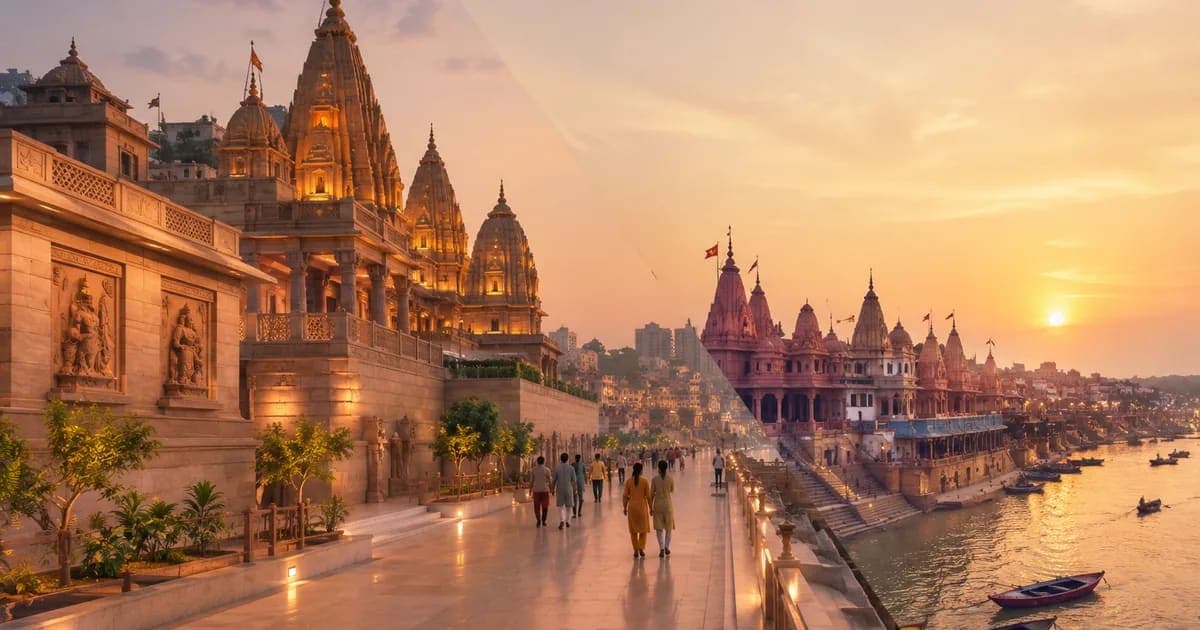
Mahakal Lok is a corridor — roughly 900 metres of walkway leading to the temple, lined with sculptures, gardens, ponds and lighting. Prime Minister Narendra Modi inaugurated the first phase on 11 October 2022. The full Mahakaleshwar temple corridor development project was reported at ₹856 crore, with the temple complex planned to expand from about 2.87 hectares to roughly 47 hectares.
Think of it like this: the temple did not change. The space around it did. And that turned out to be enough to change everything else.
Ujjain Before Mahakal Lok
Before the corridor opened, about 1.5 crore people visited the Mahakaleshwar temple in a year, according to the CEO of Ujjain Smart City speaking to PTI in October 2022. At the time, officials expected that number might double to around three crore once Mahakal Lok opened.
The temple's own administrator later told reporters that before the corridor, roughly 12,000 to 15,000 devotees came on a weekend.
Ujjain itself is a small city of around six lakh people. Hold that in your mind, because it explains why what came next hit so hard.
The Twelve Months That Changed Ujjain
Within a year, the Mahakaleshwar Temple Management Committee reported that footfall had quadrupled.
Weekend crowds went from that 12,000–15,000 range to somewhere between 1.5 lakh and 2.5 lakh, per the temple administrator. Speaking in 2025, Madhya Pradesh Chief Minister Mohan Yadav described annual footfall in Ujjain rising from about one crore to roughly five crore visitors.
Here is the detail that makes the scale easy to picture. Before the corridor, the temple sold about 25 to 30 quintals of laddoos a day. Afterwards, 60 to 70 quintals — every single day. When a city has to make more than twice as many sweets daily, everything else in that city is under the same pressure.
The Money Story: What Mahakal Lok Did to Ujjain's Economy
Temple donations tell the story most plainly. The Mahakaleshwar temple received ₹22.13 crore in donations in 2021. In 2022, that figure was ₹46.51 crore — more than doubled in a single year.
The Chief Minister's 2025 account added more. Hotel occupancy in Ujjain rose by 70 to 80 per cent, room tariffs by 30 to 50 per cent, and restaurants, food stalls and prasad shops reported business growth in the region of 300 per cent. Temple revenues, he said, had tripled, allowing reinvestment back into infrastructure.
Retail, transport and real estate all moved with it. That is what a temple economy actually looks like from the inside — not one big number, but every small business in the city getting busier at once.
The Hospitality Squeeze in Ujjain
A city built for 1.5 crore visitors a year could not house five crore. There were simply not enough rooms.
State tourism hotels ran at very high occupancy on most days. Ordinary residents started converting spare rooms and whole houses into homestays, because there was nowhere left to put people. New hotel projects followed.
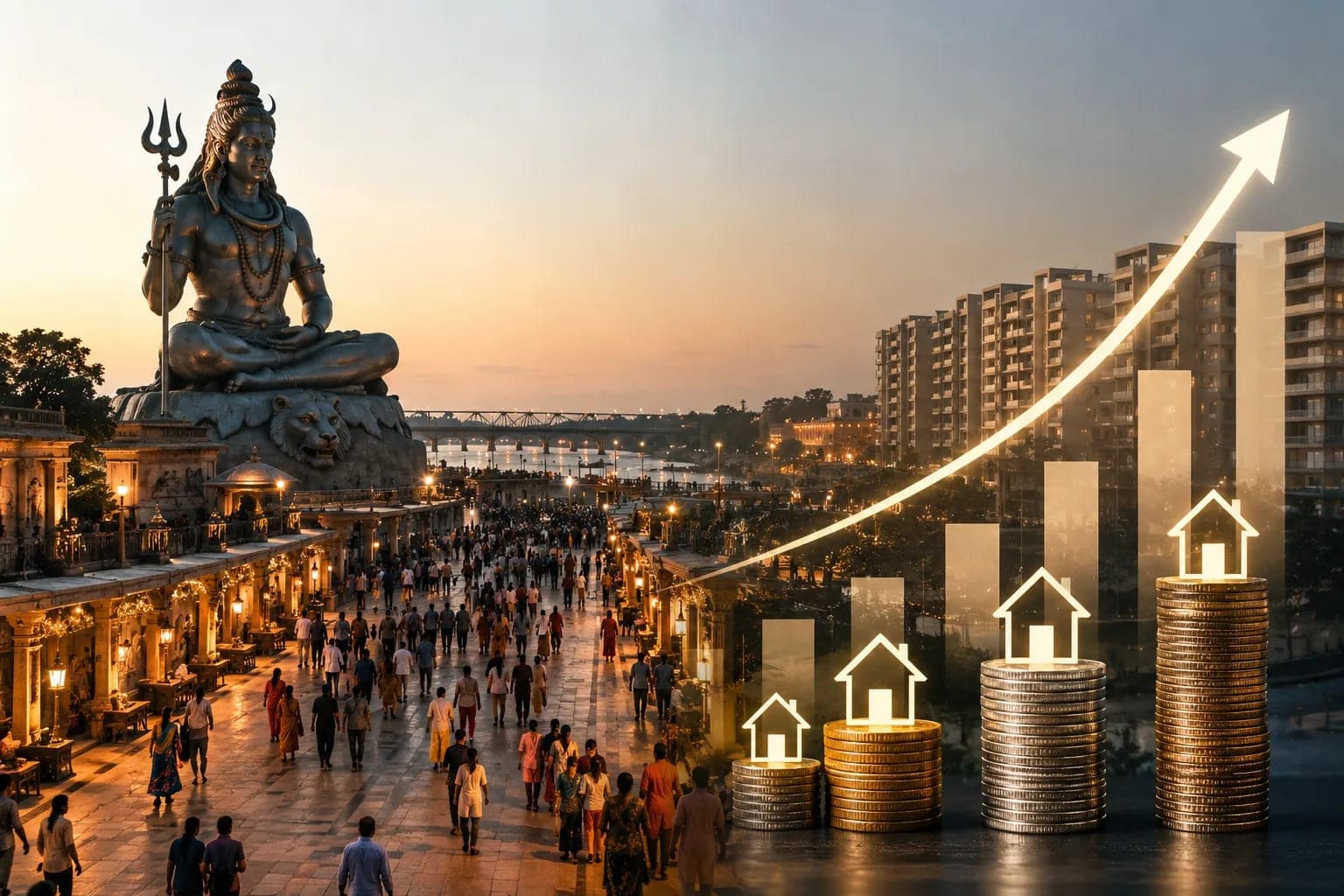
And every one of those rooms — every hotel, every homestay, every new guest house — sits on a piece of land that somebody owned, bought or built on. That is the quiet link between footfall and property. Crowds do not directly raise land prices. Crowds create businesses, and businesses need land.
The Property Lesson Inside Mahakal Lok That Nobody Sells You
This is the most valuable part of the Ujjain story, and it is the opposite of what most brokers will tell you.
Land immediately next to the temple was not the best buy.
Temple-zone land in Ujjain turned out to be the most regulated, the most congested and the most legally sensitive land in the city. Corridor expansion itself required acquiring and clearing land around the temple. Access gets restricted during festivals. Building rules are tighter. Prices ran up on sentiment before the fundamentals justified them.
The steadier gains came from approach roads and planned expansion corridors — areas like the Indore Road and Dewas Road stretches — where land was properly approved, road widths were adequate, and titles were cleaner. Well-connected land in a growth corridor generally outperformed emotionally-priced land at zero distance from the shrine.
The rule that comes out of Ujjain is worth writing down: footfall creates demand, but legal title creates security. Confusing the two is how buyers lose money in fast temple markets.
Simhastha 2028: Ujjain's Second Catalyst
Temple economies rarely get only one trigger. Ujjain's next one is already funded and dated.
Simhastha, the Kumbh Mela held in Ujjain once every twelve years, is scheduled for 2028. Madhya Pradesh government assessments reported by PTI put expected participation at around 12 crore people, with later official statements citing higher ranges. Preparation works reported across state media run to around ₹20,000 crore, covering Shipra river cleaning, bridges, roads, water systems and heritage restoration.
The Chief Minister has directed that Simhastha-related work be completed by June 2027, with seven major routes into Ujjain widened to four lanes and one to six lanes.
For anyone studying the pattern, this is the important structural point: infrastructure spending in temple cities tends to arrive in waves, not once.
What Ujjain Teaches Ayodhya and The Sarayu Ayodhya Buyers
Ayodhya is running the same sequence on a larger budget. Uttar Pradesh Tourism figures show Ayodhya's annual visitors rising from 2.84 lakh in 2017 to 29.95 crore in 2025, with roughly ₹85,000 crore sanctioned under Ayodhya Master Plan 2031.
Ujjain's lesson applies directly. The sensible question in Ayodhya is not "how close to the Ram Mandir can I get?" but "is this land approved, titled, connected and buildable?"
The Sarayu Ayodhya by House of Abhinandan Lodha sits roughly 15 minutes from the Shri Ram Mandir rather than beside it, as a freehold plotted development registered under UP RERA UPRERAPRJ311468 for Phase 1. Villa Plots of 1,248 to 1,250 sq ft start from ₹1.89 Cr, and the project is under construction with possession yet to be announced. Whether that suits you is your call — but the distance band and the paperwork are exactly the two variables Ujjain suggests you should be checking.
What Mahakal Lok Does Not Prove
Ujjain shows what happened in Ujjain. It does not promise the same outcome anywhere else, and it certainly does not promise a number.
It also does not mean every plot in a temple town appreciates. Plenty of buyers in Ujjain paid sentiment prices for land they could not build on. And nothing about buying property near a shrine carries religious merit — it is a property transaction, and anyone framing it otherwise is selling you something.
Common Questions About Mahakal Lok and Ujjain
When did Mahakal Lok open?
The first phase was inaugurated on 11 October 2022 as part of the ₹856 crore Mahakaleshwar temple corridor development project.
How much did footfall in Ujjain actually rise?
The temple management committee reported footfall quadrupling within roughly a year, with annual visitors described by the Chief Minister in 2025 as rising from about one crore to around five crore.
Is land near the Mahakal temple a good investment?
Ujjain's own experience suggests temple-adjacent land is often the most regulated and legally sensitive. Approved, well-connected land in planned corridors generally proved a steadier proposition. Verify title and land use before anything else.
The Honest Summary on Mahakal Lok and Ujjain
Ujjain is the fastest, clearest before-and-after in India's temple economy story: one corridor, twelve months, footfall up four times, donations doubled, hotels full, and a small city rebuilding itself around a crowd it never planned for. But the useful takeaway is not the excitement — it is the discipline. The buyers who did best were not the ones who bought closest to the temple. They were the ones who bought land that was approved, connected and cleanly titled. Ayodhya is now running the same sequence with far larger sanctioned spending, and the same discipline applies. If you want to see what approved, RERA-registered supply looks like in that market, review The Sarayu Ayodhya by House of Abhinandan Lodha and check every document yourself before you commit.
Mahakal Lok, Ujjain, Temple Economy, Real Estate Investment, The Sarayu Ayodhya