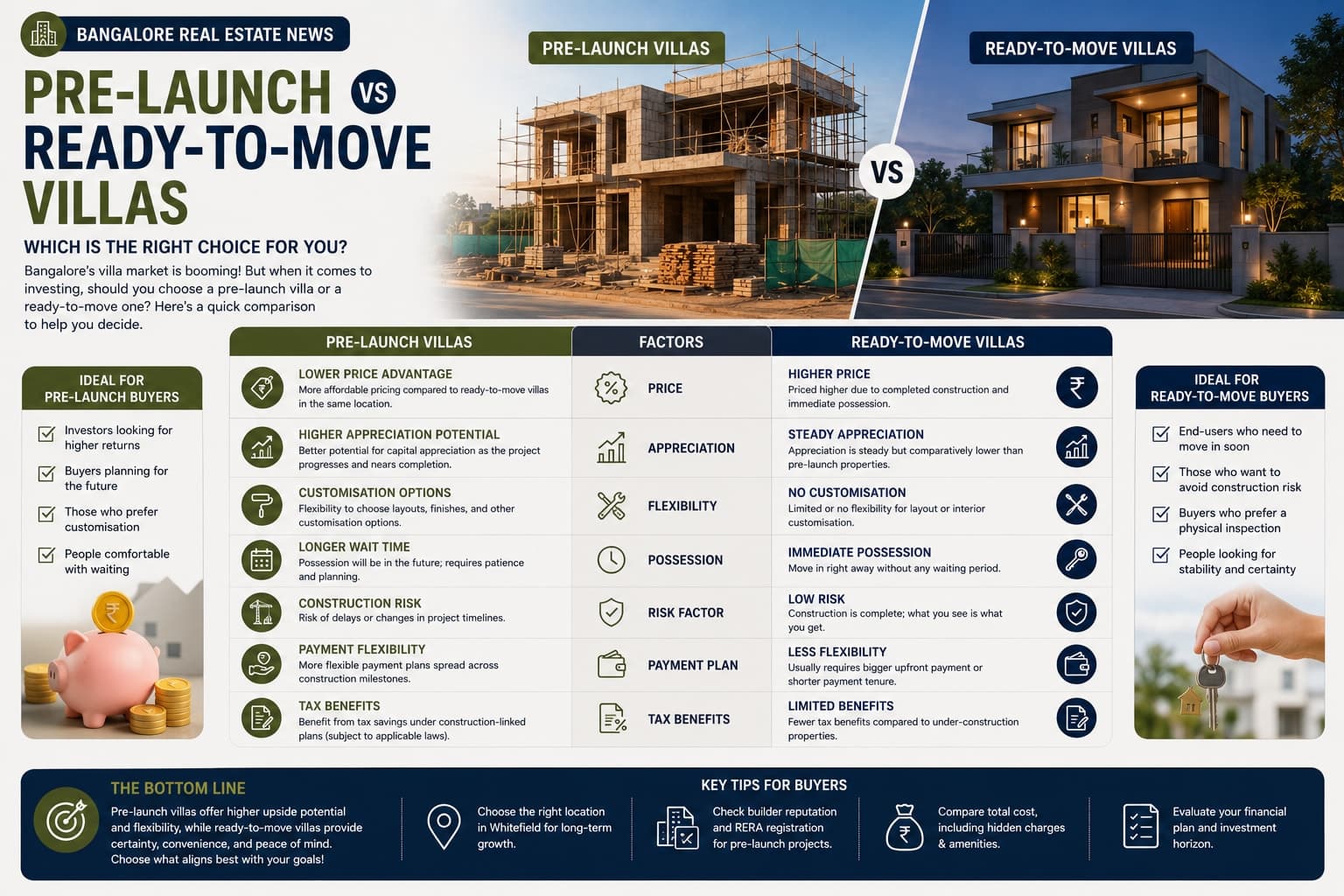
Whitefield's IT Corridor: Bangalore Real Estate News Buyers Should Track
Property headlines arrive constantly, and most of them do not matter. Here are the signals from Whitefield's IT corridor that genuinely affect homebuyers, how to read them, and what to ignore.
Anyone considering a home in East Bengaluru quickly finds themselves reading property news, and quickly discovers how little of it is useful. Announcements arrive daily, few carry real information, and the noisiest stories are often the least reliable. Yet certain developments genuinely shape what a buyer should do and when. This guide sets out the signals worth tracking around the Whitefield corridor, how to interpret each, and how to build a habit of monitoring that improves your decisions rather than your anxiety. Buyers evaluating specific communities, such as the Godrej Villa Whitefield premium 4 & 5 BHK homes, will find the exercise particularly worthwhile.
Why Tracking Beats Reacting
The purpose of following the market is not to time it perfectly, which nobody manages reliably. It is to be prepared — to recognise when a project you like is approaching launch, to understand whether prices you are quoted are reasonable, and to have your finances arranged when a genuine opportunity appears. Buyers who track patiently make calm decisions; those who react to headlines tend to rush or freeze at exactly the wrong moments. Consistency over months is far more valuable than intensity for a week.
Signal One: Office Leasing and Occupier Activity
Commercial activity is the most reliable leading indicator for a residential corridor. When companies lease additional space or announce expansion in the eastern business parks, they are adding employees who will need homes nearby. Conversely, sustained contraction signals softer housing demand ahead. This is why commercial property news deserves attention even from residential buyers. Look for patterns over quarters rather than individual announcements, since one large transaction tells you less than a consistent direction.
Signal Two: Infrastructure Milestones
Infrastructure news matters enormously but must be read carefully. There is a substantial difference between a project being proposed, sanctioned, funded, commenced and completed — and headlines frequently blur these stages. A metro line that has opened changes lives; one that has been announced changes very little for years. Track the stage a project has actually reached, verify with official sources rather than news summaries, and never pay a premium today for infrastructure that exists only on paper.
Signal Three: The Supply Pipeline
Knowing what is coming to market helps you judge both choice and pricing. A corridor absorbing several new launches simultaneously offers buyers more negotiating room than one where a single project holds all the attention. Watch for announcements of new projects, particularly in the format you want, and note how quickly earlier launches sold. For villa buyers specifically, the pipeline is thinner and moves slower, which makes each new low-density launch more consequential than an apartment project would be.
Signal Four: RERA Registrations
Regulatory filings are among the most underrated sources of information available to buyers, and they are public. When a project appears on the state authority's portal, you can review its declared details, approvals, land particulars and timelines directly rather than relying on marketing. Tracking new registrations also tells you which developers are actively bringing projects forward. For pre-launch projects, monitoring whether and when registration appears is one of the clearest indicators of how seriously a project is progressing.
Signal Five: Land Transactions by Developers
Land purchases signal intent years in advance. When established developers acquire sizeable parcels in a corridor, they are expressing a considered view about future demand there, backed by their own capital and research. For buyers, these transactions indicate where supply will eventually emerge and which pockets professional investors consider promising. Large land deals near a corridor's periphery often foreshadow the next wave of low-density development, which is particularly relevant to villa buyers.
Signal Six: Rental Movement
Rental data is a useful reality check on sale prices. Rents respond more quickly to actual demand than sale values do, because leases turn over frequently. If rents in a corridor are firm and rising steadily, underlying demand is genuine. If sale prices climb while rents stagnate, the gap deserves scrutiny. Buyers can gauge this informally by tracking listings over a few months, and the exercise sharpens your sense of what a location is really worth.
Signal Seven: Interest Rates and Financing
Few factors affect affordability as directly as borrowing costs. Changes in policy rates flow through to home loan rates and therefore to your monthly commitment and the size of loan you can service. Rate movements also influence overall market activity, since affordability shifts for every buyer simultaneously. If you intend to borrow, track rate announcements and speak to lenders periodically about what you would actually be offered, which often differs from headline rates.
Signal Eight: Policy and Statutory Changes
Regulatory developments can affect transaction costs meaningfully. Revisions to government guidance values influence stamp duty and registration charges, and changes to tax treatment or RERA rules alter the buying process. These stories are unglamorous and easily missed, yet they can affect your total outlay more than a modest movement in property prices. Follow them through official notifications where possible, and confirm implications with a qualified professional rather than assuming a news summary is complete.
What Is Mostly Noise
Equally important is knowing what to ignore. Predictions that prices will double within a fixed period deserve no weight, since nobody can know this. Stories citing unnamed sources about unconfirmed launches are unreliable. Marketing material presented as news, promotional surveys and headlines built around a single anecdotal transaction rarely tell you anything actionable. So does any content implying urgency without substance. A useful filter: ask whether the story reports something that has actually happened and can be verified, or merely something someone hopes will happen.
The Signal Data Cannot Give You
One source outranks every published indicator: people in the area. Residents will tell you how the commute behaves, whether a builder responded to complaints, how maintenance is handled and what the area is like on a wet morning. Advisors working the micro-market see transactions that never appear in a report. A few honest conversations reveal more than months of reading.
Building a Practical Tracking Habit
None of this requires much time if approached sensibly. Set aside a short period weekly rather than checking constantly. Follow official sources — the regulator's portal, transport authority updates, government notifications — alongside credible market reporting. Keep a simple record of projects you are watching, with pricing quoted and dates, so you can see how things move over time. Visit shortlisted locations periodically to observe construction and infrastructure progress yourself. Over several months this produces genuine local knowledge that no single article can provide.
Applying It to a Specific Decision
Tracking becomes valuable when it informs an actual choice. If you are considering a villa community — for instance one planned across roughly 20 acres with around 242 homes in 4 and 5 BHK configurations, priced from around ₹5.40 crore and currently at pre-launch with RERA registration awaited — the signals tell you what to watch: whether registration appears, whether pricing firms up as expected, how comparable projects nearby are priced, and whether corridor infrastructure progresses as described. Those specifics matter far more than general market sentiment.
The Bottom Line
Whitefield's IT corridor generates a steady flow of property news, but only some of it should influence your decisions. Office leasing, infrastructure milestones that have genuinely progressed, the supply pipeline, RERA registrations, developer land purchases, rental movement, interest rates and policy changes are the signals worth following. Predictions, unnamed sources and manufactured urgency are not. Track consistently, verify independently, and let the information make you prepared rather than reactive. To follow one specific community closely, explore the Godrej Villa Whitefield listing and request confirmed updates.
Disclaimer: This article is general information and market commentary based on publicly available sources. It is not financial, investment, tax or legal advice, nor an offer of sale, and it does not present verified statistics or guarantee any trend, price or return. Market conditions, infrastructure timelines and statutory rules can change and should be verified with the relevant authorities and a qualified professional. The project referenced is in its pre-launch stage with RERA registration awaited; configurations, areas and pricing are indicative and subject to change. Verify all details independently with the developer or an authorised channel partner before making any decision.