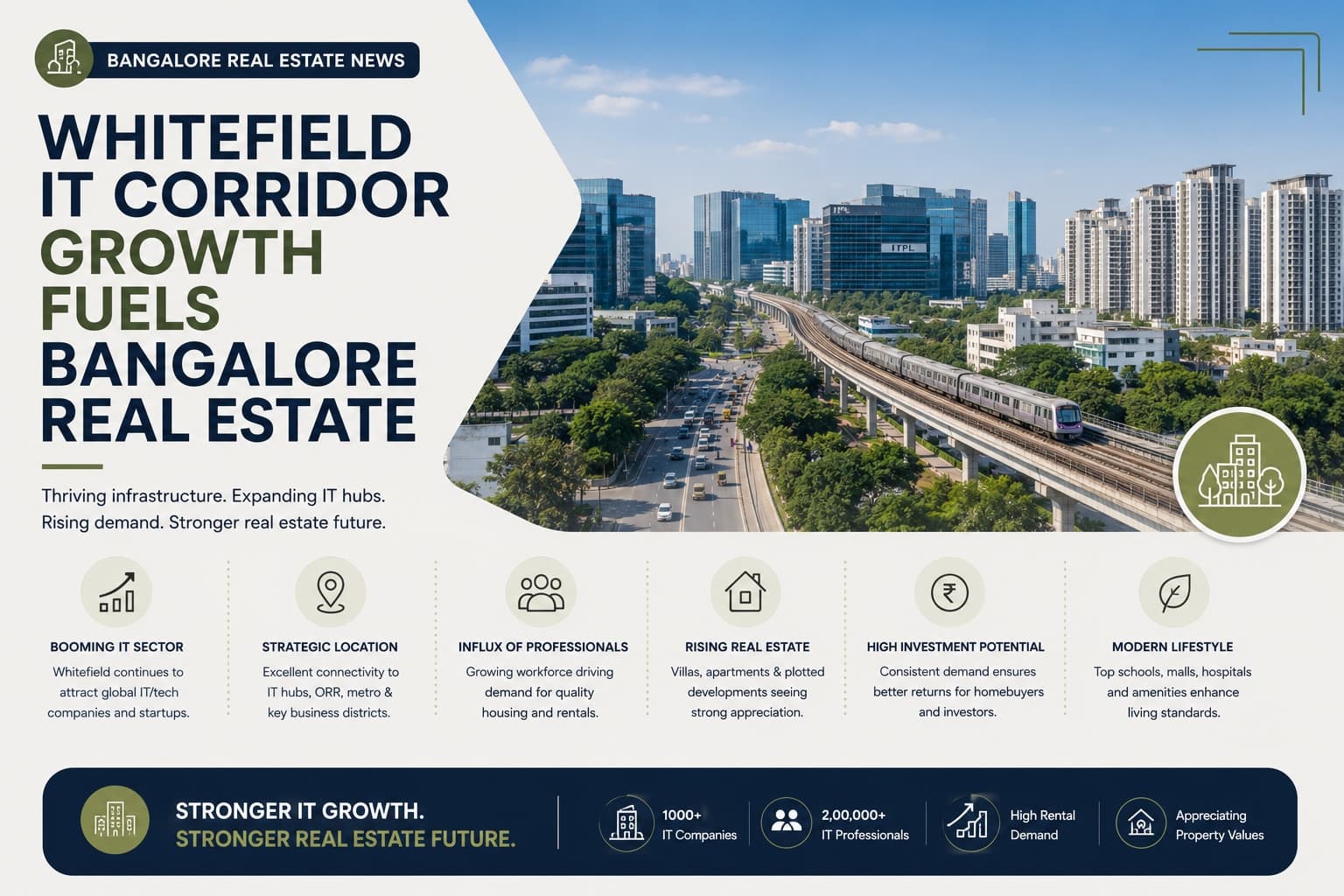
Whitefield IT Corridor Growth Fuels Bangalore Real Estate News
Few forces shape a city's housing market as directly as where its jobs are. In Bengaluru, the Whitefield IT corridor has spent two decades proving the point — and its continued growth is once again driving the eastern property story.
Bengaluru's real estate headlines rarely stray far from employment, and no corridor illustrates that link more clearly than Whitefield. What began as a peripheral technology park has grown into one of India's most significant workplace clusters, and the housing market around it has expanded in step. Today the corridor's growth is again reshaping demand, pricing conversations and the kind of homes developers choose to build in East Bangalore. Among the projects arriving in response is the Godrej Villa Whitefield Bangalore project, and this article explains how corridor growth translates into real estate momentum.
The Corridor That Built East Bangalore
Whitefield's transformation is one of the defining stories of modern Bengaluru. The establishment of International Tech Park Bangalore and the surrounding EPIP zone anchored a technology cluster that drew global occupiers, and the workforce followed. Areas such as Hoodi, Brookefield and Kadugodi shifted from quiet outskirts to dense residential neighbourhoods within a generation. That history matters because it means Whitefield is not an emerging bet but a proven corridor — one where housing demand has been anchored by real, sustained economic activity rather than speculation, through multiple market cycles.
Metro Connectivity Changed the Equation
For years, the corridor's greatest strength was also its greatest constraint: the jobs were there, but reaching them meant contending with congested roads. The extension of Namma Metro's Purple Line into Whitefield materially altered that calculation. A rail connection to the city's core changed how far and how reliably people could commute, easing a bottleneck that had shaped residential choices for years. Metro access tends to do two things to a corridor — it broadens the pool of people willing to live there, and it strengthens the case for those already working nearby to settle permanently rather than treat the area as a temporary posting.
Office Demand Feeds Housing Demand
The mechanism connecting corridor growth to property news is straightforward. When occupiers expand their footprint and add roles, they add households — people who need somewhere to live within a reasonable commute. Bengaluru's technology and global capability centre sector has continued to absorb office space in the east, and each expansion strengthens the underlying demand for homes nearby. This is why analysts watch office leasing as a leading indicator for residential markets. Housing demand generated this way tends to be durable, because it rests on employment rather than sentiment, and it renews itself as companies keep hiring.
The Upgrade Cycle
Perhaps the most underappreciated dynamic is what happens to a workforce over time. Professionals who moved to Whitefield early in their careers, often into compact apartments, are now senior, better paid and raising families. Their requirements have changed: more space, better schools nearby, room for parents or children, and somewhere they can imagine staying for a decade. Rather than leave the corridor they work in, many upgrade within it. This internal upgrade cycle is a powerful, self-sustaining source of demand for larger homes, and it is a major reason premium formats have gained ground in the east.
Social Infrastructure Reached Maturity
Corridor growth does not stop at offices. As the population grew, so did everything supporting it — reputed schools, hospitals, shopping destinations, restaurants and entertainment. Whitefield today functions as a largely self-contained part of the city, where residents can meet daily needs without long journeys into the centre. That maturity is difficult for newer locations to replicate quickly, and it is precisely what converts a workplace cluster into a genuine residential destination. For families in particular, established social infrastructure often weighs as heavily in the decision as the commute itself.
A Deep and Reliable Rental Market
The corridor's employment base also underpins one of the city's more dependable rental markets. A steady inflow of professionals joining companies in the area sustains demand for rented homes, which matters to buyers in two ways. It offers those who may relocate or delay occupation a realistic letting option, and it signals underlying strength in the local market. A location where people consistently want to live, whether they buy or rent, has a healthier demand profile than one dependent on purchase interest alone.
How Supply Has Responded
Developers read these signals closely, and the supply mix in the corridor has shifted accordingly. Alongside apartments, there is now clear movement toward premium and low-density formats — villas, row houses and larger configurations aimed at the upgrade buyer rather than the first-time purchaser. The entry of established national developers into this space reflects considered confidence in end-user demand. It also raises standards across the corridor, since projects backed by serious builders bring planning discipline and delivery track records that shape buyer expectations for everyone else.
The Ripple Into Surrounding Pockets
Growth in a corridor rarely stays neatly within its boundaries. As land in Whitefield's core has grown scarcer and more valuable, development has spread outward along connecting roads, drawing attention to adjoining pockets that offer larger parcels within acceptable reach of the same workplaces. This is the natural pattern of a maturing corridor: the centre densifies and commands a premium, while the periphery absorbs the formats that need more land. For buyers, it widens the choice available, though it makes understanding the specific micro-market more important than ever.
Why Employment-Led Demand Behaves Differently
It is worth pausing on the quality of this demand, not just its volume. Employment-led housing markets behave differently from those driven by investor enthusiasm. The buyers are people who need to live near their office, so their interest persists through quieter phases rather than evaporating when sentiment cools. They also buy for the long term, which reduces churn and supports stability. Corridors with this foundation tend to correct more gently and recover more quickly than those built on speculation, because the underlying reason to live there has not gone anywhere.
What It Means for Buyers
For anyone considering a home here, corridor growth is useful context rather than a reason to hurry. It suggests demand is anchored in something substantial, that infrastructure is likely to keep improving, and that the area's appeal has proven durable across cycles. The practical implications are simple: understand which pocket of the corridor suits your commute and budget, weigh connectivity honestly by travelling the route yourself, and register interest early in projects you rate so you receive confirmed details first. Momentum should sharpen your preparation, never replace your due diligence on pricing, approvals and RERA.
Keeping It in Proportion
Some balance is warranted. Corridor growth does not guarantee outcomes for any individual home, and location within a corridor can matter more than the corridor itself — two projects a few kilometres apart can offer very different daily experiences. Congestion remains a real consideration in parts of the east, infrastructure timelines can slip, and broader factors such as interest rates and market cycles influence results regardless of local strength. Entry price and personal verification still determine more than any headline about growth ever will.
The Bottom Line
Whitefield's IT corridor continues to do what it has done for two decades: convert employment into housing demand. A deep occupier base, improved metro connectivity, a maturing workforce upgrading in place, mature social infrastructure and a dependable rental market together explain why the corridor keeps generating real estate news — and why developers keep building here. For buyers, that context is encouraging, but the fundamentals of a sound purchase are unchanged: research the micro-market, travel the commute, verify every detail and judge value on your own terms. To see one example of the new supply arriving in the corridor, explore the Godrej Villa Whitefield Bangalore listing.
Disclaimer: This article is general market commentary based on publicly available information and broad industry observation. It is not financial, investment or legal advice, nor an offer of sale, and it does not present verified statistics or guarantee any trend, price or return. Market and infrastructure conditions can change. Any project referenced is in its pre-launch phase, with configurations, areas and pricing indicative and subject to change. All details should be independently verified with the developer or an authorised channel partner before making any decision.