The Temple Economy: Why India's Fastest-Changing Property Markets Are Pilgrimage Cities
Most people looking at Indian real estate watch the same things: IT corridors, metro lines, airports, office demand. Almost nobody builds a thesis on the oldest and largest movement of people in the country — Indians travelling for faith. Yet over the last decade the fastest-changing property markets in India have not been tech suburbs. They have been temple towns. This article explains the pattern behind that, using a five-phase framework, and shows where a project like The Sarayu Ayodhya villa plots sits within it.
What a Temple Economy Actually Means
A temple economy is what happens when a place of worship becomes big enough to reshape the town around it.
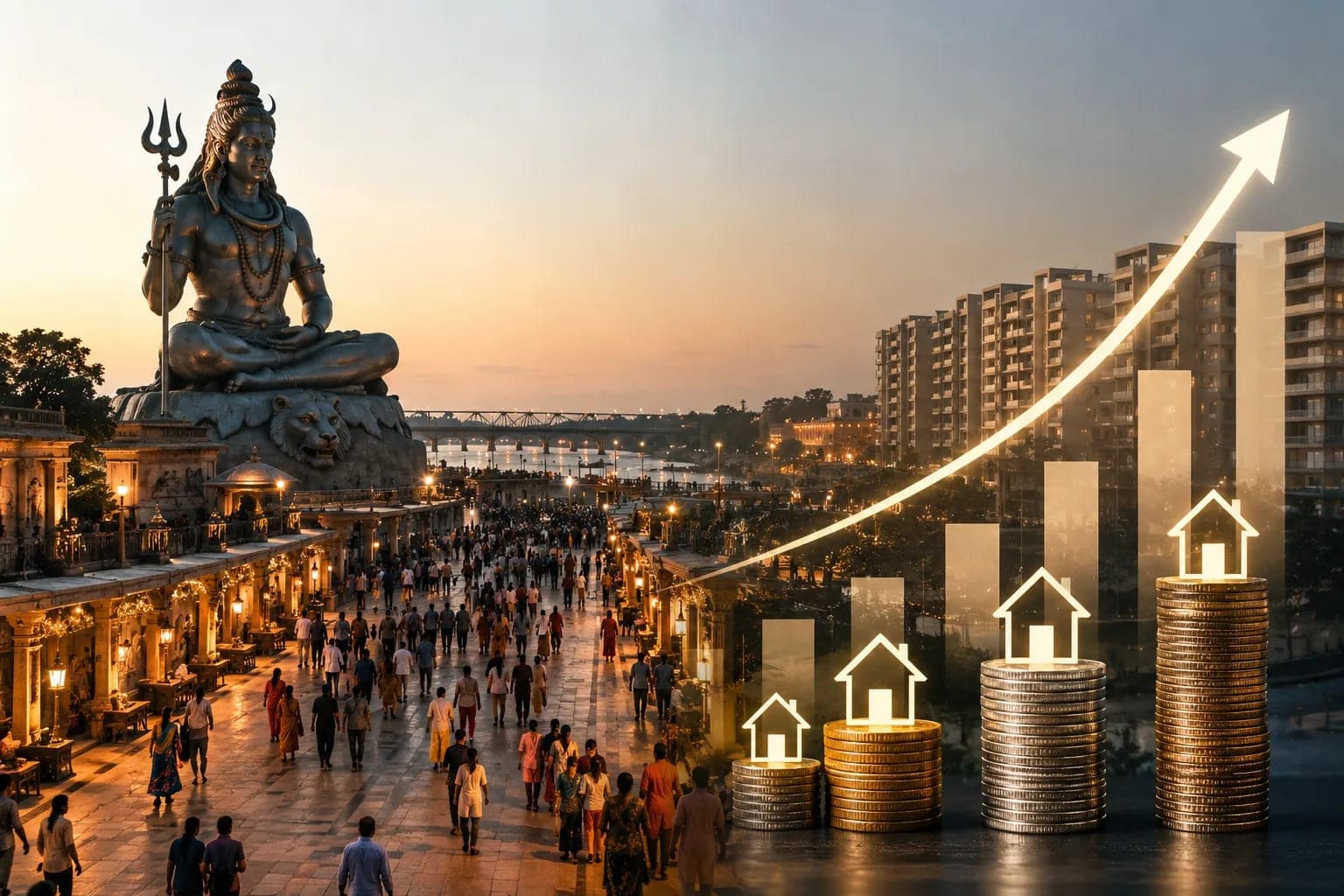
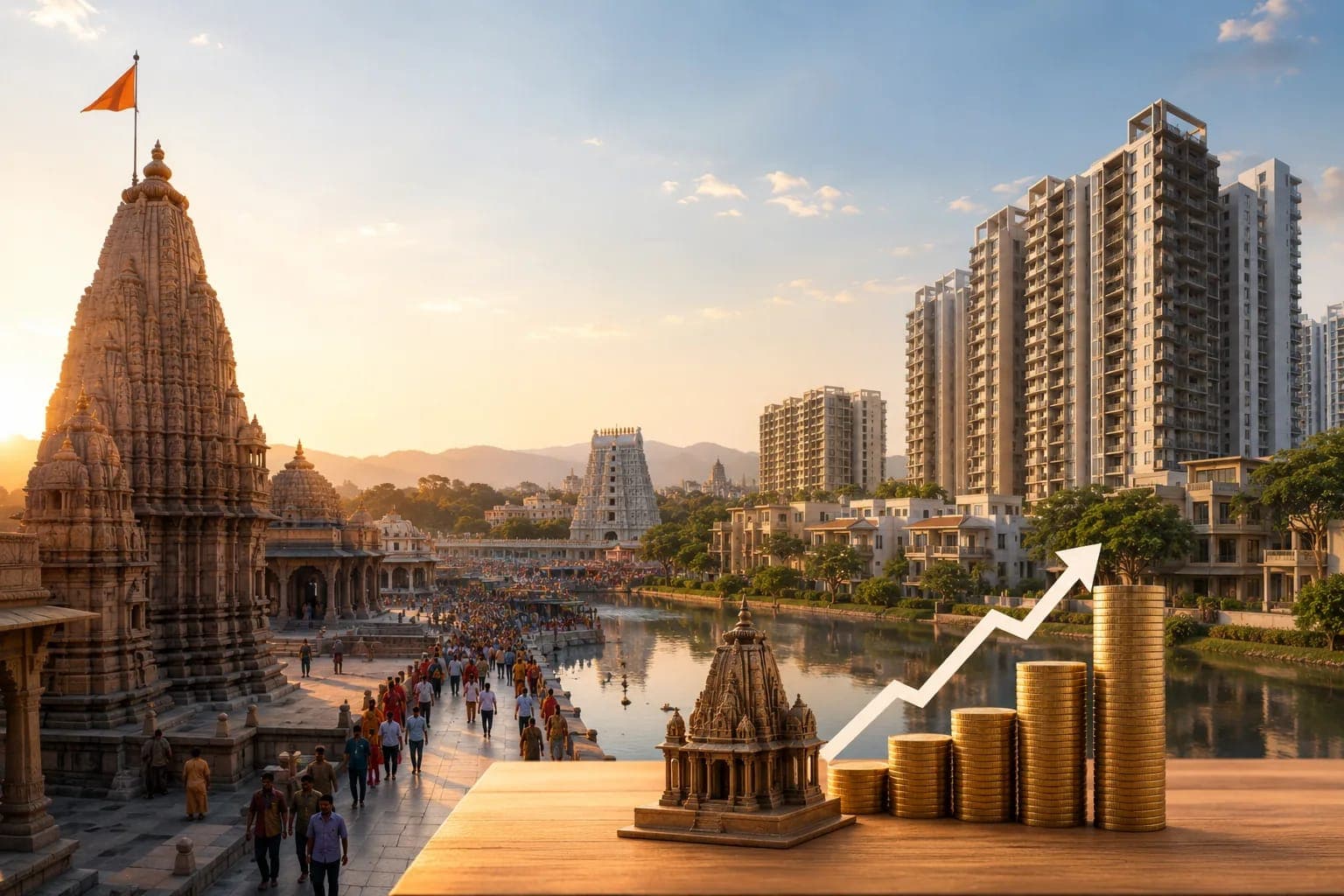
The chain is simple enough for anyone to follow. A major temple is built, restored or expanded. The government follows with money for roads, airports and riverfronts. That infrastructure makes the place easy to reach. Easy access brings crowds. Crowds need hotels, food, transport and shops. All of those sit on land. And land that suddenly has to do far more work than before gets repriced.
Faith starts the process. Infrastructure converts it into an economy. Neither half works alone, and that is the single most important idea in this article.
The Number Most Investors Miss
Roughly sixty per cent of India's domestic tourism is religious or spiritual in purpose. Ministry of Tourism data put religious tourism at around 1,439 million visits in 2022, generating in the region of ₹1.34 trillion in revenue. KPMG has valued India's temple economy at about ₹3.02 lakh crore, close to 2.32 per cent of national GDP.
This is not a niche. It is the base case of how Indians travel, and it has been for centuries. What changed recently is that the state started spending serious money on it, and institutional capital started paying attention.
The Five-Phase Temple Economy Curve
India has run this experiment several times in living memory, and the sequence repeats. Only the timeline changes.
Phase 0 — Certainty
Legal or political clarity arrives that the project will actually happen. Nothing is built yet. Local land quietly changes hands. Buyers are mostly speculators and farmers who decide to hold.
Phase 1 — Capex
Construction starts and budgets are allocated. Circle rates get revised. Roads, bypasses and airports go out to tender. Regional investors and hotel operators move in.
Phase 2 — The Opening
The temple or corridor opens. Footfall jumps in a single step rather than climbing gradually. There are not enough hotel rooms. Media coverage peaks. National retail buyers arrive.
Phase 3 — Consolidation
Organised supply finally enters. Branded, titled, RERA-registered inventory starts replacing informal farmland deals. End-users and second-home buyers appear. This is the phase where paperwork and upside briefly exist together.
Phase 4 — Maturity
The market settles at a high, stable level. Growth becomes incremental. Whatever premium exists now belongs to whoever entered earlier.
Ayodhya: The Clearest Example on Record
Ayodhya is the only Indian temple economy where the entire before-and-after sits inside roughly seven years, documented in public records.
Uttar Pradesh Tourism figures show annual visitors rising from 2.84 lakh in 2017 to 16.44 crore in 2024 and 29.95 crore in 2025. PTI reported outskirt land at ₹400–500 per sq ft in 2019 quoted at ₹1,000–1,500 within a year of the Bhoomi Pujan. In 2025 the district revised circle rates for the first time in eight years, by 30 to 200 per cent, with increases above 150 per cent within ten kilometres of the temple.
Behind it sits roughly ₹85,000 crore sanctioned under Ayodhya Master Plan 2031, including Maharishi Valmiki International Airport and major highway widening. Uttar Pradesh recorded 64.91 crore domestic tourists in 2024, the highest of any state.
None of that is a forecast. It is a record of what already happened.
Varanasi: Three Years Ahead on the Same Curve
The Kashi Vishwanath Dham corridor opened in December 2021. The temple trust has counted over 325 million visitors since. Business Standard reports that Varanasi has since overtaken Lucknow and Noida to become one of Uttar Pradesh's most expensive property markets, with portal data showing a city average around ₹7,100 per sq ft in 2026.
The transferable lesson is precise. The corridor alone did not do it. What followed did — airport expansion, a ropeway, Sarnath works, better roads. Varanasi is roughly three years ahead of Ayodhya on the identical curve, which makes it the best available preview.
Ujjain: How Fast the Change Can Happen
Mahakal Lok opened in October 2022. Before it, the Mahakaleshwar temple saw 25,000 to 40,000 visitors daily. Afterwards, roughly one lakh on ordinary days and 1.5 to 2 lakh on weekends, per the temple management committee. Temple income went from ₹22.13 crore in 2021 to ₹46.51 crore in 2022 — doubled in a year.
Ujjain also teaches the lesson nobody markets: land immediately beside the temple was not the best buy. It was the most regulated, most congested and most legally sensitive. The approach roads and growth corridors performed better.
Tirupati: What the Endpoint Looks Like
Tirumala receives 60,000 to 80,000 pilgrims every single day, the highest single-site visitation frequency in India, with TTD collections in the region of ₹3,023 crore in FY23.
The uncomfortable observation matters more than the numbers. Nobody today can buy into Tirupati at Phase 1 pricing. That window closed decades ago, and the value went to whoever held land while the growth was happening. Tirupati is not the opportunity. Tirupati is proof that the opportunity was real.
The Hotel Keys Signal
Here is the quiet giant in this whole dataset. Organised hotel keys across India's temple towns roughly tripled from about 2,300 in FY15 to about 7,500 in FY23, according to IBEF.
More recently, HVS Anarock has reported that religious destinations hold only around 6 per cent of India's branded hotel keys today but account for roughly 14 per cent of the development pipeline. In plain terms: institutional hospitality capital is building in temple towns at more than double their current share.
That is not a hotel statistic. It is a land absorption statistic. Every key stands on a plot somebody bought, financed and got approved.
Where The Sarayu Ayodhya Sits on the Curve
Kashi has moved into Phase 4. Ujjain is approaching it. Tirupati has been there for decades. Ayodhya is in Phase 3 — the consolidation window, where informal land gives way to organised, titled, branded product.
The Sarayu Ayodhya by House of Abhinandan Lodha is what Phase 3 supply looks like in practice: a freehold plotted development registered under UP RERA UPRERAPRJ311468 for Phase 1, roughly 15 minutes from the Shri Ram Mandir, with over 40 amenities and The Leela as hospitality partner. Villa Plots of 1,248 to 1,250 sq ft start from ₹1.89 Cr. The project is under construction and possession has not yet been announced.
That is the framework doing the work, not a sales pitch. Where a reader places Ayodhya on the curve is their own judgement.
What the Temple Economy Does Not Promise
An honest framework has limits, and these matter.
It does not promise your money will grow. Everything above describes what has already happened, in cities where it already happened. No pattern guarantees a repeat.
It does not make every plot in a temple town a good buy. Ujjain showed that proximity can be a liability. Title, conversion status and access decide outcomes far more than distance to a shrine.
And it says nothing about religious merit. Buying land near a temple is a property transaction, not a spiritual one. Anyone who suggests otherwise is selling you something.
Common Questions About the Temple Economy
Why do temple towns re-price at all?
Because sustained footfall creates demand for hospitality, retail and housing that the existing land supply was never built to carry, and because the state usually funds infrastructure alongside it.
Is it too late to look at Ayodhya?
The first repricing is already recorded in circle rates, so a buyer today is not entering at 2019 prices. Whether the remaining window suits you depends on your horizon and risk appetite.
The Honest Summary
The temple economy is not a slogan. It is a repeatable sequence — certainty, capex, opening, consolidation, maturity — visible in Ayodhya, Kashi, Ujjain and Tirupati, backed by government footfall data, circle rate revisions and sanctioned budgets rather than by optimism. What the framework gives a buyer is not a prediction but a position: a way of knowing which phase a market is in before deciding whether it suits them. Ayodhya's consolidation phase is where organised supply is arriving now, and The Sarayu Ayodhya by House of Abhinandan Lodha is one example of that category — worth reviewing on its documents and its title, as you would review any plot anywhere.
Temple Economy, Religious Tourism, Ayodhya, Real Estate Investment, The Sarayu Ayodhya