When buyers weigh a location's job base, they usually think of IT parks. But a financial-services district brings its own distinct kind of employment strength — and near Bhartiya City KIADB in Devanahalli, that district is IFCI Financial City. Understanding what it is, and why a financial-sector job base specifically matters for a residential project, adds an important dimension to the investment case. This guide explains both.
You can review the project itself on the Bhartiya City KIADB project page at Perfect Neighbourhood. Here, the focus is IFCI Financial City and the value of a financial job base.
What Is IFCI Financial City?
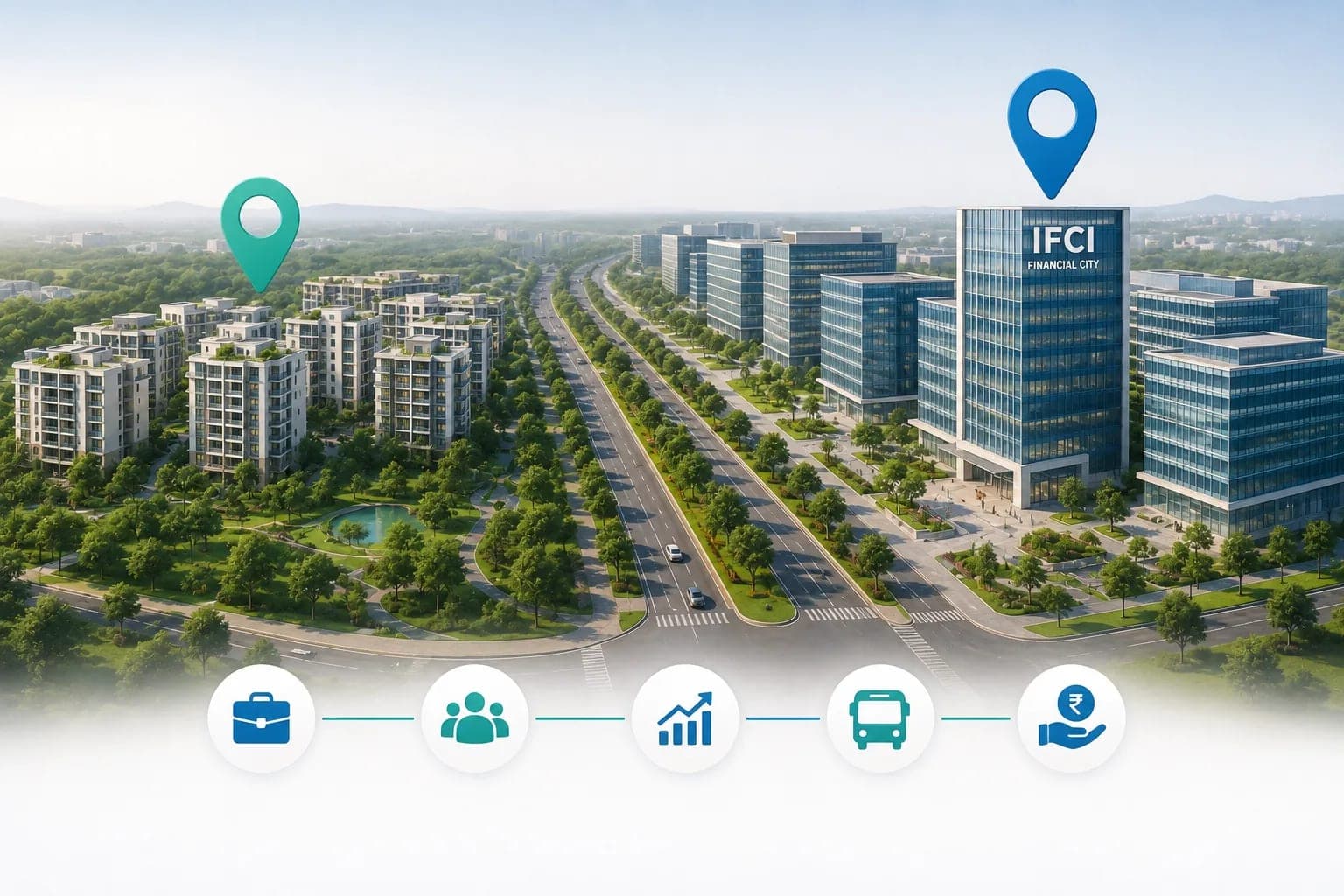
IFCI Financial City is a roughly 50-acre financial-services district being developed at Devanahalli, near the hardware park and the airport. It is being built by IFCI Infrastructure Development Ltd (IIDL), a subsidiary of IFCI — the Industrial Finance Corporation of India — with the foundation stone laid over a decade ago and an estimated investment in the region of Rs 970–1,000 crore.
The concept is straightforward and distinctive: it functions much like an IT park, but for the financial sector. Rather than technology companies, it is designed to house banks, financial institutions and insurance companies — providing them with commercial, organisational and back-office space. In essence, it is a dedicated hub for the banking, financial services and insurance (BFSI) sector in North Bangalore.
An Honest Note on Its Status
Balance and accuracy matter, so this deserves stating plainly. IFCI Financial City is a long-gestation project — its foundation was laid many years ago, and like many large infrastructure developments in emerging corridors, it has developed gradually rather than overnight. A buyer should treat it as part of the corridor's growth trajectory rather than as a fully mature, fully occupied district today.
That said, its presence is meaningful. It reflects a deliberate, government-linked intent to establish a financial-sector hub in the Devanahalli corridor — the kind of anchor development that shapes an area's long-term employment profile. As always, it is worth confirming the current status and scale for yourself rather than relying on projections alone.
Why a Financial Job Base Is Distinctly Valuable
Here is the crux: not all employment is equal from a residential-demand perspective, and a financial-services job base has particular strengths.
Stable, white-collar employment. The BFSI sector employs a large base of salaried, white-collar professionals — exactly the demographic that forms reliable homebuyers and tenants. This is settled, income-stable employment rather than transient work.
Back-office and operational scale. Financial-sector facilities of this kind often house back-office, operations and training functions, which employ significant numbers of people. That headcount translates directly into housing demand in the surrounding area.
Sectoral diversification. For a corridor already anchored by aerospace and technology employment, a financial-services hub adds a different, largely unrelated sector to the mix. This diversification is a genuine strength — it makes the overall employment base more resilient, because a slowdown in one sector is cushioned by the others.
What This Means for the Residential Catchment
A financial-services district near a residential project strengthens the catchment in specific, practical ways.
For owner-occupiers who work in the BFSI sector, it offers the prospect of living close to work in a well-planned community — a genuine lifestyle advantage. And for all owner-occupiers, the presence of a diverse, white-collar employment base underpins the long-term resale value of a home, because it keeps the location in demand.
For investors, the logic is direct: a financial-sector workforce means a pool of stable, salaried tenants. Combined with the corridor's aerospace, IT and aviation employment, this deepens the rental market and reduces its dependence on any single industry — supporting both occupancy and rental stability.
IFCI Financial City in the Bigger Picture
IFCI Financial City does not exist in isolation. It is one component of a remarkably ambitious build-out around the airport. The wider Devanahalli development includes a large business park spanning hundreds of acres with multiple IT parks, the KIADB Aerospace Park, a proposed Science Park, and the airport ecosystem itself — all part of the broader investment region taking shape near Kempegowda International Airport.
Seen this way, IFCI Financial City is one thread in a much larger fabric of planned employment infrastructure. The significance for a residential buyer is not any single hub, but the cumulative intent: a corridor being deliberately developed as a multi-sector employment destination. That is precisely the kind of foundation that supports durable, long-term housing demand.
An Honest Perspective for Buyers
A few balanced points to hold in mind:
These are growth-stage developments. IFCI Financial City and much of the surrounding employment infrastructure are developing rather than complete. The trajectory is positive, but a buyer is partly investing in continued execution of these plans.
Employment strength supports, but does not replace, due diligence. A strong job base makes the location more attractive, but you must still verify the project itself — RERA registration, pricing, developer record and possession timeline — before committing.
Verify the specifics. When any location's investment case leans on named employment hubs, it is prudent to confirm their current status and scale independently rather than accepting them at face value.
Who Should Weight This Most Heavily
The financial job base matters most to BFSI-sector professionals, for whom it offers the prospect of living near work, and to investors, for whom the stable, salaried tenant pool it represents strengthens the rental case. It also matters to any long-horizon buyer who values sectoral diversification, because a financial hub alongside aerospace and IT employment makes the corridor's demand base more resilient. For buyers whose priorities lie elsewhere, it is a supporting strength rather than a decisive factor — but a genuine one.
Final Word
IFCI Financial City adds a distinctive and valuable dimension to the employment catchment around Bhartiya City KIADB — a dedicated financial-services hub that brings stable, white-collar BFSI employment and, crucially, sectoral diversification to a corridor already anchored by aerospace and technology. As a long-developing project, it is best understood as part of the area's growth trajectory rather than a finished district. But its presence, alongside the wider Devanahalli employment build-out, reinforces exactly what gives this location its long-term strength: a deliberately developed, multi-sector job base that supports durable housing demand.
To explore the project in full — with current pricing, floor plans and RERA-verification support — review the complete details on the Bhartiya City KIADB project page.
Labels: IFCI Financial City, Devanahalli Financial District, Bhartiya City KIADB Employment, BFSI Jobs Bangalore, North Bangalore Investment