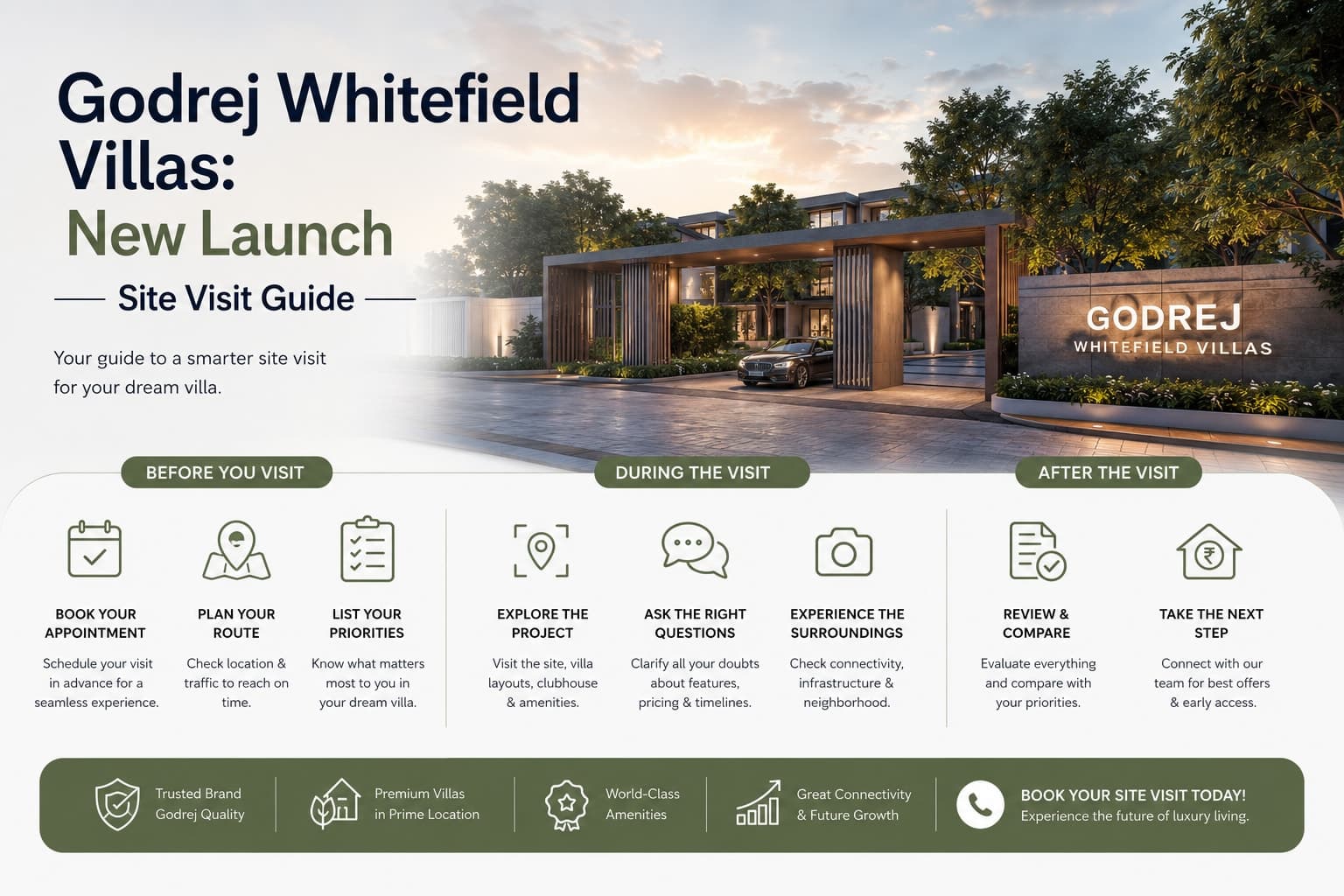
Godrej Whitefield Villas: New Launch Site Visit Guide
A practical, step-by-step guide to visiting the site of Godrej Properties' new Whitefield villa community — how to prepare, what to observe, the questions to ask, and the checks to complete before you decide.
A brochure can show you renders and floor plans, but only a site visit tells you how a place actually feels. For a villa purchase — a long-term, end-use decision — that first-hand impression is invaluable. Godrej's new villa community in Whitefield, East Bangalore, is currently in its pre-launch phase, and even at this early stage a well-planned site visit helps you judge the location, the surroundings and the master plan far better than any photograph. This guide walks you through preparing for the visit, what to look for on the ground, and the steps that follow. For the full project details alongside it, you can explore the complete Godrej Villa Whitefield Bangalore project before you go.
Why a Site Visit Matters — Even at Pre-Launch
It is easy to assume there is little to see before the villas are built, but that is not the case. Land, location and surroundings are the things you cannot change after buying, and they are exactly what a site visit lets you assess first-hand. You can experience the commute, gauge the neighbourhood, check access roads, and get a real sense of the plot and its context. You can also review the master plan on site, understand how the community is laid out, and picture where your preferred unit would sit. In short, a pre-launch visit turns an abstract listing into a concrete, grounded understanding of what you are buying into. It is also a chance to meet the team in person, gauge how transparent and knowledgeable they are, and start building the relationship that will carry you through the rest of the buying process.
Before You Go: How to Prepare
A little preparation makes the visit far more productive. Start by registering your interest with the developer or an authorised, RERA-registered channel partner and scheduling a confirmed appointment. Ask in advance what will be available to see — the site, the master plan, any sample layouts or a marketing suite. Plan to travel at a time that reflects your real routine, such as a weekday, so you experience the commute honestly. Carry a notebook or your phone to record observations, a list of questions, and your requirement details. It also helps to read up on the location and the configurations beforehand, so your time on site is spent verifying and observing rather than gathering basics.
Getting There: The Whitefield Location
The journey to the site is itself part of the assessment. The community is located in Whitefield, one of East Bangalore's most established residential and employment corridors, close to the Whitefield IT Corridor and ITPL, with connectivity through NH-648 and Soukya Road. As you travel, pay attention to the route: the condition of the approach roads, traffic at the time you would typically commute, and how close everyday essentials are. Note the distance to workplaces, schools, hospitals and shopping you would actually use. The drive to the site tells you a great deal about daily life in the community, so treat it as data rather than just travel.
What to Observe On Site
Once you arrive, observe with intent. It helps to look closely at:
- The plot and its boundaries — the size, shape and feel of the land the community sits on.
- The immediate surroundings — what neighbours the site, and how quiet or busy it is.
- Access and approach roads — their condition, width and ease of entry and exit.
- The master plan — how villas, roads, green spaces and amenities are arranged.
- Unit positioning — where your preferred villa would sit, its orientation and outlook.
- Any sample or show layout — the quality of finishes and the feel of the spaces on display.
Questions to Ask During Your Visit
A site visit is your chance to get answers directly, so go prepared with questions. Useful ones include:
- What are the confirmed configurations, sizes and the current pricing on request?
- What is the master plan, and how many villas are planned across the land?
- What amenities are proposed, and where will they be located?
- What is the indicative possession timeline and construction plan?
- What are the RERA registration details, and can they be shared in writing?
- What does the payment schedule look like, and what is due at each stage?
Assessing the Location and Surroundings
Beyond the plot itself, use the visit to read the wider neighbourhood. Drive or walk around the area to understand its character — the mix of homes, greenery, and the pace of development nearby. Check how established the surrounding infrastructure is, since a mature setting supports comfortable living from day one. Consider the future too: look for signs of upcoming roads, projects or amenities that could shape the area over the years you plan to live there. This context matters because a villa is a long-term home, and the surroundings will be as much a part of daily life as the house itself. Time your visit to notice everyday details too — how light falls, how noisy the area is, and whether the pace of the surroundings suits the life you want.
Understanding the Master Plan and Sample Villa
Whether or not finished villas are ready to tour, the master plan is central to your visit. Ask to walk through it in detail: how the low-density layout is organised, where the open spaces and amenities sit, and how internal roads connect the community. If a sample layout or show unit is available, use it to judge the quality of construction, the finishes and the feel of the spaces at the sizes on offer — from the 4 BHK through to the larger 5 BHK. If nothing is built yet, focus on the plan and the specification sheet, and ask for both in writing so you can study them afterward at your own pace.
Checking the Paperwork
A site visit should always lead into due diligence. Before committing any significant money, confirm the project's RERA registration details and verify them independently, ask for the written cost sheet including any additional charges, and understand the payment schedule and cancellation terms. Confirm the configurations, indicative areas and possession timeline in writing, and make sure you are dealing with the developer or an authorised, RERA-registered channel partner throughout. The visit builds your feel for the place; the paperwork protects your investment. Both matter, and they work best together rather than one without the other.
After the Visit: Next Steps
Once you are home, take a little time to reflect before acting. Review your notes, compare the site against your expectations, and weigh how the location, surroundings and master plan fit your needs. If the visit strengthened your interest, request the confirmed pricing and floor plans, complete your due diligence, and consider comparing the project with a closely related option in the same corridor. If anything gave you pause, note it down and follow up with specific questions. A site visit is not the end of the process but a pivotal step in it — one that turns a promising listing into an informed decision you can make with confidence.
The Bottom Line
A site visit is one of the most valuable steps in buying a villa, and it is well worth doing even at pre-launch. Prepare in advance, experience the commute, observe the plot and surroundings closely, study the master plan, ask the right questions, and follow up with proper due diligence on pricing and RERA. Do this, and you will judge Godrej's new Whitefield villa community on first-hand evidence rather than marketing alone. To schedule your visit and see full details, explore the Godrej Villa Whitefield Bangalore listing and register your interest.
Disclaimer: This article is an informational guide based on publicly available marketing information and general site-visit practices, and is not an offer of sale or legal or financial advice. The project is in its pre-launch phase; configurations, areas, amenities, timelines and pricing are indicative and subject to change. All details, approvals and RERA registration should be independently verified with the developer or an authorised channel partner before booking or making any payment.