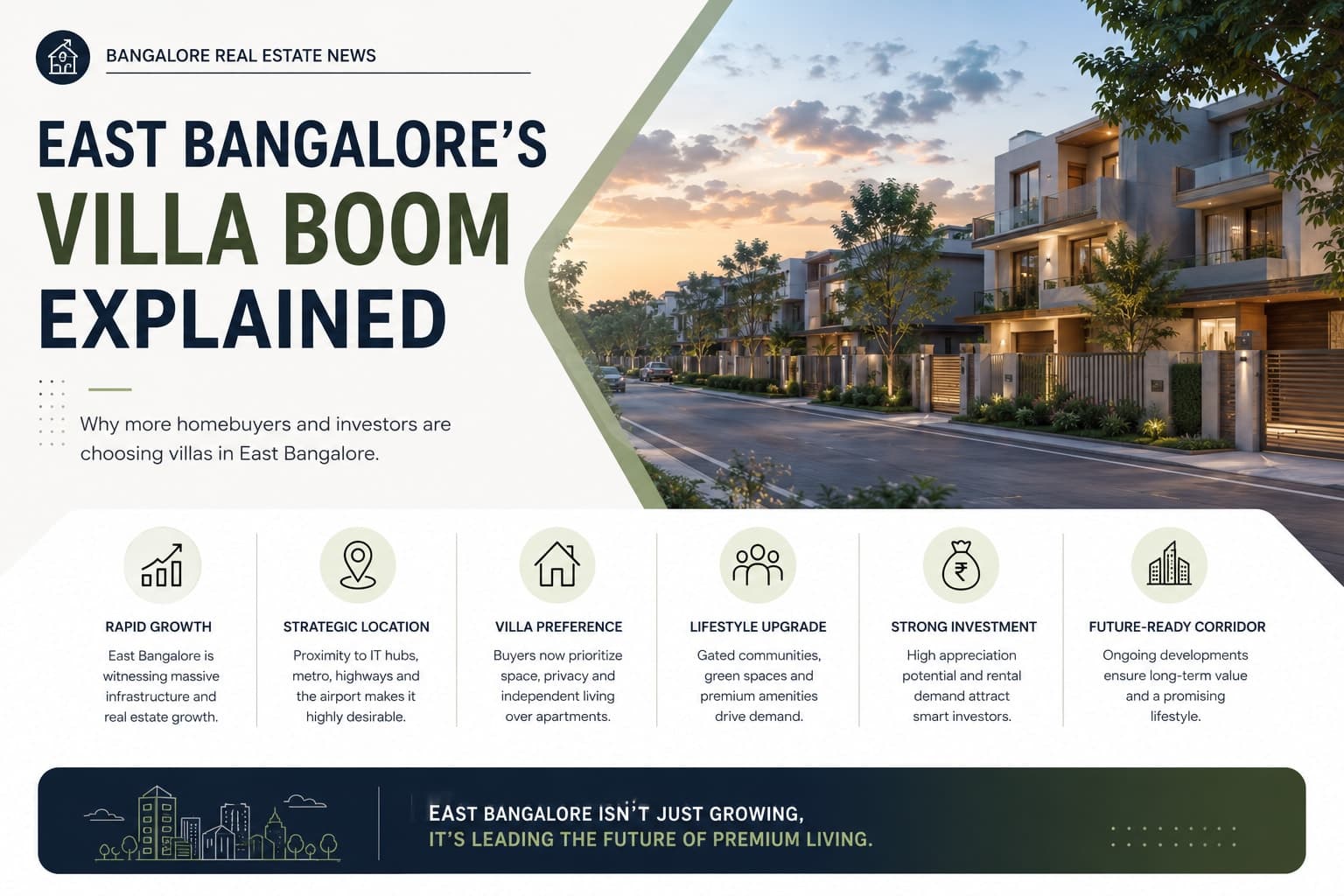
Bangalore Real Estate News: East Bangalore's Villa Boom Explained
Independent homes are no longer a footnote in East Bangalore's housing story. Across the eastern corridors, villa and row-house communities are launching, selling and shaping the conversation in a way they have not for years. Here is what is actually driving it.
Drive east out of the city today and the change is visible from the road. Between the office parks and the arterial highways, gated communities of independent homes are appearing where farmland and vacant plots once stood. What was a niche corner of Bengaluru's market — expensive, scarce and slow-moving — has become one of its most talked-about segments. Calling it a boom is not marketing language; it reflects a genuine convergence of employment growth, land availability, infrastructure and buyer appetite that has landed on East Bangalore in particular. One example of the new supply entering this market is the Godrej Villa Whitefield Bangalore project, and this article explains the forces behind the wider trend.
What the Boom Actually Looks Like
The shift is best understood as one of visibility rather than invention. Villas have always existed in Bengaluru, but they sat at the margins — a handful of small enclaves, often distant, aimed at a narrow buyer. What has changed is scale and seriousness. Large, master-planned communities of independent homes are now being launched by established national developers, on sizeable land parcels, within reach of major workplaces. When a format moves from scattered projects to planned communities backed by major builders, it has crossed from niche into segment, and that is precisely the threshold East Bangalore's villa market has crossed.
The Employment Engine
Nothing sustains a housing market like jobs, and East Bangalore has them in depth. The Whitefield IT corridor, ITPL and the surrounding technology and business parks anchor one of the city's largest concentrations of well-paid employment. That workforce has matured alongside the corridor: professionals who arrived early in their careers are now senior, better paid, and often raising families. Their housing needs have changed with them. The demand for larger, independent homes in the east is not new demand arriving from elsewhere — it is largely the same population, upgrading in place, close to the offices they already commute to.
Infrastructure Unlocked the Land
Employment alone cannot create a villa market; land must be reachable. This is where East Bangalore's infrastructure story matters. Sustained investment in road connectivity — arterial highways, widened corridors and improving link roads — has steadily brought outer pockets within practical commuting distance. Land that was once too remote to be viable for end-users has become genuinely liveable, and land that is liveable can support the large parcels a low-density villa community requires. Each improvement in connectivity effectively expands the map of where independent homes make sense, and East Bangalore has benefited from that expansion more consistently than most parts of the city.
The Micro-Markets Driving Growth
The boom is not evenly spread; it concentrates in specific pockets. Whitefield remains the anchor, combining a mature social fabric with direct proximity to the IT corridor. Around it, corridors such as Sarjapur Road, Old Madras Road and the stretches toward Budigere Cross and Hoskote have drawn attention because they offer something Whitefield's core increasingly cannot — larger, more affordable land parcels within acceptable reach of employment. Each micro-market attracts a slightly different buyer, but the underlying logic is consistent: proximity to work, room to build low-density, and infrastructure good enough to make the commute reasonable rather than punishing.
Who Is Buying
The buyer profile explains much about why this segment feels durable. These are predominantly end-users rather than speculators — established professionals, dual-income households and multi-generational families purchasing a home they intend to occupy for years. Many are moving from apartments they already own in the same corridor, trading up for space rather than relocating across the city. Some are non-resident Indians with roots in Bengaluru buying a family home. What unites them is a long horizon. Demand anchored in people who plan to live in the house tends to be steadier and less prone to sharp reversals than demand driven by short-term trading. It also changes what buyers scrutinise: schools, hospitals, daily commutes and the long-term quality of the community itself matter far more to them than any short-term price movement ever will.
Why Villas Specifically
Buyers with the means to choose are increasingly choosing independence. A villa offers space across multiple levels, private outdoor area, no shared walls and a defined plot of land — a combination apartments cannot replicate. Changed working patterns reinforced this: when a home must also accommodate focused work and study, extra rooms and separation stop being luxuries. Add the long-standing cultural pull of owning land rather than an apartment share, and the appeal is easy to understand. The modern gated villa enclave resolves the old trade-off, pairing that independence with security, amenities and maintained common areas.
The Supply Response
Perhaps the clearest evidence of the boom is on the supply side. Established developers do not commit capital to large land parcels and low-density layouts on a hunch; they do it after studying demand carefully. The entry of major national builders into East Bangalore's villa segment signals considered confidence that end-user appetite is real and sustainable. Their participation also changes the segment's character, bringing planning discipline, delivery track records and community management standards that smaller projects often could not offer. That in turn draws buyers who would previously have hesitated over an independent home, deepening the market further.
Scarcity Is the Constraint
For all the activity, the defining feature of this market remains limited supply. A low-density villa community consumes far more land per home than a tower, and large contiguous parcels within reasonable reach of the eastern employment hubs are genuinely finite. As land values in the best-connected pockets rise, the economics of building villas there grow harder, pushing new projects outward. The result is a segment where demand can build faster than supply can respond, particularly for well-located communities. That imbalance is central to understanding why good projects attract attention quickly.
What It Means for Buyers
A busy market cuts both ways. On one hand, more choice and more credible developers mean better options than existed a few years ago. On the other, the best-positioned homes in the most sought-after communities move quickly, and hesitation can cost you selection rather than just price. The sensible response is preparation over urgency: define your requirement, understand the micro-markets, register interest early in communities you rate, and be ready to act when confirmed details arrive. Momentum is a reason to be organised, never a reason to skip homework.
Keeping Perspective
It is worth resisting the temptation to read a boom as a guarantee. Housing markets respond to interest rates, economic conditions and local supply, all of which shift over time. Infrastructure timelines slip, corridors develop unevenly, and a project's specific location within a micro-market matters enormously. Entry price and thorough due diligence still determine outcomes far more than any headline trend. Treat the boom as useful context for your timing and shortlist, not as a substitute for verifying approvals, RERA registration, pricing and the developer's record.
The Bottom Line
East Bangalore's villa boom is the product of durable forces rather than a passing mood: a deep employment base, improving connectivity that unlocked usable land, a maturing workforce upgrading in place, changed expectations of what a home should do, and established developers responding with serious, planned communities. Against genuinely constrained supply, that combination has moved independent homes from the margins to the mainstream of the eastern corridor. For buyers drawn to the format, the fundamentals of a sound purchase are unchanged — research the micro-market, verify everything, and judge value on your own terms. To see one example of this new supply, explore the Godrej Villa Whitefield Bangalore listing.
Disclaimer: This article is general market commentary based on publicly available information and broad industry observation. It is not financial, investment or legal advice, nor an offer of sale, and it does not present verified statistics or guarantee any trend, price or return. Market conditions can change. Any project referenced is in its pre-launch phase, with configurations, areas and pricing indicative and subject to change. All details should be independently verified with the developer or an authorised channel partner before making any decision.