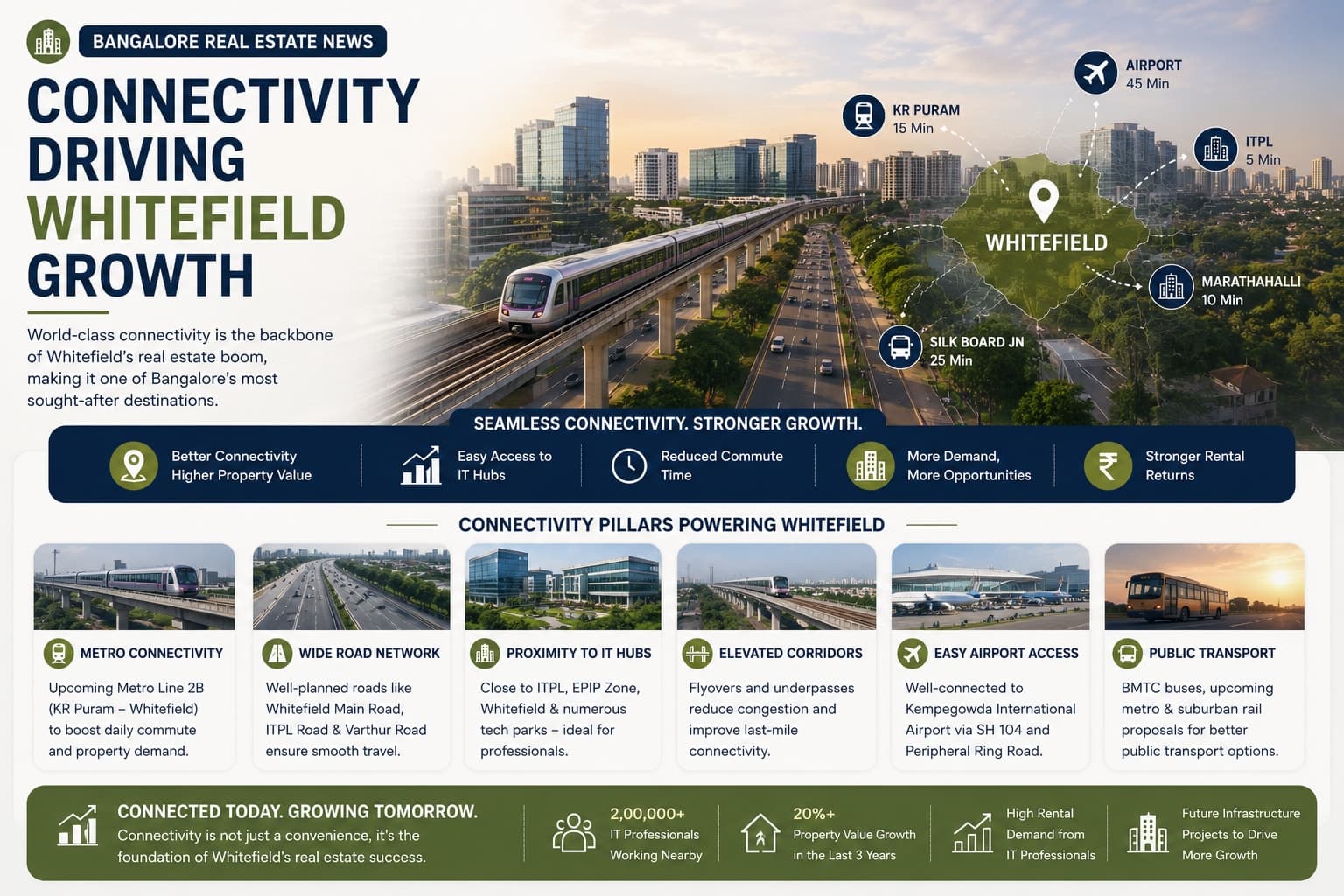
Bangalore Real Estate News: Connectivity Driving Whitefield Growth
Jobs brought people to Whitefield. Connectivity decided whether they stayed. As metro, road and rail links have improved, the corridor's property market has responded — here is how the two are connected.
For most of its modern history, Whitefield's property story carried an asterisk. The employment was world-class, the housing plentiful, the schools and hospitals well established — but getting in and out could be punishing. That single constraint shaped everything from where families chose to live to what developers were willing to build. Over recent years, sustained investment in transport infrastructure has begun to lift it, and the corridor's real estate market has moved in step. Communities such as the Godrej Whitefield Signature Villas new launch reflect the kind of premium development that improved access makes viable.
Why Connectivity Is the Decisive Variable
Among all the factors that shape a residential corridor, connectivity does the most work. Employment creates the reason to live somewhere; connectivity determines how many people can realistically act on it. A location within thirty minutes of a job centre draws from a vastly larger pool of buyers than one at ninety. Improve access and you effectively enlarge the market for every home in the area. This is why infrastructure announcements move property conversations so reliably, and why the sequence in Whitefield — jobs first, access later — matters for understanding its trajectory.
The Metro Changed the Calculation
The most consequential development has been the extension of Namma Metro's Purple Line into Whitefield. Rail transit does something roads cannot: it offers journey times that hold steady regardless of traffic. For a corridor whose principal weakness was unpredictable road congestion, that reliability is transformative. It widens the catchment of people willing to consider living or working here, and it changes the calculus for anyone weighing Whitefield against corridors closer to the centre. Metro access also tends to concentrate residential interest around station catchments, subtly reshaping demand within the corridor itself.
The Road Network Underneath
Roads still carry most of Whitefield's daily movement, and the network has expanded alongside the metro. Arterial connections including NH-648 and Soukya Road link the corridor to the wider region, while the Outer Ring Road provides access to the eastern and northern business districts without routing traffic through the city centre. Widening projects and improved link roads have gradually increased capacity across the corridor. Progress here is incremental rather than dramatic, but each improvement expands the area from which the employment hubs are practically reachable.
Rail and the Suburban Question
Whitefield has long had a railway station, and it has quietly served commuters for years. Its significance may grow considerably if Bengaluru's suburban rail ambitions advance as planned, since suburban services would offer another high-capacity, congestion-independent route between the eastern corridor and the city. For now this remains a developing story rather than a settled one, and buyers should treat it as potential upside rather than a certainty. Still, the existence of rail infrastructure gives Whitefield an option that several competing corridors simply lack.
Airport Access
For senior professionals and frequent travellers, airport access is a genuine consideration. Whitefield connects to Kempegowda International Airport primarily via the Outer Ring Road and northern arterial routes. It is not the closest corridor to the airport — that distinction belongs to North Bengaluru — but the journey is manageable and has benefited from broader improvements to the ring road network. For households where one member travels often, this factor sits alongside the daily commute rather than replacing it in importance.
How Better Access Translates Into Property Demand
The mechanism is straightforward once you see it. Improved connectivity widens the buyer pool, and a wider pool supports both transaction volume and pricing. It also shifts buyer psychology from temporary to permanent: people who can reach their office reliably are more willing to purchase rather than rent, and more willing to buy larger homes they intend to keep. That shift toward long-term, end-use ownership is precisely what underpins demand for premium formats, and it explains why developers have grown more confident committing to substantial projects here. Better access also strengthens the rental market, since tenants weigh commute time heavily, which in turn gives owners more flexibility if their circumstances change.
The Effect on the Premium and Villa Segment
Connectivity matters disproportionately for larger homes. Villa communities need sizeable land parcels, which are generally found away from a corridor's dense core. Whether such locations work at all depends entirely on how well they connect back to workplaces and amenities. As access has improved, land slightly removed from Whitefield's centre has become genuinely viable for low-density development. The Godrej Signature Villas project illustrates the pattern — roughly 20 acres supporting around 242 homes in 4 and 5 BHK configurations from 3,715 to 5,500 sq. ft., with indicative pricing from around ₹5.40 crore. Projects at that scale depend on buyers being confident about reaching them.
The Last-Mile Problem
Honest assessment requires acknowledging what remains unsolved. Metro and highways move people between broad points; the final few kilometres often remain the difficulty. Internal roads within parts of the corridor carry heavy loads, and connectivity from a metro station to a specific residential pocket can involve a journey that undermines the benefit. This is why corridor-level infrastructure never substitutes for checking your own route. Two homes a few kilometres apart can have entirely different daily realities depending on which internal roads they depend on. Feeder services, autos and cab availability around a station also vary from one pocket to another, and shape the commute as much as the trunk network.
What Is Still Pending
Several elements of Bengaluru's transport plans remain in progress, including suburban rail expansion and various road projects across the eastern region. Infrastructure timelines in any large city are prone to slipping, and it would be unwise to purchase a home on the assumption that a proposed project will be delivered on schedule. The sound approach is to value what already exists, treat announced projects as possible future improvement, and avoid paying a premium today for connectivity that has not yet materialised.
How Buyers Should Assess Connectivity
Assessing access properly takes a little effort and repays it generously. Travel your actual commute at the hours you would genuinely make it, in both directions, rather than relying on map estimates taken at quiet times. Check the distance from the property to the nearest metro station and how you would cover it. Examine the condition and width of the internal roads serving the project. Ask about planned infrastructure, but verify status independently rather than accepting sales claims. Speak to residents nearby, who will describe the real experience more accurately than any brochure.
What This Means Going Forward
The broad direction of travel in Whitefield has been toward better access, and there is reason to expect that to continue as the city's transport network matures. That supports the corridor's position as an established residential destination rather than a speculative one. It does not, however, guarantee outcomes for any individual home. Location within the corridor, the specific project, and the price you pay remain the factors that determine whether a purchase works for you, regardless of how favourable the wider infrastructure picture appears.
The Bottom Line
Connectivity has been the key that unlocked Whitefield's next phase. Metro access brought reliability to a corridor long constrained by traffic, road improvements widened its practical catchment, rail offers further potential, and airport access remains workable. Together these have deepened buyer confidence and made larger, premium formats viable in locations that previously felt too remote. For buyers, the lesson is to verify connectivity personally rather than accept it as a headline, and to value what exists today over what is promised. To review one premium villa community in the corridor, explore the Godrej Whitefield Signature Villas listing.
Disclaimer: This article is general market commentary based on publicly available information and broad industry observation. It is not financial, investment or legal advice, nor an offer of sale, and it does not present verified statistics or guarantee any infrastructure delivery, trend, price or return. Infrastructure projects and timelines are subject to change and should be verified with the relevant authorities. Any project referenced is in its pre-launch phase, with configurations, areas and pricing indicative and subject to change. All details should be independently verified with the developer or an authorised channel partner before making any decision.