Ayodhya Master Plan 2031: What ₹85,000 Crore Actually Buys
Most property stories are built on what somebody hopes will happen. This one is built on what has already been sanctioned. Ayodhya's redevelopment carries a reported price tag of around ₹85,000 crore, and that figure gets quoted constantly without anyone explaining what it pays for. This article breaks it down — the roads, the airport, the riverfront, the zoning — and explains how a buyer should actually read a master plan, whether they are looking at farmland or at organised supply like The Sarayu Ayodhya villa plots.
What the Ayodhya Master Plan 2031 Actually Is
A master plan is a city's rulebook for growing. It decides which land becomes housing, which becomes commercial, which stays green, and where new roads will run. It is prepared by a development authority — in this case the Ayodhya Development Authority — and it looks ahead by a set number of years.
The Ayodhya Master Plan 2031 sets the framework to 2031. Sitting on top of it is a longer-range document called Ayodhya Vision 2047, which looks two decades further out.
Why this matters to a buyer is simple. A master plan tells you what a piece of land is legally allowed to become. That is often more important than what it looks like today.
The Headline: ₹85,000 Crore, 250 Projects, 34 Agencies
Ayodhya's redevelopment has been reported at around ₹85,000 crore over roughly ten years. Under the Master Plan 2031 and Vision 2047 together, up to 250 projects worth more than ₹80,000 crore are being executed by 34 different agencies.
The largest reported components include roughly ₹12,000 crore for National Highways Authority of India regional road widening, ₹3,935 crore for the Bharatmala bypass, and around ₹3,000 crore for Maharishi Valmiki International Airport.
In October 2025, Chief Minister Yogi Adityanath reviewed the Master Plan and officials confirmed that 159 projects worth ₹8,594 crore had been approved within the Ayodhya Development Area specifically.
That last figure is the useful one. The ₹85,000 crore is the ambition. The ₹8,594 crore already approved inside the development area is money with paperwork behind it.
The Number Most People Miss: Ayodhya's Population Is Set to More Than Double
Here is the single strongest fact in the entire master plan, and almost nobody quotes it.
Officials informed the October 2025 review that Ayodhya's population, currently around 1.1 million, is expected to reach 2.4 million by 2031 and 3.5 million by 2047.
Think about what that means in plain terms. The government is planning for the city to hold more than twice as many residents within about five years, and roughly three times as many within twenty.
Visitor numbers are exciting but they come and go. Residents stay. They need houses, schools, hospitals, shops and offices — permanently. A doubling resident population is a housing demand statement, and it comes from the state's own planning documents rather than from anybody's forecast.
Connectivity: Roads, the Bypass and the Greenfield Expressway
The Master Plan includes a ring road, a greenfield expressway, the Chaurasi Kosi Parikrama Marg, a grand entrance gate and multi-level parking, alongside the highway widening and the Bharatmala bypass already mentioned.
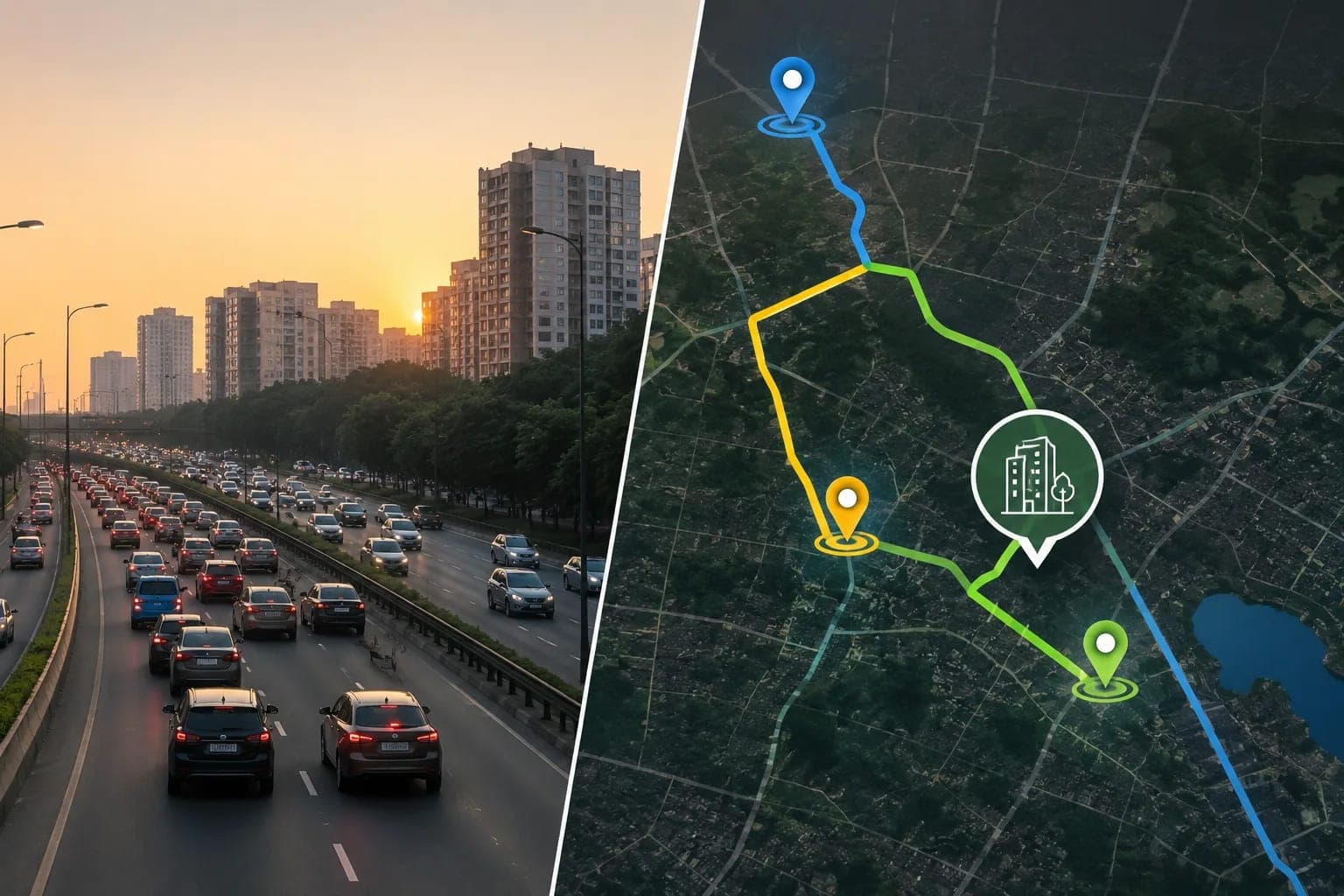
A bypass matters more than it sounds. It moves through-traffic around a city instead of through it, which does two things at once: it unclogs the old centre, and it creates a new corridor of accessible land along its route. In city after city, bypass corridors become the areas that develop next.
Ayodhya Dham Junction railway station has already been redeveloped, adding rail capacity to the road and air improvements.
Maharishi Valmiki International Airport
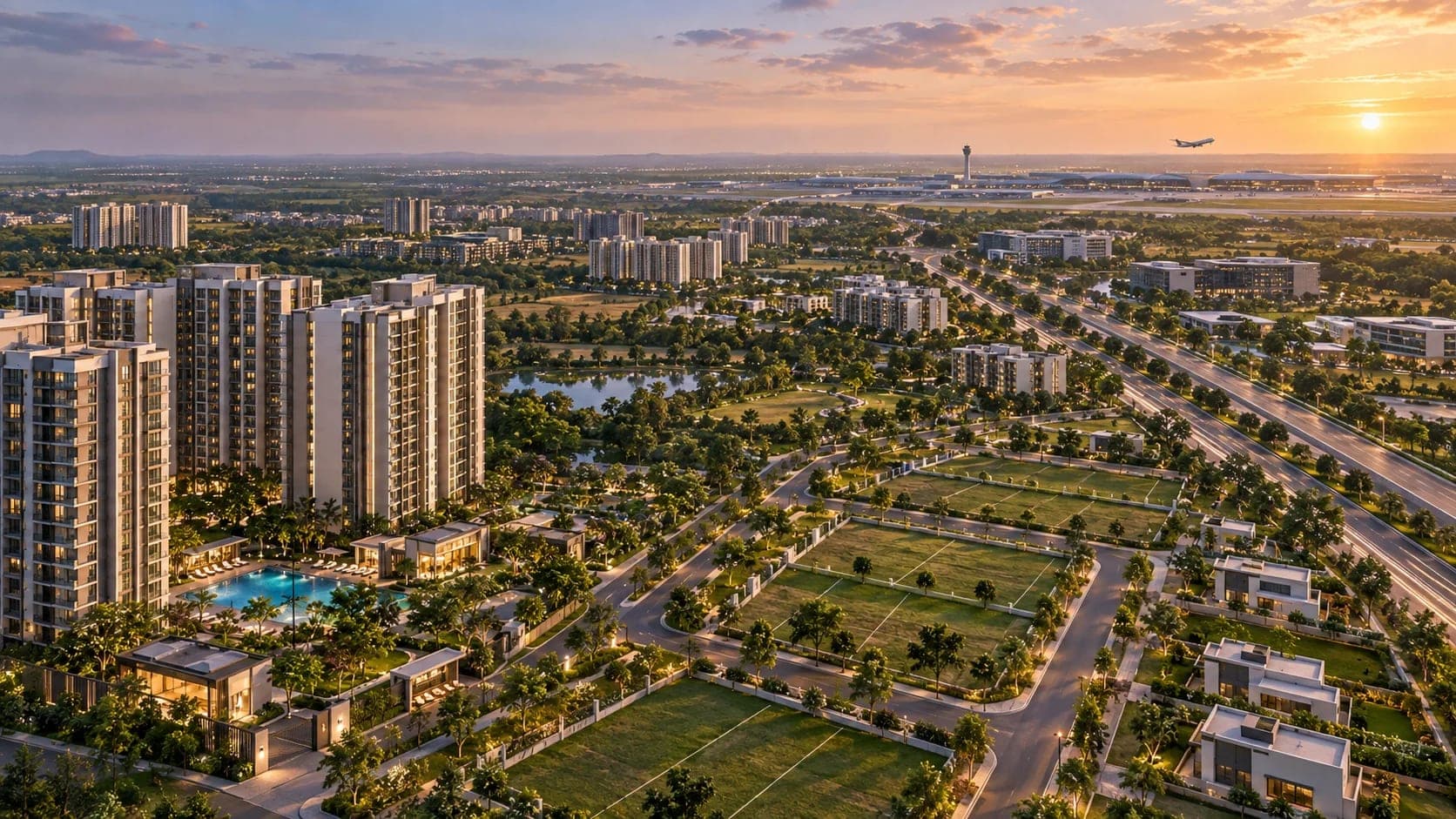
The airport, reported at around ₹3,000 crore, is operational, with phased expansion planned including a longer runway capable of handling international flights.
For property, an airport does something specific: it changes who can realistically buy. A city reachable only by an eight-hour drive draws regional buyers. A city with an international airport draws NRI buyers and national investors. That widening of the buyer pool is usually the most durable effect an airport has on a local property market.
The Sarayu Riverfront, the Kunds and the Green City Plan
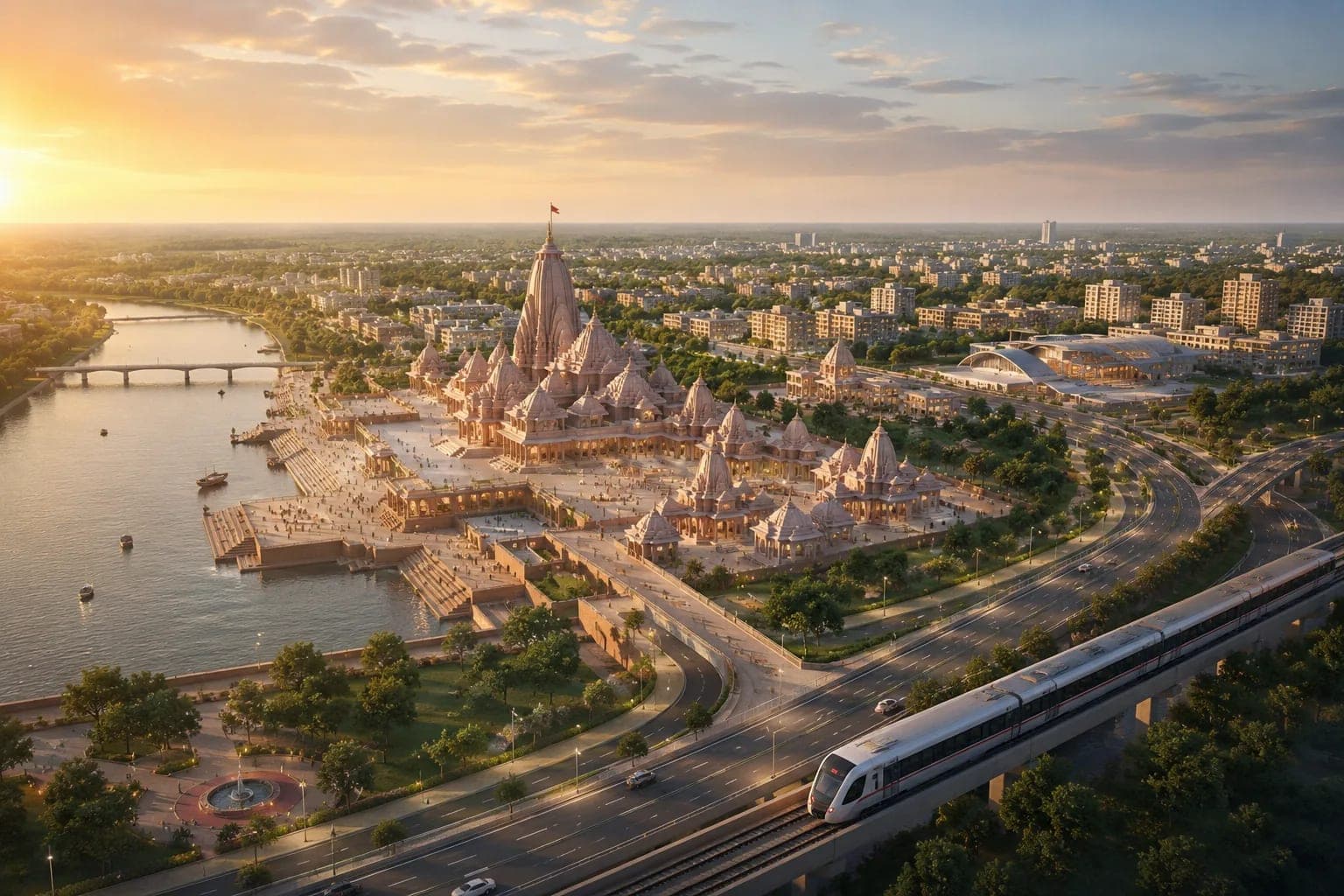
Around ₹2,000 crore has been reported for Sarayu riverfront development, turning the ghats into a destination rather than only a bathing site.
Under Vision 2047, eight kunds — traditional ponds — are being rejuvenated and conserved. The plan also envisages Ayodhya as a green, solar-powered city, including a solar power plant, tree cover, and eco-friendly mobility.
Riverfront and green infrastructure tends to be dismissed as decoration. It is not. Lifestyle infrastructure is what converts a place people visit into a place people want to own a home in — which is the difference between a tourist town and a residential market.
The 18 Zones: Why Land Use Matters More Than Location
This is the part of the Master Plan that buyers should care about most, and it gets almost no coverage.
To ensure balanced development, the Ayodhya Development Area has been divided into 18 zones, with land use allocated on the basis of a projected population of 23.94 lakh.
What that means for you is direct. Every piece of land in Ayodhya now sits inside a zone with a designated purpose. A plot in a residential zone can become a house. A plot marked agricultural or green cannot, unless conversion is formally granted in writing.
So the question to ask about any land in Ayodhya is not just "where is it?" but "which zone is it in, and what does that zone permit?" A cheap plot in the wrong zone is not a bargain. It is a plot you cannot build on.
Ayodhya Vision 2047: What Comes After 2031
Vision 2047 describes Ayodhya as a global spiritual hub, a city of knowledge, a city of festivals and a green solar-powered city, with pilgrim-friendly infrastructure, heritage walks and historical circuits. Around 200 projects sit under this document, alongside new residential townships, a temple museum and expanded hotel capacity.
The practical point for a buyer is about time horizons. A master plan running to 2031 and a vision running to 2047 tell you that state spending here is expected to continue for two decades. That is a long-horizon signal, not a short-term one — and it should shape how long you expect to hold anything you buy.
How to Read a Master Plan Before You Buy
- Find the plot on the zoning map and confirm the zone permits what you intend.
- Check whether the land is agricultural and whether conversion has been granted in writing.
- Identify which committed road or corridor actually serves the plot, and confirm it exists on the ground.
- Distinguish between "announced", "sanctioned" and "under construction" — three very different states.
- Visit and look. If the master plan says a road runs past the site, go and see whether it does.
- Confirm the plot falls within the registered RERA phase of whatever project you are buying into.
Where The Sarayu Ayodhya Sits Against the Master Plan
The Sarayu Ayodhya by House of Abhinandan Lodha sits roughly 15 minutes from the Shri Ram Mandir and roughly 30 minutes from Maharishi Valmiki International Airport, near NH-27 and the Sarayu river.
It is a freehold plotted development registered under UP RERA UPRERAPRJ311468 for Phase 1, with Villa Plots of 1,248 to 1,250 sq ft from ₹1.89 Cr. Status is under construction, with possession yet to be announced.
The relevant point for this article is not the pricing. It is that a RERA-registered, approved layout answers the zoning question in a way informal farmland does not. Whether the project suits you is a separate judgement — but the land-use and approvals question, which the Master Plan makes central, is one you can actually verify here.
What ₹85,000 Crore Does Not Buy
It does not buy certainty about prices. Sanctioned infrastructure improves a city's fundamentals; it does not guarantee what any individual plot will be worth. Anyone quoting you a multiple of future appreciation is making a claim they are not permitted to make.
It does not buy speed. Large infrastructure programmes routinely slip. Vision 2047 is a twenty-year horizon by design.
And it does not buy protection from a bad purchase. A perfect location inside a booming master plan is worthless if the title is unclear or the land cannot be built on.
Common Questions About the Ayodhya Master Plan 2031
How much is being spent on Ayodhya's development?
Around ₹85,000 crore has been reported for redevelopment over roughly a decade, with up to 250 projects worth more than ₹80,000 crore under Master Plan 2031 and Vision 2047, executed by 34 agencies.
How much will Ayodhya's population grow?
Officials cited a rise from about 1.1 million currently to 2.4 million by 2031 and 3.5 million by 2047 during the Chief Minister's October 2025 review.
How do I check the zoning of a plot in Ayodhya?
The Ayodhya Development Area is divided into 18 zones. Check the plot against the Ayodhya Development Authority's zoning map and obtain written confirmation of land use before purchase.
Key Points to Remember
- ₹85,000 crore is the ambition; ₹8,594 crore is approved. As of the October 2025 review, 159 projects worth ₹8,594 crore had been approved within the Ayodhya Development Area itself.
- The population projection is the strongest fact in the plan. From about 1.1 million today to 2.4 million by 2031 — residents create permanent housing demand in a way visitors do not.
- Zoning decides what land can become. The development area is split into 18 zones; a plot's zone matters more than its distance from the temple.
- Connectivity is the durable variable. The bypass, ring road, greenfield expressway and international airport change who can buy here, not just how easily people visit.
- A sanctioned budget is evidence, not a promise. It tells you what the state has committed to build. It says nothing about what any plot will be worth.
The Honest Summary
The Ayodhya Master Plan 2031 is the most credible forward-looking document available on this market, precisely because it is not a forecast — it is a list of things the state has committed money and agencies to building, with a population target attached. That makes it far more useful than any appreciation projection. But a master plan rewards the buyer who reads it properly: checking the zone, confirming land use, verifying which committed road actually reaches the plot, and separating what is sanctioned from what is merely announced. If you want to see how those questions are answered by an approved, RERA-registered development, review The Sarayu Ayodhya by House of Abhinandan Lodha and verify every document independently before you commit.
Ayodhya Master Plan, Ayodhya Infrastructure, Ayodhya Real Estate, The Sarayu Ayodhya, HoABL