Ayodhya Before and After the Ram Mandir: A City Transformation Report (2017–2026)
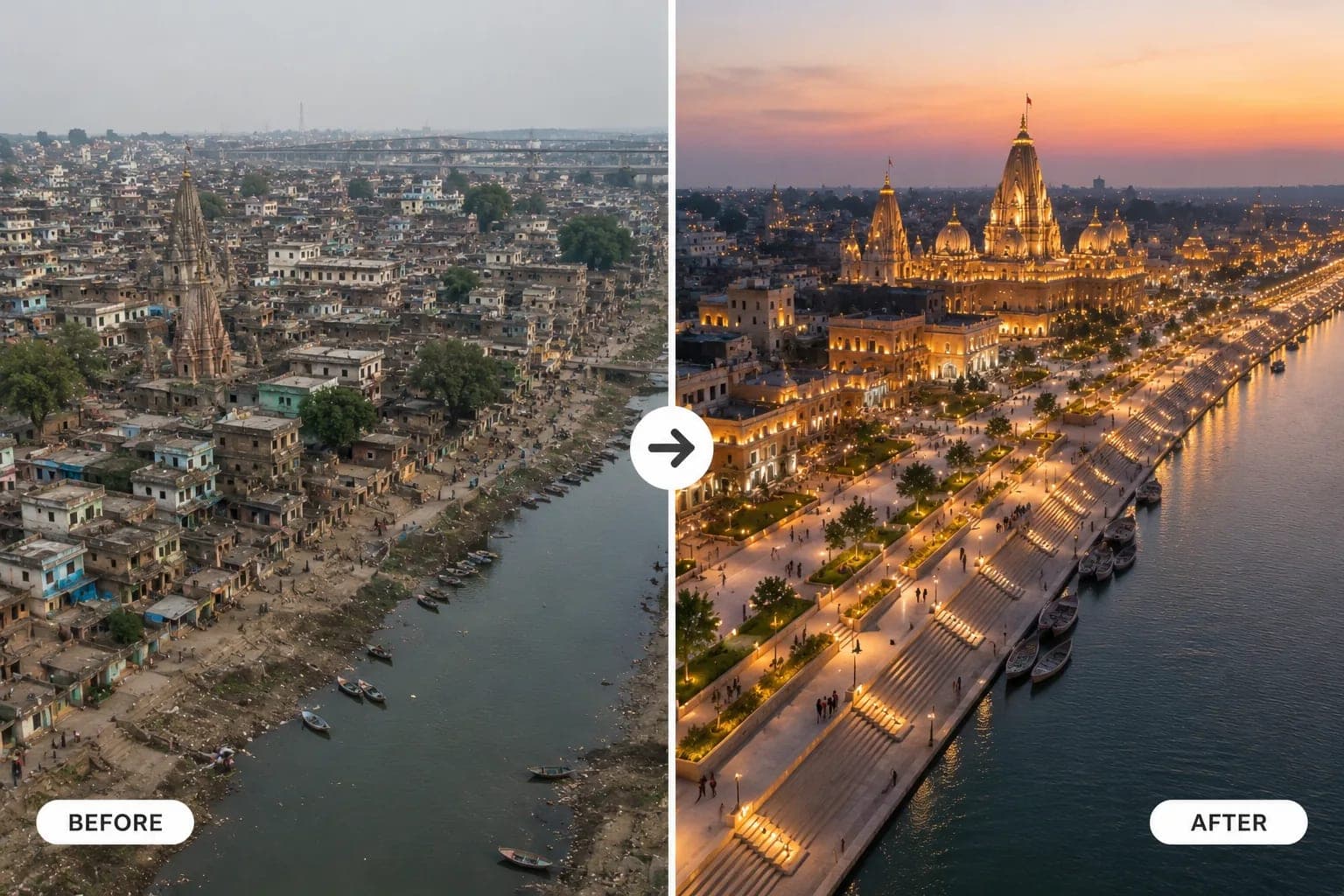
In 2017, Ayodhya was a quiet town on the banks of the Sarayu river. Most people knew its name, but very few visited it. Today it is one of the most watched real estate markets in India. This report explains what Ayodhya looked like before the Ram Mandir and what it looks like now, using only numbers published by government bodies and news agencies. If you are researching plots in Ayodhya, Ayodhya property investment, or a branded plotted development such as The Sarayu Ayodhya by House of Abhinandan Lodha, the honest place to begin is with the city itself, not with the project.
Ayodhya Before the Ram Mandir: A Small Town in 2017
Ayodhya in 2017 was a pilgrimage town, not a destination. According to Uttar Pradesh Tourism figures, the city received about 2.84 lakh visitors in the whole of that year. To put that in simple terms, that is fewer people in twelve months than a single big Indian railway station handles in a week.
The town had narrow roads, small guest houses and dharamshalas, and very little organised hospitality. Land on the outskirts sold for around ₹400 to ₹500 per square foot in 2019, as reported by PTI. There was no airport, no bypass, and no riverfront project. Ayodhya land was mostly farmland, bought and sold quietly between local families.
Three Dates That Changed Ayodhya Forever
Almost everything that happened to Ayodhya real estate can be traced to three days:
- 9 November 2019 — the Supreme Court verdict, which removed the biggest question mark hanging over the city.
- 5 August 2020 — the Bhoomi Pujan, when construction actually began.
- 22 January 2024 — the Pran Pratishtha, when the temple opened to the country.
Think of it like a school announcing a new campus. First there is an announcement, then builders arrive, then the gates open. Each stage brings a different kind of change to the neighbourhood around it. Ayodhya went through all three stages in under five years.
The Footfall Story: From 2.84 Lakh to 29.95 Crore Visitors
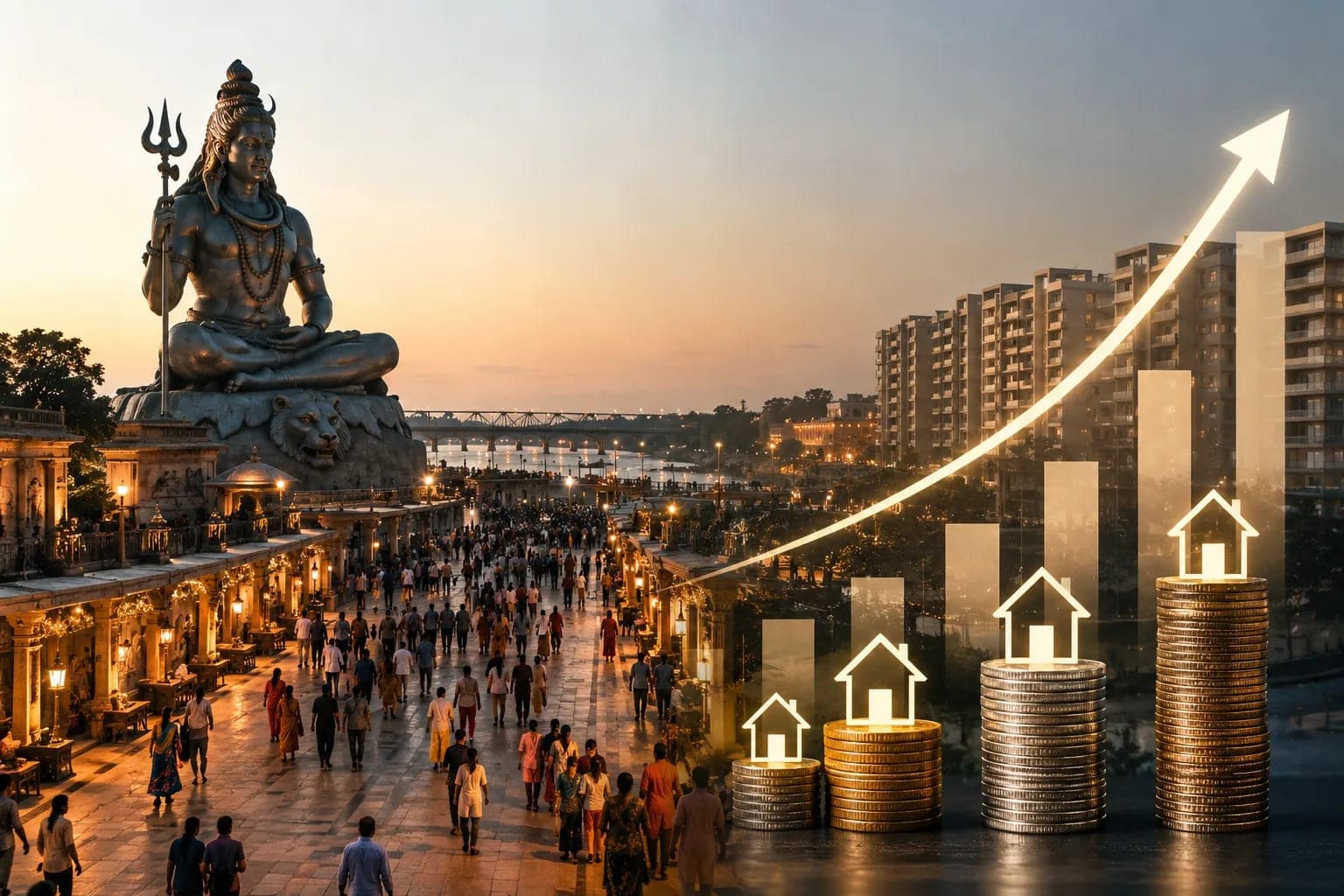
This is the single most important number in the whole story. Uttar Pradesh Tourism recorded about 2.84 lakh annual visitors to Ayodhya in 2017. In 2024, that figure was 16.44 crore. In 2025, it reached 29.95 crore.
That is not a slow increase. That is a step change. The same roads, the same river and the same small town suddenly had to handle a crowd it was never built for. Uttar Pradesh as a whole recorded 64.91 crore domestic tourists in 2024, the highest of any Indian state, and Ayodhya became one of the main reasons why.
When this many people arrive, they need places to stay, eat, park and shop. Every one of those needs sits on a piece of land that somebody has to own. That is how footfall quietly turns into a property market.
The Land Story: What Ayodhya's Circle Rate Revision Really Means
A circle rate is the minimum value the government sets for land in an area. Your stamp duty is calculated on it. It is a floor price, not a ceiling, and it usually follows the market rather than leading it.
In 2025, the Ayodhya administration revised circle rates for the first time in eight years. According to figures from the Sadar tehsil sub-registrar reported by PTI, rates rose between 30 per cent and 200 per cent across the district, and by more than 150 per cent within a ten kilometre radius of the temple. Near the temple itself, rates moved from ₹6,650–6,975 per square metre to ₹26,600–27,900 per square metre.
Market rates moved earlier. PTI reported that outskirt land selling at ₹400–500 per square foot in 2019 was quoted between ₹1,000 and ₹1,500 within a year of the Bhoomi Pujan, with town-centre land at ₹2,000–3,000. Al Jazeera reported agricultural land moving from roughly ₹1.6 crore per acre in 2019 to around ₹6.4 crore per acre by January 2024.
Notice what this is and what it is not. This is a record of what has already happened, written down in a government registry. It is not a promise about what will happen next.
The Infrastructure Story: ₹85,000 Crore for One City
A city cannot absorb crore-scale footfall without being rebuilt. Under Ayodhya Master Plan 2031, the Uttar Pradesh government has sanctioned roughly ₹85,000 crore of infrastructure and urban renewal spending. Reported allocations include:
- Around ₹3,000 crore for Maharishi Valmiki International Airport
- Around ₹12,000 crore of NHAI regional road widening
- ₹3,935 crore for the Bharatmala bypass
- Around ₹2,000 crore for Sarayu riverfront development
A sanctioned budget is not a wish. It is a commitment with a paper trail, and you can go and check how much of it exists on the ground. For anyone looking at land in Ayodhya for sale, connectivity is the part worth studying closely, because roads and airports stay permanent long after a festival crowd goes home.
What Changed for the People Who Live in Ayodhya
The visible change is jobs. Business Standard has reported national and international hotel chains entering a market that previously had almost no organised hospitality. Homestays multiplied. Drivers, guides, shopkeepers, caterers and cleaners found year-round work instead of seasonal work.
Across India's temple towns, organised hotel keys grew from about 2,300 in FY15 to about 7,500 in FY23, according to IBEF. That is a hospitality number on the surface, but underneath it is a land number. Every hotel room stands on a plot that someone bought, financed and got approved.
What Has Not Changed in Ayodhya Yet
An honest report has to include this part. Large sections of the master plan are still under construction. Some approach roads are unfinished. Older parts of the town still get congested on festival days. Organised, clearly titled inventory is still limited compared to the size of the demand.
There is also a genuine risk for buyers. A lot of Ayodhya land is agricultural, and agricultural land cannot be built on unless conversion has been formally granted in writing. This is the single most common trap for outside buyers, and no amount of excitement about the city protects you from it.
Ayodhya Real Estate in 2026: Two Very Different Ways to Buy
Today a buyer in Ayodhya effectively chooses between two categories.
The first is informal land. It is farmland or small parcels sold locally, often cheaper on paper, often with title, conversion or access questions that only appear later. The second is organised supply: a branded plotted development that is freehold, RERA-registered, planned, and sold by a developer who can be held accountable.
This second category is new to Ayodhya. It arrived only after the market grew large enough to interest serious developers. That is the pattern seen in Varanasi and Ujjain too, where informal land deals dominated for two or three years before branded land and titled inventory arrived.
The Sarayu Ayodhya by HoABL: An Example of Organised Supply
The Sarayu Ayodhya by House of Abhinandan Lodha is one example of what that organised category looks like. It is a freehold plotted development registered under UP RERA UPRERAPRJ311468 (Phase 1), sitting roughly 15 minutes from the Shri Ram Mandir and roughly 20 minutes from Maharishi Valmiki International Airport, with over 40 amenities and The Leela as hospitality partner.
Configurations are stated plainly. Villa Plot of 1,248–1,250 sq ft from ₹1.89 Cr, Royal Plot of 1,500 sq ft on request, and Premium Villa Plot of 1,507 sq ft at ₹2.16 Cr. The project status is under construction and possession is yet to be announced. Anyone comparing HOABL Ayodhya price points against local land rates should compare like with like: a titled, approved, planned plot is a different product from raw agricultural land.
Questions Buyers Ask About Ayodhya Property Investment
Is Ayodhya still worth looking at in 2026?
The recorded changes are real and documented. Whether it suits you depends on your holding horizon and your risk appetite. Ayodhya landed investment in 2026 is not a short trade, and nobody can honestly tell you what prices will do next.
Can an NRI buy land in Ayodhya?
An NRI can buy residential and plotted property in India but cannot buy agricultural land. This is exactly why the freehold and conversion question matters so much.
Should I buy as close to the temple as possible?
Not automatically. Ujjain showed that land next to a temple is often the most regulated, most congested and most legally sensitive. Connectivity usually matters more than raw distance.
What This Report Means If You Are Buying in Ayodhya
Ayodhya between 2017 and 2026 is one of the clearest before-and-after records in Indian real estate, because almost every number in it comes from a government department or a news wire rather than from a brochure. The city grew first, the state spent second, and organised supply arrived third. A buyer today is arriving at that third stage, which is the first stage where clean paperwork and upside exist together. If you want to see what that looks like as an actual product, review the configurations, freehold title and RERA details of The Sarayu Ayodhya villa plots on Perfect Neighbourhood, and verify every document yourself before you commit.
Ayodhya, Ram Mandir, Ayodhya Real Estate, The Sarayu Ayodhya, HoABL