Godrej Whitefield Villas: Ten-Year Capital Appreciation Scenarios
Nobody can tell you what a property will be worth in ten years. Anyone who claims otherwise is selling something.
What can be done honestly is different and more useful: take the actual purchase cost, apply a range of growth assumptions, subtract the taxes and costs that genuinely apply, and show what remains. The arithmetic is not encouraging or discouraging by itself — it simply gives you a realistic frame instead of a hopeful one.
That frame is worth building before you commit. If you are evaluating this in East Bangalore, the Godrej Whitefield villas project page carries the current pricing position.
First, get the cost basis right
Almost every appreciation calculation you will see starts from the wrong number.
The base price starts at Rs 5.40 Cr onwards. But your actual cost basis includes:
- GST at 5 percent on under-construction residential property, without input tax credit — approximately Rs 27 lakh.
- Karnataka stamp duty, cess, surcharge and registration at roughly 7.5 to 7.6 percent for property above Rs 45 lakh — approximately Rs 41 lakh.
So your true cost basis is closer to Rs 6.08 Cr, before developer charges for car parking, clubhouse membership, infrastructure and corpus fund.
That difference of Rs 68 lakh is not a detail. It is the first thing your appreciation has to cover before you are even at break-even.
What the historical record suggests
Published market data offers some grounding, though it should be treated cautiously.
ANAROCK's research put Bengaluru's average residential price at around Rs 8,870 per sq ft in Q3 2025, with roughly 10 percent annual growth. Marketing and listing sources for Whitefield specifically report rates moving from around Rs 4,800 per sq ft in 2019 to roughly Rs 10,500 to 11,500 per sq ft by early 2026, with premium projects quoting nearer Rs 14,500 per sq ft.
Those Whitefield figures come from marketing sites rather than independent research, so treat them as directional rather than precise.
The counterweight is current and real. ANAROCK reported Bengaluru's unsold housing stock rising to around 64,863 units at the end of 2025, up roughly 23 percent year on year. Knight Frank found the inventory build concentrated in the Rs 1 crore-plus segment, up around 19 percent — which is exactly the band this product sits in. And Q1 2026 saw new launches outpace sales across India's top seven cities for the first time since 2021.
Strong historical growth, meaningful current headwinds. Both are true.
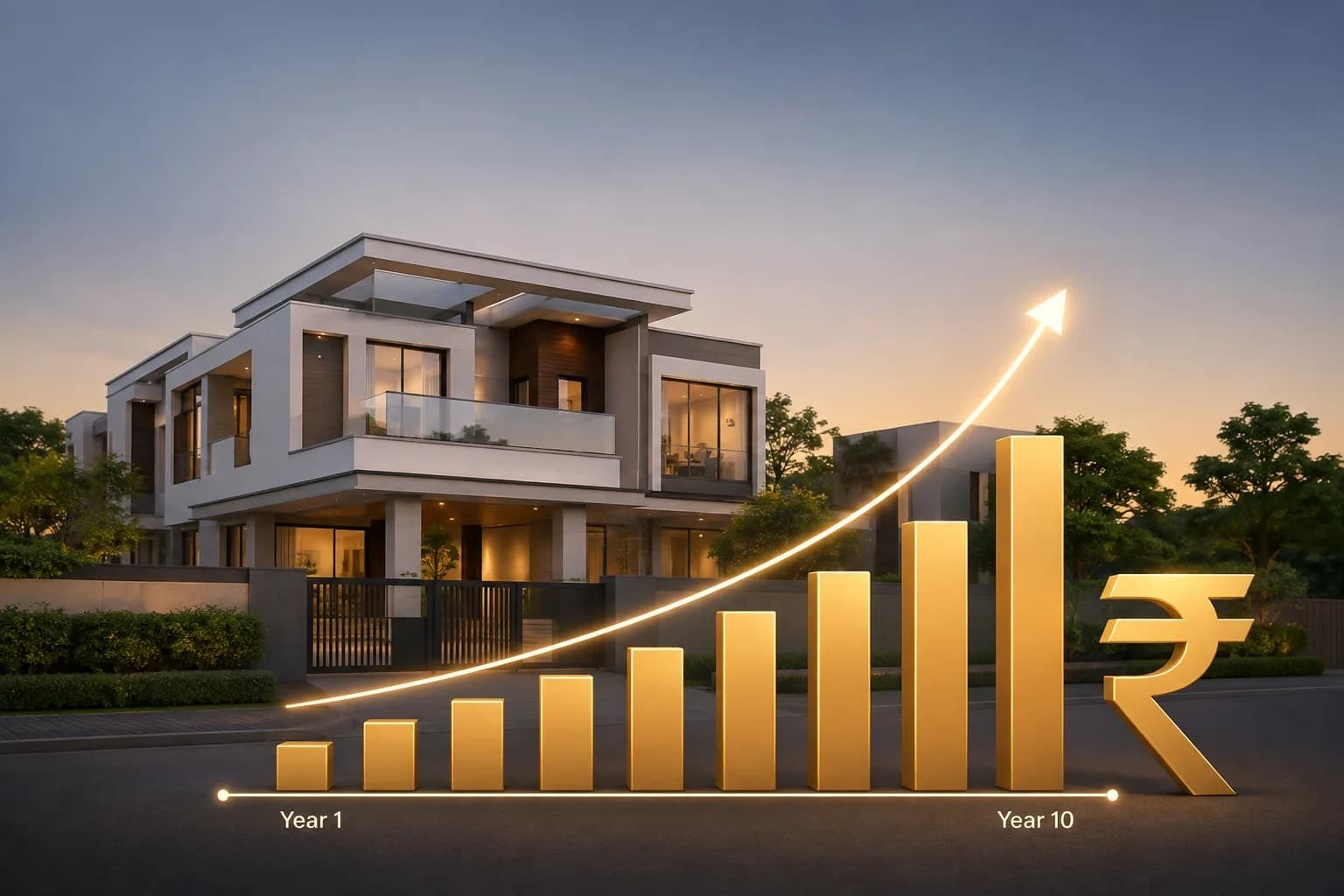
Three scenarios, worked properly
The following are illustrative arithmetic, not forecasts. They assume purchase at Rs 5.40 Cr, a ten-year hold from purchase, exit costs of roughly 1.5 percent brokerage, and long-term capital gains at 12.5 percent without indexation for acquisitions after July 2024.
Scenario A — Conservative: 5 percent annual growth
Sale value after ten years: approximately Rs 8.80 Cr.
Less brokerage of roughly Rs 13 lakh and capital gains tax of roughly Rs 32 lakh, net proceeds land near Rs 8.34 Cr.
Against a Rs 6.08 Cr basis, that is a gain of about Rs 2.26 Cr — an effective net return of roughly 3.2 percent a year.
Scenario B — Moderate: 8 percent annual growth
Sale value after ten years: approximately Rs 11.66 Cr.
Less brokerage of roughly Rs 17 lakh and capital gains tax of roughly Rs 68 lakh, net proceeds land near Rs 10.81 Cr.
Effective net return: roughly 5.9 percent a year.
Scenario C — Strong: 11 percent annual growth
Sale value after ten years: approximately Rs 15.33 Cr.
Less brokerage of roughly Rs 23 lakh and capital gains tax of roughly Rs 1.13 Cr, net proceeds land near Rs 13.97 Cr.
Effective net return: roughly 8.7 percent a year.
The finding worth sitting with
Look at Scenario A carefully.
Five percent headline growth becomes roughly 3.2 percent net. Not because the growth assumption was wrong, but because acquisition costs of Rs 68 lakh and exit costs of Rs 45 lakh have to be absorbed first.
Even the strong scenario converts 11 percent headline growth into roughly 8.7 percent net.
The gap between headline appreciation and what you keep is consistently two to three percentage points. Any calculation that ignores it overstates your outcome materially — and most calculations do.
Two adjustments these scenarios do not include
The construction period. The project is at pre-launch with possession to be announced. Between first payment and possession, the asset produces nothing while any loan accrues interest. If you are also paying rent, you carry both. A ten-year hold from purchase includes several years where the asset cannot be occupied or let — which the arithmetic above does not penalise but reality does.
Holding costs. Property tax on a large independent home, maintenance charges in a low-density community where around 242 households share amenities across roughly 20 acres, terrace waterproofing on a recurring cycle, exterior repainting, garden upkeep. Across ten years, these accumulate substantially. Rental income, if you let the property, offsets some of it — but villas at this level produce modest yields relative to capital deployed, so treat rent as a partial offset rather than a return.
What actually supports the appreciation case
The scenarios are arithmetic. The reasoning behind which one you find plausible is separate.
Land share is the durable component. Each home sits on a 3,715 sq ft land parcel. Buildings depreciate — structures age, finishes date, systems need replacing. Land does not. Over a decade, the land component is what carries value, and a villa owner holds materially more of it than any apartment owner in the same corridor.
Format scarcity is real. A 20-acre parcel yielding around 242 homes is a fundamentally different economic proposition from the same parcel yielding two thousand apartments. Land fragments through inheritance and small sales and never reconsolidates, which means once a corridor's land values cross a threshold, this format stops being buildable there permanently.
Corridor fundamentals are established rather than promised. ITPL, the EPIP Zone and Prestige Tech Park anchor employment. Schools, hospitals and retail are built out. NH-648 handles connectivity. Established infrastructure supports value better than announced infrastructure.
What could go the other way
Premium supply outrunning premium demand, which is currently happening. Liquidity constraints at this ticket size — fewer buyers can write a five-crore cheque, and sales happen on the market's timeline rather than yours. Construction delay extending the non-productive period. And RMP 2041, when eventually notified, imposing new zoning or buffer restrictions on land developed under an expired framework.
How to use this
Do not treat any scenario as a prediction. Use the method: take your actual all-in cost, apply a growth range you find defensible, subtract exit costs and tax, and see what remains.
Then ask whether that net return justifies the capital and the illiquidity — and whether you would still want to own the home if the answer were no.
The project's RERA status is currently listed as to be verified. Under Karnataka RERA, no booking amount should change hands until registration is complete and verified independently on the state portal.
The same assessment applies at the Godrej Row Houses Soukya Road project page.
All scenarios are illustrative arithmetic based on stated assumptions, not forecasts or advice. Market data cited is from published third-party sources and is point-in-time. Tax rates are current at the time of writing and subject to change. Consult your own chartered accountant before relying on any figure here.