A-Khata vs B-Khata vs E-Khata in Bangalore: What Each One Actually Means for Your Loan, Your Resale and Your Risk
Ask ten homebuyers in Bengaluru what a Khata is, and you will get ten different answers. Some think it is proof of ownership. Some think A-Khata is a "government stamp of approval." Some have been told that B-Khata is "the same thing, just cheaper." All three assumptions can cost you lakhs — in a rejected home loan, a stuck resale, or a property that never gets regularised. With North Bengaluru corridors like Devanahalli seeing heavy end-user and investor interest around projects such as Bhartiya City KIADB in Devanahalli, understanding Khata classification has become a basic buyer skill, not a legal technicality. This guide breaks down what A-Khata, B-Khata and the new E-Khata actually mean for financing, exit value and long-term risk.
First, What a Khata Actually Is (And What It Is Not)
A Khata is a municipal revenue record. It records who is liable to pay property tax on a given property, along with details like built-up area, location, and tax assessment. It is issued by the local civic body — BBMP within Bengaluru city limits, or the relevant municipal council, town panchayat or gram panchayat outside them.
Here is the part most buyers miss: a Khata is not a title document. It does not prove ownership. Ownership is established by your sale deed, the mother deed, the chain of title, and the encumbrance certificate. The Khata simply tells the civic body who to bill. However, because the civic body only issues a clean Khata to properties that meet approval norms, the Khata type has become the market's shorthand for "is this property legally sound?"
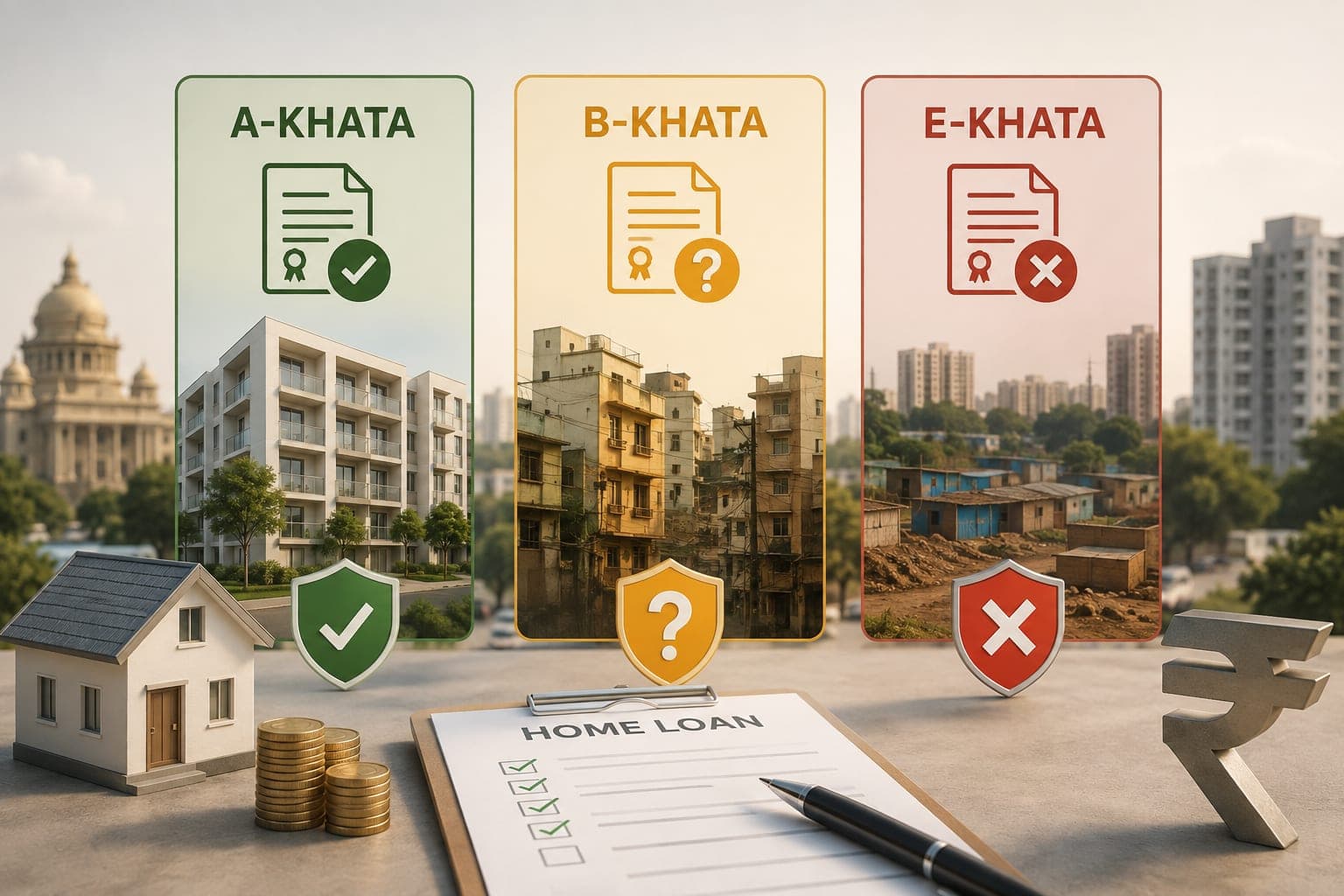
A-Khata: The Clean, Fully Compliant Record
An A-Khata is issued to properties that are fully compliant with municipal norms. In practice this means the land use is legally converted from agricultural to residential, the layout or building plan is approved by the competent authority, the property falls within the sanctioned civic limits, and property tax has been assessed and is being paid.
What A-Khata gives you:
- Home loans from virtually every bank and housing finance company, usually at standard rates
- Straightforward building plan sanction and occupancy certificate processing
- Legal water, sewerage and electricity connections without workarounds
- The widest resale buyer pool, because your buyer can also get financed
- Cleaner trade licence and commercial permission approvals, if ever needed
Every apartment or plotted development sold by a credible, RERA-compliant developer should be on an approved, taxable and transferable record. This is the baseline you should expect — not a bonus feature.
B-Khata: The Compromise That Is Now Being Phased Out
The B-Khata originated from the "B register," a separate list maintained for properties that were within civic jurisdiction and were paying tax, but did not meet full approval norms. Typical B-Khata properties include revenue sites on unconverted agricultural land, plots in unapproved or partially approved layouts, and constructions that deviated from sanctioned plans.
Why B-Khata properties look attractive: they are cheaper, sometimes 20–35% below comparable A-Khata rates in the same micro-market. That discount is not generosity. It is the market pricing in risk.
What B-Khata actually costs you:
- Financing: most mainstream banks decline B-Khata properties. You are pushed toward NBFCs and cooperative lenders at higher interest rates, lower loan-to-value ratios, and shorter tenures — or you fund it entirely from your own pocket.
- Resale: your future buyer faces the same lending problem, which shrinks your exit pool to cash buyers and slows down transactions considerably.
- Approvals: building plan sanction and occupancy certificates are difficult or unavailable, which affects everything downstream.
- Regularisation uncertainty: amnesty and regularisation schemes have been announced, contested and stalled repeatedly over the years. Buying on the assumption that "it will convert to A-Khata soon" is speculation, not planning.
Importantly, the Karnataka government has moved to stop the creation of new B-Khata records, with the intention that the category will not continue to grow. Existing B-Khata holders are being routed toward a regularisation and digitisation path. Because rules in this area change with government notifications, always verify the current position with a property lawyer before you transact.
E-Khata: The Digital Layer That Changed Everything
E-Khata is not a fourth category of property. It is the digitisation of the Khata system. Instead of a paper extract issued over the counter, the record is generated, verified and stored digitally, linked to the property's geo-coordinates, ownership details, tax assessment and unique property identification number.
The system typically works in two stages:
Draft E-Khata
An auto-generated preliminary record based on existing municipal data. It may contain errors in area, ownership name spelling, or property details, and it is not the final legal record. Its job is to let owners verify and correct their data.
Final E-Khata
Issued after the owner submits supporting documents — sale deed, encumbrance certificate, tax paid receipts, Aadhaar-linked identity — and the civic body verifies them. This is the operative record for transactions.
Why E-Khata matters practically: property registration in digitised jurisdictions is increasingly linked to a valid E-Khata. Sub-registrar offices reference it. Banks reference it during legal due diligence. It reduces the scope for duplicate Khatas, fabricated extracts and ownership disputes, because the record is centralised and verifiable online.
E-Khata records also carry the underlying A or B classification forward. Getting an E-Khata does not automatically upgrade a B-Khata property to A-Khata status. It simply makes the existing status transparent and harder to misrepresent — which is precisely why some sellers of non-compliant property are uncomfortable with it.
Side-by-Side: How the Three Compare
By nature, A-Khata is a fully compliant municipal record and B-Khata is a non-compliant or only partially compliant one. E-Khata is not a third status at all — it is the digital format in which either record is held.
On home loans, A-Khata is widely financed by mainstream banks. B-Khata is restricted, pushing buyers toward NBFCs at higher cost. E-Khata financing depends entirely on the underlying A or B status it carries.
On building plan sanction, A-Khata properties can obtain it; B-Khata properties generally cannot. Again, E-Khata simply reflects the underlying status.
On resale liquidity, A-Khata is high because your buyer can also get financed. B-Khata is low and largely limited to cash buyers. E-Khata improves transparency and buyer confidence on either.
On registration, A-Khata is smooth and B-Khata is complicated. A valid E-Khata is increasingly required outright in digitised jurisdictions.
What This Means Outside BBMP Limits
Much of North Bengaluru's growth — Devanahalli, the KIADB Aerospace Park belt, and the airport corridor — sits outside core BBMP jurisdiction. Here the records may come from a municipal council, town panchayat or gram panchayat, and you will encounter terms like e-Swathu Form 9 and Form 11 for panchayat-limit properties.
The principle stays the same: check whether the land is legally converted, whether the layout or project is approved by the competent planning authority, and whether the developer holds a valid RERA registration. Properties developed on government-allotted industrial or institutional land parcels follow their own allotment and approval framework, which a lawyer should read alongside the title chain. A project's brand credibility helps, but it is never a substitute for document verification.
Your Practical Due-Diligence Checklist
- Ask for the Khata extract and Khata certificate — and read the classification, not just the header
- Check land conversion order (DC conversion) for the parent land
- Verify layout or building plan approval from the competent authority
- Pull a 30-year encumbrance certificate and match the title chain to the mother deed
- Confirm the RERA registration number on the official state portal
- Check the E-Khata status online and confirm the details match the sale deed
- Collect up-to-date property tax paid receipts
- Get a title opinion from an independent property advocate — not the seller's lawyer
The Bottom Line
A-Khata is the standard you should buy at. B-Khata is a discount that transfers risk from the seller to you, and that risk shows up exactly when you need liquidity most — at loan sanction and at resale. E-Khata is the transparency layer that makes both statuses visible and verifiable, and it is fast becoming non-negotiable for registration and financing.
If you are evaluating an under-construction option in the Devanahalli and KIADB Aerospace Park corridor, do the paperwork check before the price negotiation, not after. To review current inventory, configurations, pricing and approval details in this micro-market, explore Bhartiya City KIADB, Devanahalli and speak to a RERA-registered advisor before you commit.
Disclaimer: This article is for general information only and does not constitute legal advice. Khata rules, regularisation schemes and digitisation norms are governed by state notifications that change periodically. Verify the current position with a qualified property lawyer before transacting.
A Khata vs B Khata Bangalore, E Khata Bangalore, Bhartiya City KIADB Devanahalli, Home Loan on B Khata Property, Property Documents Checklist Bengaluru