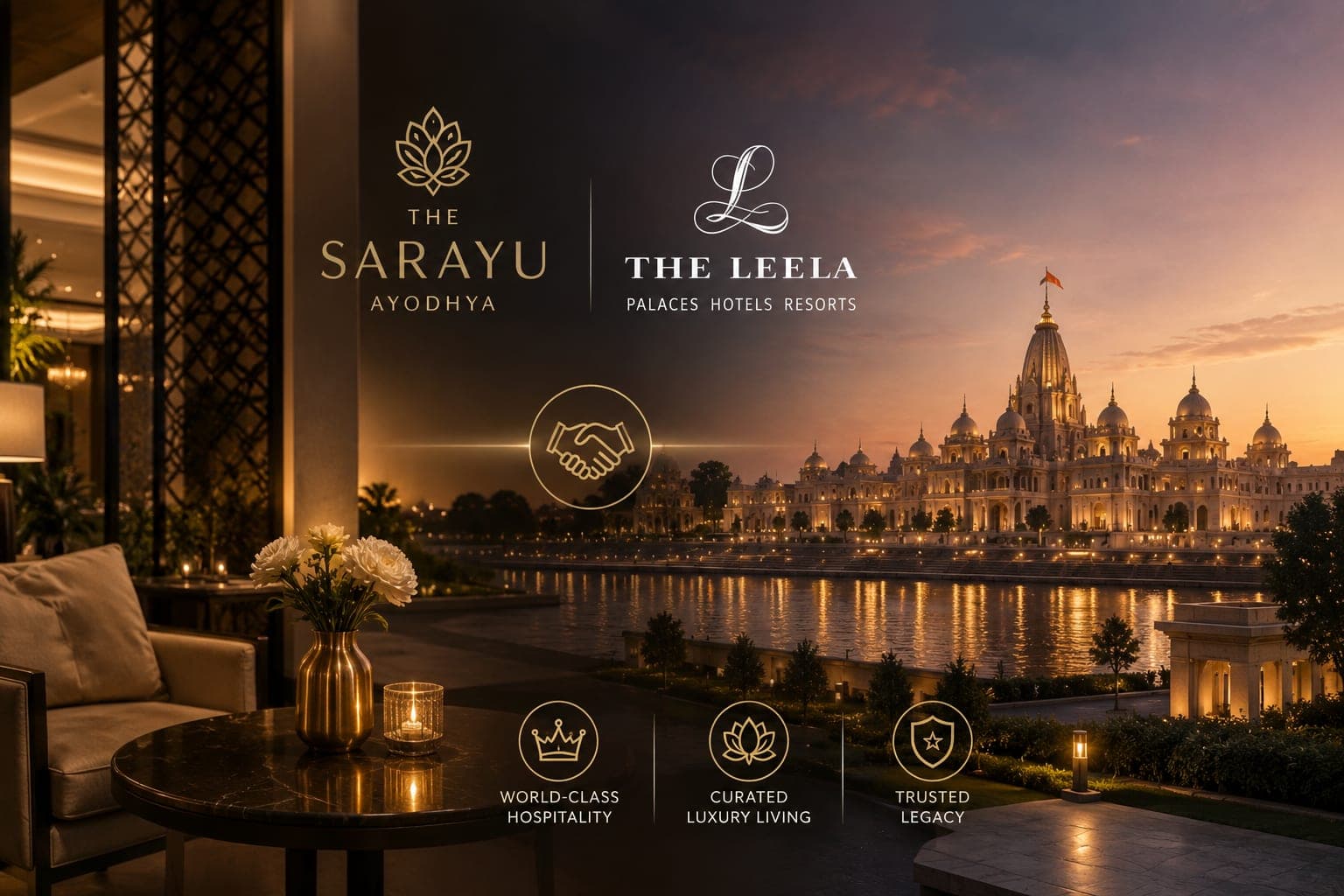
When a plotted development announces a partnership with a luxury hotel brand, the natural reaction is scepticism — is this substance or is it a logo on a brochure? The collaboration behind The Sarayu Ayodhya by House of Abhinandan Lodha and The Leela deserves a closer look, because the logic behind it says a great deal about how the developer reads the Ayodhya market and what buyers are actually being sold.
The Core Problem the Partnership Solves
Plotted developments have a structural weakness. You buy land, you build a home, and then for several years you live in a half-populated layout where the clubhouse is underused, the landscaping is thin and there is no service infrastructure to speak of. In a primary-residence market this resolves itself as occupancy fills. In a second-home market — which is precisely what Ayodhya is for most Sarayu buyers — it may never resolve, because occupancy is intermittent by design.
A second home that sits empty for ten months of the year needs somebody to look after it, and it needs an environment that feels alive when the owner arrives. That is a hospitality problem, not a real estate problem. Bringing in a hospitality operator is the structurally correct answer.
Why The Leela Specifically
The Leela occupies a particular position in Indian luxury hospitality — Indian-owned, palace-hotel heritage, and a service philosophy built around Indian cultural codes rather than an imported template. That matters enormously in Ayodhya.
A buyer purchasing near the Sarayu River, fifteen minutes from Shri Ram Mandir, is making a decision with a spiritual dimension. A hospitality partner whose brand vocabulary already speaks in the register of Indian tradition, ritual and hospitality-as-dharma is a far better cultural fit than a global chain optimised for business travellers. The pairing reads as coherent rather than opportunistic.
What the Collaboration Brings to the Ground
Hospitality-Grade Common Areas
The grand clubhouse at the heart of the project is conceived to hotel standards rather than builder-club standards. The practical differences are in the details buyers notice only after moving in: finish quality that survives a 21 decade, service staffing ratios, operating hours that are actually maintained, and consistent housekeeping of shared spaces.
A Service Layer for Absentee Owners
This is the single most valuable component for the NRI and out-of-state buyer segment. Hospitality-led estate management typically extends to property upkeep during vacancy, arrival preparation, guest coordination and a single accountable point of contact — the difference between a second home that is a pleasure and one that becomes an administrative burden managed over WhatsApp from another time zone.
Curated Experiences and Programming
The amphitheatre and floating stage within the project become genuinely useful when there is an operator capable of programming them. Cultural evenings, festival celebrations, wellness sessions in the wellness zone, and community events around Deepotsav are the kind of activation that turns amenity infrastructure from a photograph into a lived experience.
Wellness and Leisure Standards
Walking trails, jogging tracks, landscaped gardens and the wellness zone all benefit from operator discipline. Landscaping in particular is where most plotted projects decline fastest, because maintenance budgets get cut once handover is complete.
The Effect on Asset Value
There are three mechanisms by which a hospitality association affects the value of Sarayu plots Ayodhya.
Brand-driven demand. A recognised luxury hospitality name widens the buyer pool, particularly among NRIs and high-net-worth individuals who use brand as a proxy for quality when they cannot inspect the site frequently. A wider buyer pool supports both primary absorption and eventual resale liquidity.
Maintained environment. Property values in gated communities track the condition of common areas closely. A layout where the clubhouse works, the landscaping is healthy and security is visible commands a resale premium over an identical layout that has been allowed to decay. Hospitality-led operations are a hedge against that decay.
Differentiation. Ayodhya's land market has expanded quickly, and much of the new supply is undifferentiated. A project with an operator association occupies a category of its own, which insulates it somewhat from price competition in the broader market.
Reading the Partnership Honestly
Buyers should be precise about what they are evaluating. A hospitality collaboration in a plotted development is not the same as buying a branded residence where the operator manages your individual unit. Here, the operator association principally shapes the common infrastructure, the service environment and the overall positioning. Your plot remains your plot, and what you build on it remains your responsibility.
Practical questions worth asking before booking include the scope and duration of the operator arrangement, which specific facilities fall within it, what the associated maintenance and membership costs are, whether services are bundled or charged on usage, and what happens to the arrangement at the end of its initial term. None of these are objections — they are simply the questions a diligent buyer asks about any long-dated service commitment.
Why It Fits Ayodhya's Buyer Profile
Consider who is actually buying in this market. A Mumbai-based business family wanting a home near the temple for annual visits. An NRI in Dubai or New Jersey with a strong emotional connection to Ayodhya and no practical ability to manage an Indian property remotely. A high-net-worth individual assembling a portfolio of spiritually significant assets. A retiree planning a later-life base in a pilgrimage city.
Every one of those profiles shares a common constraint: intermittent presence. Every one of them is willing to pay for the problem of intermittent presence to be solved. That is exactly what a hospitality partnership is designed to do, and it explains why the HOABL Ayodhya price sits above conventional plotted inventory in the same catchment.
The Wider Positioning
Seen in context, the collaboration is one component of a coherent 7-star positioning that also includes over forty curated amenities, wide internal roads and landscaped boulevards, gated security with CCTV surveillance and 24x7 manned protection, and a location within fifteen minutes of Shri Ram Mandir, twenty minutes of Ayodhya Dham Railway Station and thirty minutes of Maharshi Valmiki International Airport. The project is registered under UP RERA as UPRERAPRJ311468 for Phase 1.
The hospitality layer is what converts that collection of features into a consistent experience. Amenities without operations are assets that depreciate. Amenities with operations are assets that hold value.
The Takeaway
The Leela collaboration is best understood not as a marketing embellishment but as the operating system for a second-home community in a city where most owners will be absent most of the time. For buyers evaluating Ayodhya plots HOABL inventory against alternatives, it is the clearest structural differentiator on the table — and the one most likely to still matter in year ten.
To review the full amenity list, the current cost sheet and the specifics of what the hospitality association covers, see the complete project profile for Sarayu Ayodhya or speak with the Perfect Neighbourhood advisory team on +91 93796 27377.
Frequently Asked Questions
Does The Leela partnership mean my home will be hotel-managed?
No. The collaboration principally shapes the common infrastructure, the service environment and the overall positioning of the development. Your plot remains your plot, and what you build on it remains your responsibility. This is different from a branded residence, where an operator manages the individual unit.
Will the hospitality partnership increase my maintenance costs?
Hospitality-grade operations do carry a cost, typically reflected in a one-time amenity contribution and a recurring maintenance charge. Ask for both figures in writing, along with the scope of services covered and the duration of the arrangement, before booking.
22How does the partnership help NRI buyers specifically?
It addresses the core problem of absentee ownership. Estate management, upkeep during vacancy, arrival preparation and a single accountable point of contact are what turn a remote second home from an administrative burden into an asset you can actually enjoy. For buyers visiting a few times a year from overseas, this is often the single most valuable component of the package.