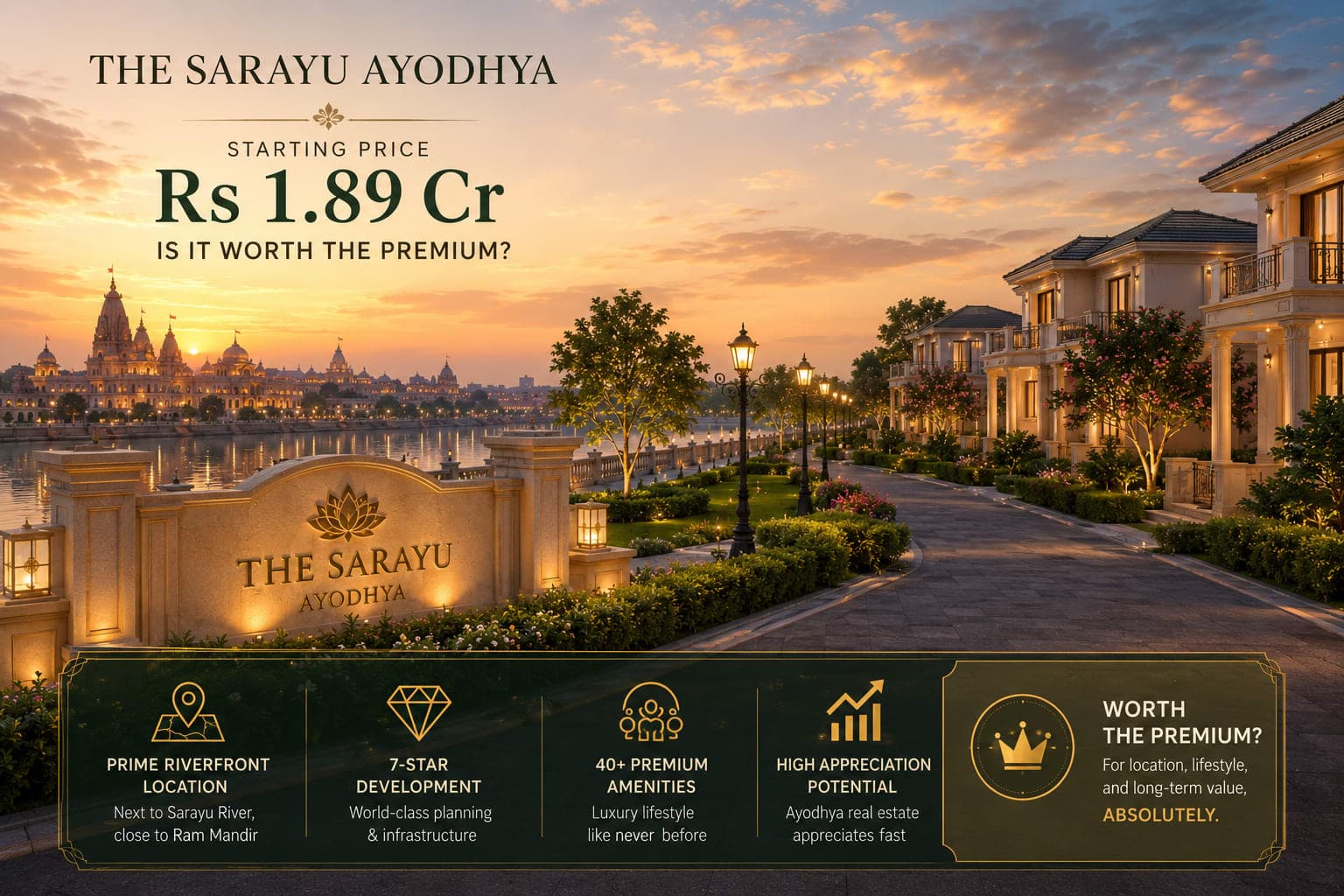
Rs 1.89 Crore is a serious number for a plot in a tier-2 city, and it invites a fair question: is the premium justified, or are buyers paying for brand? This is a deliberately sceptical examination of the entry price at The Sarayu Ayodhya by House of Abhinandan Lodha — what the money buys, what it does not, and the conditions under which it makes sense.
What Rs 1.89 Cr Actually Buys
| Configuration | Villa Plot |
|---|---|
| Plot Area | 1,248 – 1,250 sq.ft. |
| Indicative Price | Rs 1.89 Cr – Rs 1.90 Cr* |
| Ownership | Freehold plotted land within a gated development |
| Included | Access to 40+ amenities, gated security, developed infrastructure |
| RERA | UPRERAPRJ311468 (Phase 1) |
*Pricing and specifications are tentative and subject to revision based on final approvals. The figure is the base land consideration and excludes preferential location charges, infrastructure and amenity contributions, stamp duty, registration and maintenance corpus.
That last line is the first honest observation: the all-in cost is materially higher than the headline. Any buyer comparing the Sarayu Ayodhya price against alternatives must compare all-in against all-in, not headline against headline.
Deconstructing the Premium
The premium over conventional plotted inventory in Ayodhya is attributable to five identifiable components. Each is worth assessing separately, because a buyer may value them very differently.
1. Location Within the Temple Catchment
Approximately fifteen minutes from Shri Ram Mandir, near the Sarayu River, with NH-27 access, twenty minutes to Ayodhya Dham Railway Station and thirty minutes to Maharshi Valmiki International Airport. This component is not brand — it is scarcity, and it is the least questionable part of the premium. Land in this band is finite and cannot be manufactured.
2. Common Infrastructure
Wide internal roads, storm-water drainage, water and sewerage networks, electrical provisioning, street lighting and landscaped boulevards. In a plotted development there is no built-up area to amortise this cost against, so it necessarily sits inside the land rate. A cheaper plot elsewhere usually means this infrastructure is thinner, later, or the buyer's problem.
3. The Amenity Programme
Grand clubhouse, wellness zone, amphitheatre and floating stage, landscaped gardens, walking trails, jogging track, kids play area, open green areas and community spaces. This is real capital deployed, and it is the component buyers should assess most carefully against their own intended use. A pure land-banker who will never set foot in the clubhouse is paying for something they will not consume.
4. The Hospitality Layer
The collaboration with The Leela introduces operating standards, estate management for absentee owners and programmed community life. For a second-home buyer visiting three times a year from Dubai, this is arguably the highest-value component in the entire package. For a resident who intends to live there full time, it is worth considerably less.
5. Legal and Brand Assurance
RERA registration under UPRERAPRJ311468, a documented layout, escrow-disciplined collections and an established developer. In a market where a significant volume of land trades without registration, this is not a soft benefit — it is risk reduction with a quantifiable value.
The Case Against Paying the Premium
A fair analysis has to make the opposing argument properly.
Cheaper land exists in Ayodhya. Buyers willing to purchase unorganised parcels, accept a less convenient location, forgo amenities and handle infrastructure, security and legal verification themselves can acquire land at a meaningfully lower rate per square foot. For a pure land-banking strategy with a ten-year horizon and no intention to build or visit, that route can produce a higher percentage return.
Second, part of any premium in a launch-phase branded project is paying forward for value that has not yet been delivered. Possession is to be announced. The clubhouse, the amphitheatre and the landscaping exist as commitments rather than as completed assets, and the buyer is funding them in advance.
Third, brand premiums compress in soft markets. When supply increases — as it inevitably will in a market appreciating this quickly — differentiated product holds better than commodity product, but the differential is not infinite.
Fourth, liquidity at the premium end is thinner. Fewer buyers can write a Rs 2 Cr cheque in Ayodhya than a Rs 60 lakh one, and that narrows the exit pool.
The Case For Paying It
Against that, four arguments hold up well.
The risk-adjusted comparison favours registered inventory. A cheaper unregistered parcel carries title risk, conversion risk, encroachment risk and litigation risk. Adjusting a headline discount for those exposures usually eliminates most of the apparent saving.
The amenity and hospitality infrastructure is genuinely consumed by the target buyer. This is not a project sold to land bankers — it is sold to people who intend to build and visit. For that buyer, the premium purchases utility, not status.
Differentiated product defends value. As Ayodhya's supply expands, the gap between an amenity-backed gated community and a bare plotted layout will widen, not narrow. The premium buys a position on the right side of that divergence.
Absentee ownership has a real cost. Managing a plot remotely — guarding against encroachment, maintaining the boundary, dealing with local authorities — is expensive in time and stress. Gated security, CCTV surveillance, 24x7 manning and hospitality-led estate management convert that cost into a maintenance charge.
A Framework for Your Own Decision
- Will you build within five years? If yes, the infrastructure and amenity premium is money you will consume. If no, a larger share of it is dead weight.
- How often will you visit? Frequent visitors extract full value from the amenity layer. Never visitors do not.
- Can you manage local due diligence and ongoing oversight yourself? If not, the legal and operational assurance is worth a great deal.
- What is your holding horizon? Under three years, the premium is hard to justify. Over seven, it is far more defensible.
- What proportion of your net worth is this? A satellite allocation tolerates a premium. A concentrated bet should not.
Comparing Correctly
When benchmarking Ayodhya plots HOABL pricing against alternatives, insist on like-for-like: all-in cost including every charge, distance to the temple measured in real travel time, RERA registration status, the specific amenities committed and their delivery phase, the security and maintenance arrangement, and the plot's orientation and position within its layout. Comparisons that only match plot area and headline price are not comparisons at all.
The Verdict
The premium is defensible — but conditionally. For the buyer this project is actually designed for, namely an NRI or high-net-worth second-home purchaser with a five-to-ten-year horizon who values a serviced, legally clean, amenity-backed environment and intends to build, Rs 1.89 Cr onwards is a reasonable entry into a scarce and durable location. For a pure land-banking investor optimising percentage return with no interest in the built environment, cheaper alternatives exist and the premium is harder to justify.
The right answer depends entirely on which buyer you are. For a current itemised cost sheet, plot-wise pricing and an objective comparison against alternatives in the same micro-market, review the complete project profile for HOABL Ayodhya price and configuration details, or speak with the Perfect Neighbourhood advisory team on +91 93796 27377.
Frequently Asked Questions
Why is The Sarayu Ayodhya priced higher than other Ayodhya plots?
The premium reflects five things: a location roughly fifteen minutes from Shri Ram Mandir near the Sarayu River, developed common infrastructure, an amenity programme of more than forty facilities, the hospitality layer introduced through the collaboration with The Leela, and RERA registration under UPRERAPRJ311468 in a market where much land still trades unregistered.
Can I find cheaper plots in Ayodhya?
Yes, and buyers should be clear-eyed about it. Unorganised parcels in less convenient locations, without amenities and without registration, trade at meaningfully lower rates. The relevant comparison is risk-adjusted: adjusting a headline discount for title, conversion, encroachment and litigation exposure usually eliminates most of the apparent saving.
Is Rs 1.89 Cr the final cost?
No. It is the base land consideration for the entry Villa Plot. Preferential location charges, infrastructure and development charges, amenity contribution, stamp duty, registration and maintenance corpus sit on top. Always compare all in cost against all-in cost when benchmarking alternatives.
Who should not buy at this price point?
Buyers who need liquidity within twenty-four months, those seeking rental yield, investors optimising purely for lowest cost per square foot with no intention of building or visiting, and anyone who would be over-concentrated by a single commitment of this size.