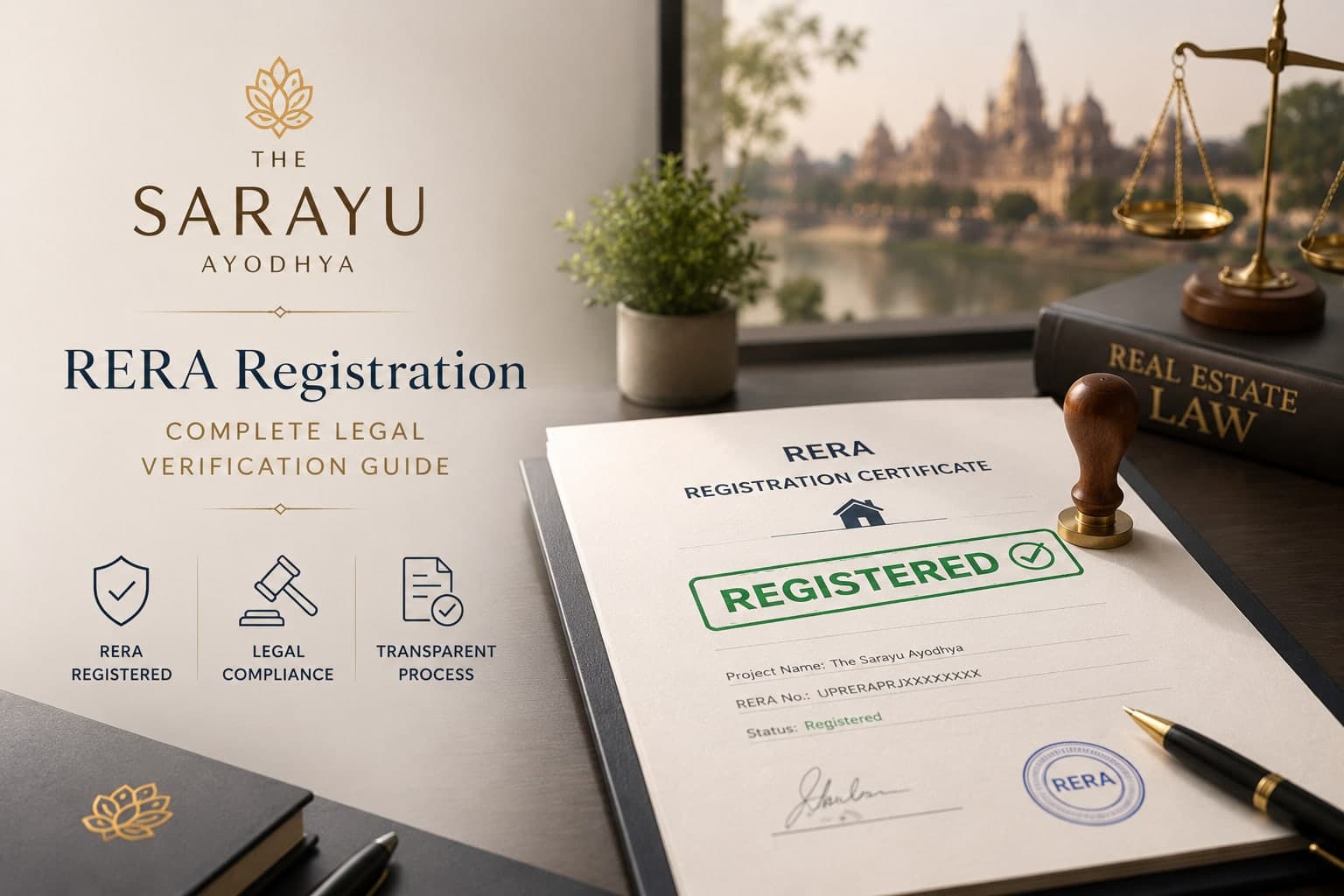
In a market moving as quickly as Ayodhya's, legal verification is not paperwork — it is the difference between an appreciating asset and a decade of litigation. Buyers evaluating The Sarayu Ayodhya by House of Abhinandan Lodha have a significant advantage here, because the project's Phase 1 is registered with Uttar Pradesh RERA under number UPRERAPRJ311468. This guide explains what that registration means, what it does not cover, and the complete verification sequence a serious buyer should run before signing.
The RERA Registration Detail
| RERA Authority | Uttar Pradesh Real Estate Regulatory Authority (UP RERA) |
|---|---|
| Phase 1 Registration Number | UPRERAPRJ311468 |
| Project | The Sarayu, Ayodhya |
| Developer | House of Abhinandan Lodha (HoABL) |
| Project Type | Plotted development — Villa Plot / Royal Plot / Premium Villa Plot |
| Status | Under Construction |
Why RERA Matters More for Plots Than for Apartments
There is a persistent misconception that RERA applies only to apartment projects. It does not. Plotted developments above the prescribed threshold fall squarely within its scope, and arguably the protections matter more here.
With an apartment, a buyer can see a physical structure rising. With a plot, the buyer is purchasing a demarcated rectangle on a layout plan, and the value of that rectangle depends almost entirely on promises about what will be built around it — the internal roads, the drainage, the water and power infrastructure, the clubhouse, the landscaped boulevards. RERA converts those promises into registered, enforceable commitments.
What RERA Registration Actually Gives You
Verified Title and Land Ownership
Registration requires the promoter to submit title documents and an encumbrance position to the authority. The land cannot be registered if the promoter's ownership or development rights are unclear.
Approved Layout on Public Record
The sanctioned layout plan, plot demarcation, common areas and amenity allocation are filed with the authority. A developer cannot quietly convert a promised park into additional saleable plots.
Escrow Discipline
Seventy per cent of buyer collections must be held in a dedicated project account and used only for that project's land and development cost. This is the provision that most directly protects buyers against fund diversion.
Carpet-Area Equivalent Certainty
For plots, this translates into a registered plot area that cannot be reduced. The 1,248 to 1,250 square feet of a Villa Plot, the 1,500 square feet of a Royal Plot and the 1,507 square feet of a Premium Villa Plot are recorded dimensions, not negotiable marketing figures.
Timeline Accountability
The promoter commits to a completion date for registered infrastructure. Delay triggers defined consequences, including interest liability.
A Real Grievance Forum
UP RERA provides an adjudicatory mechanism that is materially faster and cheaper than civil litigation.
Step-by-Step Verification Process
Step 1 — Verify the Registration Independently
Visit the UP RERA portal and search the registration number UPRERAPRJ311468. Confirm the promoter name, project name, registered land area, validity period and current status. Never rely on a number printed in a brochure without checking it at source.
Step 2 — Confirm Your Plot Falls Within the Registered Phase
This is the step most buyers skip and the one that causes the most trouble. A large development may register phases sequentially. Ask explicitly whether the specific plot number you are being offered sits within UPRERAPRJ311468 or within a phase that is yet to be registered. Get the answer in writing.
Step 3 — Match the Layout Plan
Obtain the RERA-filed layout and compare it against the sales plan you were shown. Check plot numbering, plot dimensions, road widths, and the location and extent of common areas, the clubhouse, the amphitheatre zone and open green areas.
Step 4 — Examine the Title Chain
Engage an independent advocate to trace ownership over the preceding decades. Review the sale deeds, mutation entries, and khasra and khatauni records maintained by the revenue authorities in Uttar Pradesh.
Step 5 — Confirm Land Use Conversion
Verify that the land has been lawfully converted from agricultural to non-agricultural residential use, and that the conversion order is current and applies to the entire parcel being sold.
Step 6 — Obtain the Encumbrance Certificate
Confirm the absence of mortgages, liens, attachments or pending charges over the land. Where the developer has taken construction finance, verify the no-objection and release mechanism for individual plots.
Step 7 — Check Local Authority Approvals
Layout sanction from the relevant development authority, road and drainage approvals, water and electricity provisioning clearances, and environmental clearance where applicable.
Step 8 — Read the Agreement for Sale Closely
RERA prescribes a model agreement. Scrutinise the plot description and dimensions, the payment schedule, the infrastructure completion date, the penalty clauses on both sides, the cancellation and refund terms, and the maintenance obligations after handover.
Step 9 — Verify at Registration
At the sub-registrar's office, confirm stamp duty computation, ensure the plot description in the deed matches the RERA record exactly, and complete mutation in your name after registration.
Red Flags in the Wider Ayodhya Market
Ayodhya's rapid appreciation has attracted unorganised supply alongside credible developers. Signals that warrant caution include land offered without any RERA registration, prices dramatically below the prevailing rate for the micro-market, pressure to pay large sums before documentation is shared, refusal to permit independent legal review, agricultural land marketed as residential without a conversion order, and title documents provided only as photocopies.
The advantage of buying registered inventory such as Sarayu plots Ayodhya is that most of these risks are structurally removed before the buyer arrives.
Additional Considerations for NRI Buyers
Overseas Indian buyers should additionally ensure compliance with FEMA provisions governing property acquisition, route funds through NRE, NRO or FCNR accounts with a clear audit trail, execute a properly attested and adjudicated power of attorney if a representative will act on their behalf, and understand TDS obligations and repatriation limits at the point of eventual sale.
What Verification Does Not Replace
RERA registration confirms regulatory compliance. It does not evaluate whether the price is fair, whether the location will appreciate, or whether the project suits your financial position. Those remain commercial judgements. Registration removes legal risk; it does not remove market risk.
Summary
Phase 1 registration under UPRERAPRJ311468 places The Sarayu in the minority of Ayodhya inventory that carries formal regulatory protection, with a defined layout, an escrow-disciplined funding structure and an accessible grievance mechanism. Buyers should still complete independent title, conversion and encumbrance verification, and should confirm in writing that their specific plot falls within the registered phase.
For a complete legal checklist, RERA documentation support and verified plot availability, review the full project profile for House of Abhinandan Lodha Ayodhya or speak with the Perfect Neighbourhood advisory team on +91 93796 27377.
Frequently Asked Questions
Is The Sarayu Ayodhya RERA registered?
Yes. Phase 1 is registered with Uttar Pradesh RERA under number UPRERAPRJ311468. Buyers should verify this independently on the UP RERA portal rather than relying on brochure figures, and should confirm in writing that their specific plot number falls within the registered phase.
Does RERA apply to plotted developments?
Yes. Plotted developments above the prescribed threshold fall squarely within RERA's scope. Arguably the protections matter more here than in apartment projects, because a plot buyer is purchasing largely on the basis of promises about surrounding infrastructure rather than a visible structure.
What documents should I verify before buying?
The RERA registration and filed layout, the title chain over the preceding decades, mutation entries and revenue records including khasra and khatauni, the land-use conversion order, the encumbrance certificate, layout sanction from the relevant development authority, and the RERA-prescribed agreement for sale. Independent legal review is strongly advisable.
What extra steps apply to NRI buyers?
Overseas buyers should confirm FEMA compliance, route funds through NRE, NRO or FCNR accounts with a clear audit trail, execute a properly attested and adjudicated power of attorney if a representative will act locally, and understand TDS obligations and repatriation limits ahead of any future sale.