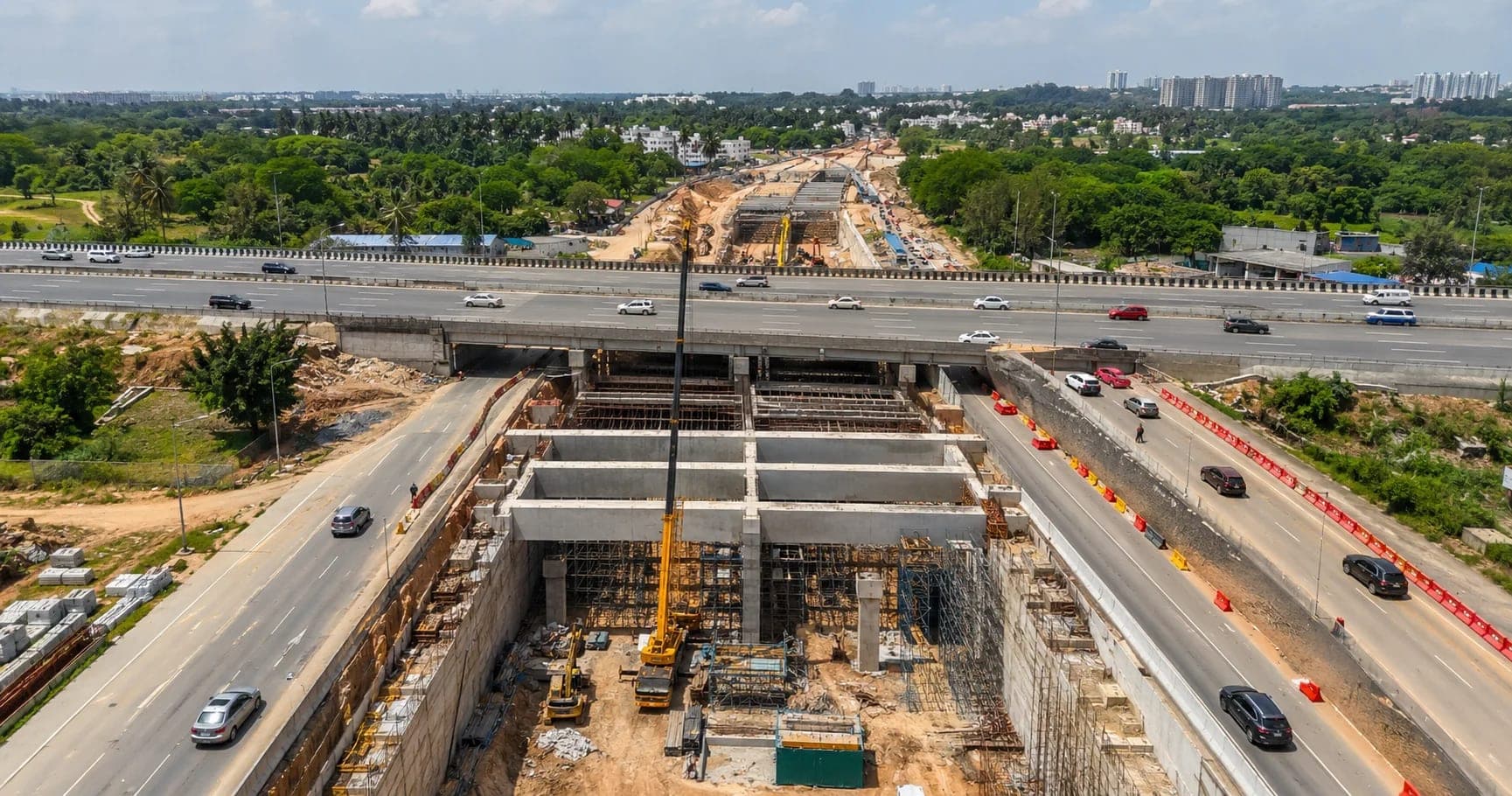
Sadahalli Underpass: Bengaluru's Big Step Toward a Signal-Free Airport Road
For years, anyone driving from Hebbal to Kempegowda International Airport has hit the same bottleneck: the traffic signal at Sadahalli. That's about to change, as the National Highways Authority of India has finally begun work on an underpass designed to erase that last red light from the entire stretch.
If you commute on this route regularly, take an airport cab often, or you're simply tracking Bengaluru's infrastructure story, here's a clear breakdown of what the Sadahalli underpass project actually involves, why it matters, and when you can realistically expect it to be ready.
What Is the Sadahalli Underpass Project?
The project centers on building a six-lane underpass at Sadahalli Junction on NH-44, the highway that links Hebbal to the airport. The structure will run for roughly 750 metres, cutting straight through the point where traffic currently has to stop at a signal.
Once operational, vehicles heading to or from the airport will be able to pass straight through Sadahalli without slowing down for a red light. That single change is the whole point of the project: turning the 22-kilometre Hebbal-airport corridor into a genuinely uninterrupted, signal-free drive.
Why This Stretch of Road Needed an Underpass
The Hebbal-airport road is one of Bengaluru's busiest and most economically important corridors. It carries a steady stream of airport traffic, IT-sector commuters, and logistics vehicles around the clock. Yet for all the effort that's gone into widening and upgrading this route over the years, one intersection at Sadahalli kept forcing traffic to stop.
On a road that's otherwise built for uninterrupted, high-speed movement, a single signal creates an outsized problem. Queues build up quickly during peak hours, flights get missed by a matter of minutes, and the ripple effect slows down traffic well before and after the junction itself. Removing that one signal is expected to smooth out flow across the entire corridor, not just at that specific point.
How NHAI Plans to Manage Construction Without Choking Traffic
Anyone who has lived through highway construction in Bengaluru knows the real worry isn't the final result, it's the disruption while the work is underway. NHAI appears to have planned around this concern directly.
Before breaking ground on the underpass itself, the authority is widening the service roads that run alongside the main carriageway. The idea is to shift regular traffic onto these expanded service lanes so that construction can proceed on the main stretch with minimal impact on daily commuters. Access for residents and businesses in the villages near the junction is expected to remain uninterrupted throughout the build.
The full construction timeline for the underpass is expected to span close to two years from the start of major work, though this depends on how smoothly land, utilities, and phased traffic diversions come together on the ground. It's worth keeping in mind that timelines on large infrastructure projects often shift, so commuters should treat any single date as an estimate rather than a guarantee.
Who Benefits Once the Underpass Opens
The most obvious winners are the thousands of people who use this road every single day, airport staff, frequent flyers, cab and logistics operators, and residents of North Bengaluru neighbourhoods that feed into this corridor. A shorter, more predictable commute to the airport has value that goes well beyond convenience: it affects everything from missed flights to fuel costs to the reliability of last-mile logistics for businesses operating near the airport.
There's also a broader angle here. North Bengaluru, particularly the belt around Devanahalli, Yelahanka, and the areas closer to the airport, has been steadily attracting real estate development, warehousing, and aerospace-linked industry. A smoother, faster connection to the airport tends to make this belt more attractive for both residential buyers and businesses looking to set up near a major transport hub. Infrastructure upgrades like this one are often cited as one of the quiet but meaningful drivers behind rising interest in North Bengaluru's property market.
- Daily commuters and airport travellers get a faster, more predictable journey.
- Cab, logistics, and cargo operators benefit from reduced idle time and better trip planning.
- North Bengaluru's real estate and industrial belt gains improved connectivity, a factor that often supports long-term property demand.
- Residents near Sadahalli Junction should see reduced local congestion once the signal is gone for good.
What to Expect Going Forward
For now, the practical takeaway for regular travellers is straightforward: expect some temporary rerouting and slightly slower movement near Sadahalli Junction as construction ramps up, but not a full closure of the corridor. NHAI's approach of widening service roads first suggests an attempt to keep disruption manageable rather than forcing commuters through months of gridlock.
Longer term, this underpass fits into a broader pattern of Bengaluru investing in signal-free, high-speed connections to its airport, a priority that has only grown as passenger traffic through Kempegowda International Airport continues to climb year after year. Projects like this one, alongside other road and infrastructure upgrades planned for North Bengaluru, are part of a larger push to keep the region's growth from being held back by outdated road design.
If you rely on the Hebbal-airport route often, it's worth keeping an eye on official NHAI updates as construction progresses, since phased traffic diversions may affect specific lanes or timings at different stages of the project.
Quick FAQs
Where exactly is the Sadahalli underpass being built?
It's coming up at Sadahalli Junction on NH-44, along the Hebbal to Kempegowda International Airport road, currently the only point on this stretch with a traffic signal.
How long will construction take?
The project is expected to take close to two years to complete, with service roads being widened first to help manage traffic during the build.
Will the road stay open during construction?
Yes, NHAI plans to keep the corridor accessible throughout, using widened service roads and phased traffic diversions to minimise disruption for daily commuters and local residents.
Why does removing one traffic signal matter so much?
Because it's the only signal left on an otherwise high-speed, 22-kilometre corridor. A single stop point creates queuing and delays that affect the entire route, especially during peak airport travel hours.