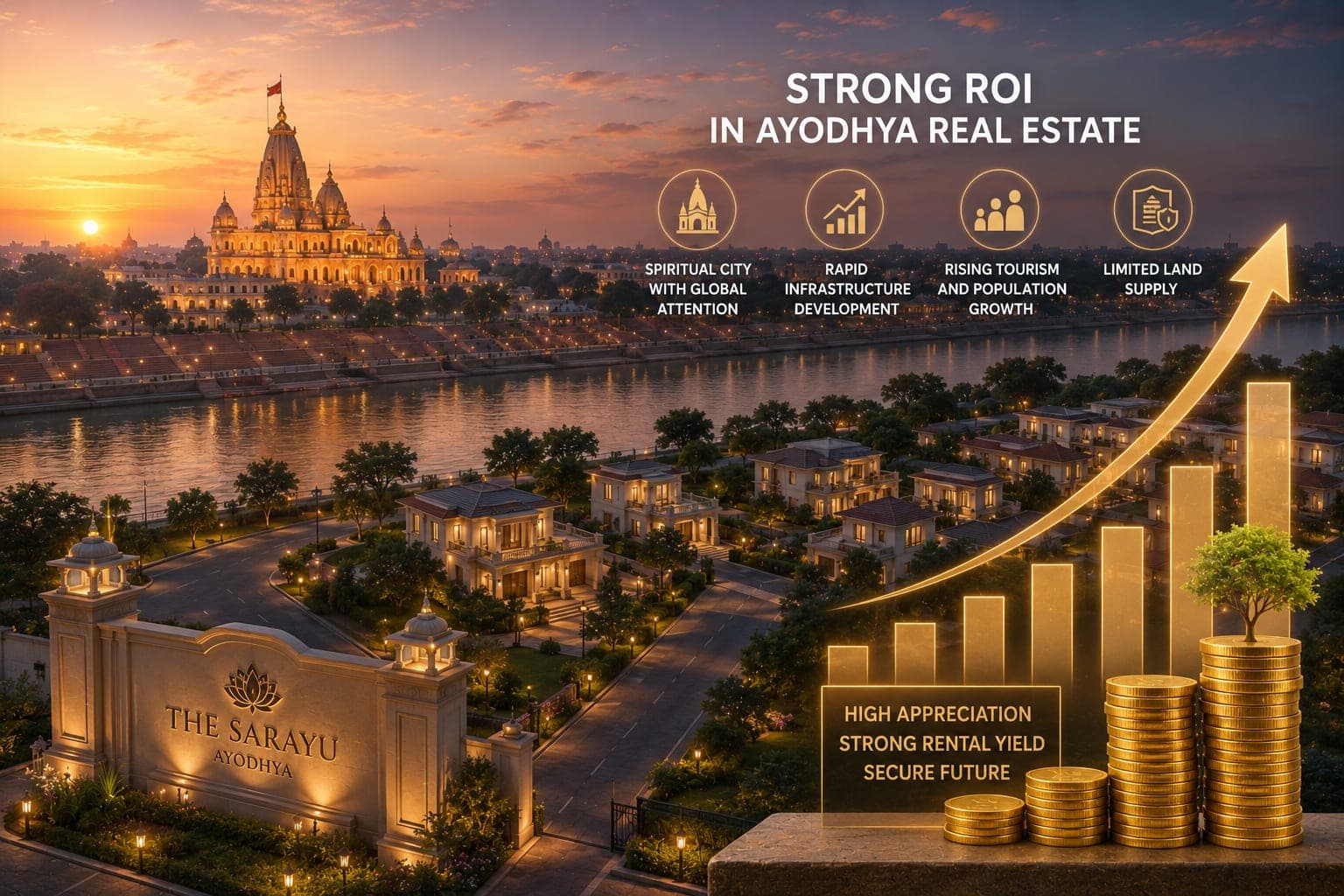
Every property pitch in Ayodhya today leads with appreciation. Very few explain the mechanism behind it, and fewer still are honest about what can go wrong. This is a structured look at the investment case for The Sarayu Ayodhya by House of Abhinandan Lodha — the drivers, the risks and the framework for deciding whether it belongs in your portfolio.
The Starting Position
| Entry Price | Rs 1.89 Cr onwards (Villa Plot, 1,248–1,250 sq.ft.) |
|---|---|
| Asset Type | Freehold plotted land in a gated development |
| Location | Near Sarayu River, ~15 min from Shri Ram Mandir |
| RERA | UPRERAPRJ311468 (Phase 1, UP RERA) |
| Status | Under construction, possession TBA |
Why Land Behaves Differently From Built Property
The most important structural point in any plotted investment analysis is that land and buildings appreciate through completely different mechanisms.
An apartment is a depreciating structure sitting on an undivided share of appreciating land. Over twenty years the structure ages, requires capital repair and loses relative value against newer supply, while your share of the land carries the return. In a plot, there is no depreciating component at all. You own the land outright, its condition does not deteriorate, holding costs are minimal, and you retain complete flexibility over when and what to build.
This is why long-horizon investors consistently favour land in growth corridors — the compounding is cleaner and the maintenance drag is close to zero.
The Five Appreciation Drivers in Ayodhya
1. A Permanent, Non-Cyclical Demand Driver
Most Indian real estate markets are driven by employment — an IT corridor, a manufacturing cluster, a port. Those drivers are cyclical and can relocate. Ayodhya's driver is a religious destination of national significance, which is neither cyclical nor mobile. Pilgrimage demand is among the most durable forms of demand in existence.
2. Infrastructure Still in Its Build-Out Phase
Maharshi Valmiki International Airport is operational, Ayodhya Dham Railway Station has been upgraded, NH-27 connectivity is in place, and urban development spending continues. Land values respond to infrastructure in stages, and Ayodhya is early in that response curve rather than late.
3. Structural Supply Constraint
Land near the Sarayu River and within the temple catchment is bounded and finite. Organised, RERA-registered, professionally planned inventory is a small subset of an already constrained pool. Scarcity within a growing demand pool is the cleanest appreciation setup available.
4. Buyer Pool Expansion
The buyer base has widened from local purchasers to include domestic high-net-worth individuals, business families, celebrities and the global Indian diaspora. Airport connectivity converted Ayodhya from a regional market into a national and international one, and buyer pool expansion is a direct multiplier on price.
5. Product Differentiation
Within Ayodhya, a 7-star positioned, hospitality-partnered, amenity-backed gated layout occupies its own category. Differentiated product typically holds price better during market softness and commands a resale premium over commodity inventory.
The Three Return Paths
Path 1 — Hold the Land
Buy, register, hold, sell. No construction cost, no tenant management, near-zero holding cost beyond maintenance charges and property tax. The simplest and most capital-efficient route, and the one most suited to investors without an emotional attachment to the location.
Path 2 — Build and Hold as a Second Home
Construction adds cost but also adds optionality: personal use, occasional rental during peak pilgrimage seasons, and a higher-value asset on eventual sale. This suits buyers whose motivation is partly personal, which describes a large share of the Ayodhya market.
Path 3 — Build for Yield
A constructed home in a gated community fifteen minutes from the temple has a plausible short-stay rental market, particularly around Deepotsav, Ram Navami and peak pilgrimage windows. This path carries the most operational complexity and depends on a hospitality management arrangement to be practical for absentee owners.
The Risks, Stated Plainly
An honest assessment requires giving these equal weight.
Premium entry pricing. Sarayu plots Ayodhya are priced above conventional plotted inventory in the same city. Part of the HOABL Ayodhya price reflects brand, hospitality partnership and amenity infrastructure rather than raw land value. If the market's willingness to pay for those attributes weakens, the premium compresses.
Liquidity is still developing. Ayodhya's secondary market is young. Selling a Rs 2 Cr plot in Ayodhya today is not comparable to selling an equivalent asset in a mature metro market. Plan for a longer exit window than you would elsewhere.
Possession is yet to be announced. This is a forward-dated commitment. Capital is deployed before the asset is fully delivered, and RERA protection mitigates but does not eliminate timeline risk.
Rental yield is thin. Land generates no income. Even a constructed home in Ayodhya is unlikely to produce metro-comparable yields. This is an appreciation play, not a cash-flow play, and should be underwritten as such.
Concentration and event risk. Ayodhya's real estate story is closely tied to a single demand driver. Any material change in visitor economics, policy or regional development priorities would affect the market disproportionately.
Rapid appreciation attracts supply. Sharp price movements draw new projects. Over a five-to-ten-year horizon, competing supply will moderate the pace of appreciation from its current level.
How to Underwrite This Properly
- Horizon: underwrite as a five-to-ten-year hold. Anyone modelling a two-year flip is mispricing the liquidity risk.
- All-in cost: model base price plus PLC, infrastructure charges, amenity contribution, stamp duty, registration and maintenance corpus — not the headline number.
- Portfolio weight: treat this as a satellite allocation within a diversified portfolio rather than a core holding.
- Tax: long-term capital gains apply after the prescribed holding period, with indexation and reinvestment exemptions available. Model post-tax, not gross.
- Financing: plot loans carry lower loan-to-value ratios and shorter tenures than home loans. Factor the interest cost into your return calculation.
- Exit plan: decide before buying whether you are selling raw land, a built home, or holding across generations. The answer changes which configuration you should buy.
Who This Investment Genuinely Suits
It suits investors with a long horizon and no need for interim income; NRIs and high-net-worth individuals seeking a spiritually significant asset with credible legal protection; buyers who want personal use alongside capital appreciation; and portfolio investors adding early-stage growth-corridor land exposure.
It does not suit investors who need liquidity within twenty-four months, those seeking rental yield, buyers optimising purely for lowest cost per square foot, or anyone who would be over-concentrated by a single Rs 2 Cr commitment.
The Balanced Verdict
The appreciation logic is sound and rests on a demand driver that is unusually durable, a supply constraint that is structural, and infrastructure that is still maturing. RERA registration under UPRERAPRJ311468 removes most of the legal risk that historically made tier-2 land investment unattractive. The genuine questions are about entry price, liquidity and holding period — all of which are manageable with the right horizon and the right expectations.
For a current cost sheet, comparative micro-market pricing and an investment-focused review, see the complete project profile for Abhinandan Lodha Ayodhya or speak with the Perfect Neighbourhood advisory team on +91 93796 27377.
Frequently Asked Questions
What returns can I expect from The Sarayu Ayodhya?
No responsible advisor should quote a guaranteed figure. The appreciation drivers are strong, namely a durable non cyclical demand driver, a structural supply constraint near the river and temple catchment, ongoing infrastructure delivery and an expanding buyer pool. But this should be underwritten as a five-to-ten-year appreciation play, not a short-term or yield-driven investment.
Is land a better investment than an apartment?
Structurally, land has an advantage: there is no depreciating structure, holding costs are minimal and you retain full flexibility over when and what to build. An apartment carries an ageing structure that requires capital repair and loses relative value against newer supply. The trade-off is that land generates no rental income.
What are the tax implications?
Gains on sale attract capital gains tax, with long-term treatment and indexation benefits available after the prescribed holding period, and reinvestment exemptions available under specified conditions. NRI sellers additionally face TDS obligations and repatriation limits. Model returns post-tax rather than gross.
What is the biggest risk?
Liquidity. Ayodhya's secondary market is still young, and selling a premium plot here is not comparable to selling an equivalent asset in a mature metro market. Plan for a longer exit window, and treat the position as a satellite allocation rather than a concentrated bet.