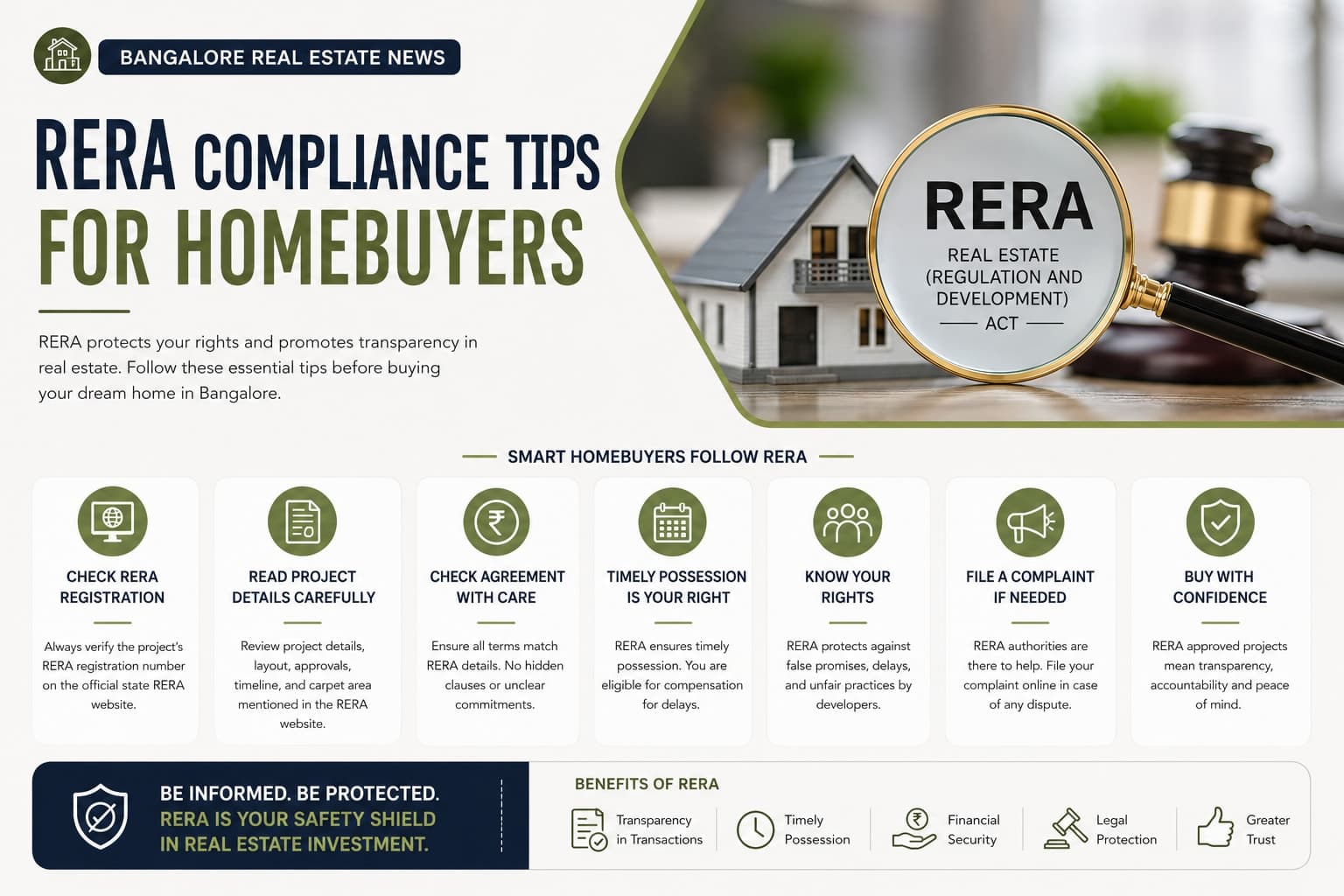
Bangalore Real Estate News: RERA Compliance Tips for Homebuyers
RERA gave Indian homebuyers real protection — but only if you use it. These are the practical compliance checks worth completing before you part with any significant money on a Bangalore property.
Most buyers know RERA exists. Far fewer know how to actually use it, and that gap is where avoidable problems begin. The Real Estate (Regulation and Development) Act, 2016 introduced disclosure requirements, financial safeguards and a grievance mechanism designed to shift the balance toward purchasers. In Karnataka, the state authority is commonly referred to as K-RERA. What follows is a practical set of compliance checks any buyer can complete, whether you are considering an apartment, a plot or a villa community such as the Godrej Villa Whitefield Bangalore project. Treat this as general guidance rather than legal advice.
Start With the Registration Number
The single most important check is also the simplest. Ask the developer or channel partner for the project's RERA registration number in writing, then look it up yourself on the Karnataka RERA portal rather than accepting a screenshot or a verbal assurance. Confirm that the project name, the promoter, the location and the land extent shown on the portal match what you have been told. A mismatch between the marketing material and the registered record is a serious signal that deserves a clear explanation before you proceed any further.
Check Whether Registration Is Even Required
Not every project requires registration. The Act generally exempts smaller developments — broadly, those below a defined land area and unit count — though the precise thresholds and state rules can vary and change. If a seller tells you registration is unnecessary, ask specifically why, and verify the exemption rather than taking it on trust. Genuine exemptions exist and are perfectly legitimate, but the claim is also a convenient cover for projects that simply have not registered, so the distinction is worth establishing early.
Verify the Agent, Not Just the Project
Buyers routinely check the project and forget the intermediary. Real estate agents are themselves required to register under the Act, and their registration can be verified on the same portal. Dealing with a registered agent gives you an accountable counterparty and a clearer path if something goes wrong later. It is a quick check that many buyers skip, and it costs nothing to complete before your first meaningful conversation about payment.
Understand What Carpet Area Actually Means
One of RERA's most useful contributions was standardising how area is described. Carpet area refers broadly to the usable floor area within the walls of the home, and it is meaningfully smaller than the saleable or super built-up area typically quoted in marketing. Always ask for the carpet area alongside any headline figure, and use it when comparing projects. Two homes advertised at similar saleable areas can differ noticeably in the space you will actually live in, and only the carpet figure reveals that.
Read the Disclosed Documents
Registration obliges promoters to disclose project particulars on the regulator's portal, and those disclosures are there for you to read. Look at the approvals and sanctioned plans, the declared land details, the promoter's other projects, and the stated completion timeline. Compare all of it against the sales pitch. This exercise takes an hour and frequently surfaces discrepancies that no brochure would ever reveal, which is precisely why the disclosure requirement exists in the first place.
Know How Your Money Is Meant to Be Handled
Among the Act's more significant protections is the requirement that a substantial proportion of the money collected from buyers be maintained in a separate account and used for that project's construction and land costs, rather than diverted elsewhere. You will not audit this yourself, but understanding the principle helps you ask better questions about payment structures. Be cautious about arrangements that push you toward large payments outside the documented schedule, or toward accounts that do not correspond to the registered project.
Insist on a Written Cost Sheet
Verbal pricing is not a basis for a decision on a purchase this size. Request a written cost sheet that separates the base price from every additional charge — statutory taxes, maintenance deposits, infrastructure or amenity charges, parking, and any preferential-location premium. Ask what is included and what is not, and confirm the figure again at the point of booking. Costs quoted informally during an early conversation have a habit of expanding, and only a written breakdown protects you from that.
Check Timelines and Defect Liability
The registered completion date matters, because it is the commitment against which delays are measured. Note it, and ask what happens if it is missed. Equally, understand that the Act provides for a defect liability period after possession, during which the promoter is generally responsible for rectifying certain structural or workmanship defects brought to their attention. Knowing this before you take handover means you raise issues within the window rather than discovering the protection existed only after it has lapsed.
Understand Your Grievance Route
Protection is only meaningful if you know how to invoke it. The Act establishes a route for buyers to file complaints with the state authority regarding registered projects, with an appellate mechanism above it. You may never need it, but understanding that the route exists changes how you approach negotiations and how seriously you treat written documentation. Keep an organised file of every allotment letter, receipt, cost sheet and material communication, because a documented record is what makes any future recourse practical. Emails and written messages are worth preserving for the same reason: a conversation you cannot evidence is very difficult to rely on later.
Be Especially Careful at Pre-Launch
Pre-launch deserves particular caution because registration may still be in progress. This is common and not inherently improper, but it changes what you should be willing to do. Registering interest, requesting information and visiting the site all cost you nothing. Paying substantial sums before you can verify registration and approvals is where the risk sits. If you are asked for significant money at that stage, ask for the registration timeline in writing and consider waiting until the number can be independently confirmed.
Signals That Warrant Caution
Certain behaviours should prompt you to slow down regardless of how appealing a project seems. Reluctance to put details in writing, pressure to pay quickly before documentation is available, figures that shift between conversations, and vague answers about approvals all belong in this category. So does any assurance of guaranteed returns, which no one can honestly offer. A promoter unwilling to answer straightforward compliance questions during the sales process is unlikely to become more forthcoming once your money is committed.
Build the Habit of Verification
The underlying principle across all of these tips is simple: verify independently rather than relying on assurance. Check the portal yourself, read the documents yourself, keep your own records, and confirm figures in writing at every stage. None of this signals distrust — it is ordinary diligence for the largest transaction most families ever undertake, and reputable developers expect and welcome it. Where a seller treats reasonable verification as an inconvenience, that reaction is itself informative. Good developers understand that an informed buyer makes a more confident one, and answer accordingly.
The Bottom Line
RERA compliance is not paperwork to be delegated or skimmed; it is the framework that protects your money and your rights as a buyer. Verify the registration number on the official portal, confirm the agent is registered, understand carpet area, read the disclosed approvals, insist on a written cost sheet, note the timeline and defect liability period, and know your grievance route. Complete these checks and you convert a hopeful purchase into an informed one. To apply them to a live project, explore the Godrej Villa Whitefield Bangalore listing and request its compliance details.
Disclaimer: This article is general information about RERA and is not legal, financial or investment advice, nor an offer of sale. Provisions, thresholds and procedures under the Real Estate (Regulation and Development) Act, 2016 and applicable state rules may change and can vary by state and project. Any project referenced is in its pre-launch phase, with details indicative and subject to change. Verify all registration details, approvals and documents independently with the official Karnataka RERA portal, the developer or an authorised channel partner, and consult a qualified legal professional before making any booking or payment.