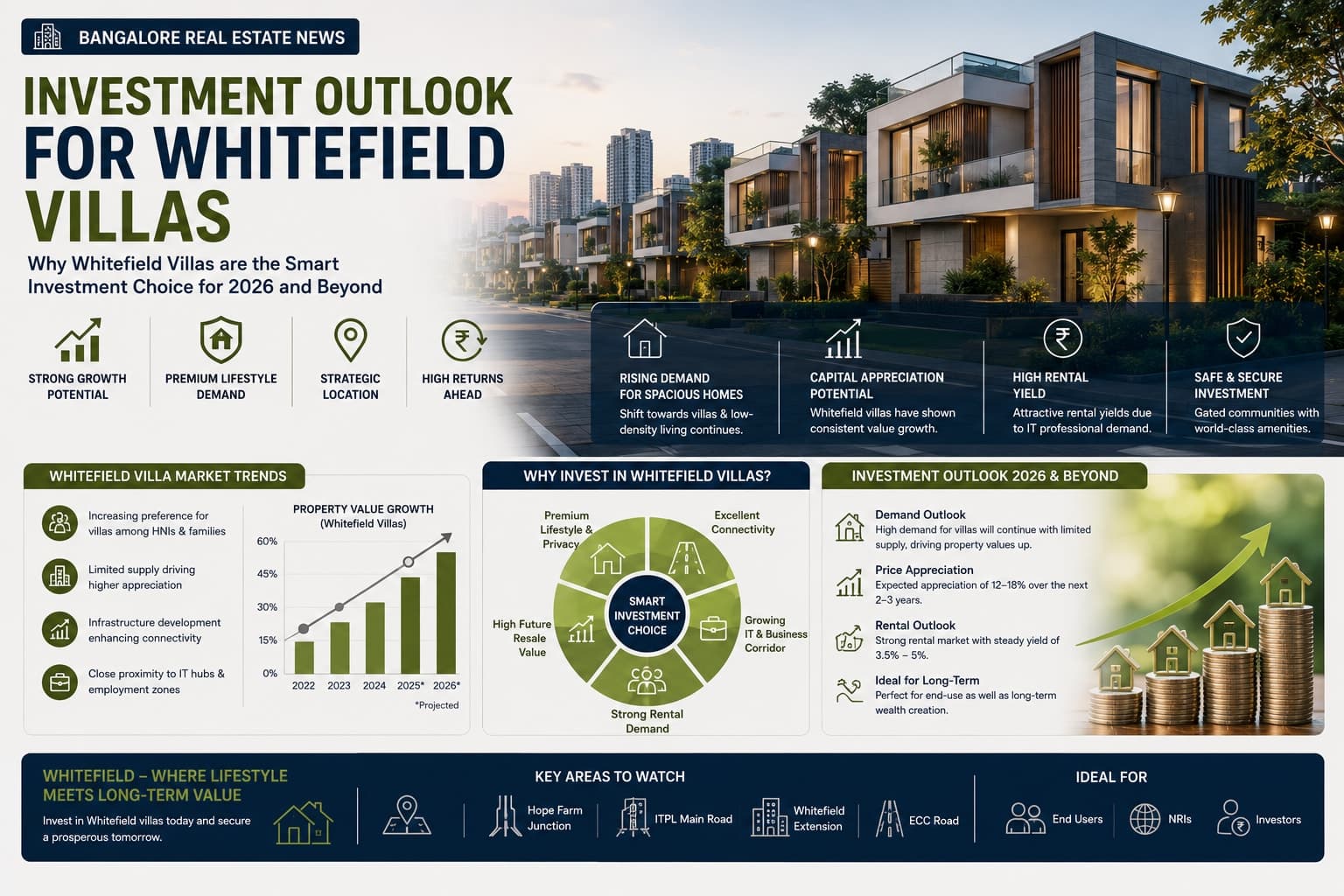
Bangalore Real Estate News: Pre-Launch vs Ready-to-Move Villas
One offers better choice and a lower entry point but asks you to wait and trust. The other gives you certainty and immediate possession at a higher price. Here is an honest comparison to help you decide which suits your circumstances.
Among the decisions a villa buyer faces, few have as much practical consequence as whether to buy early or buy finished. The two routes carry genuinely different risk profiles, cost structures, timelines and emotional experiences. Neither is universally correct, and the buyer who understands the trade-offs makes a far better decision than one following general advice. Communities such as the Godrej Villa Whitefield premium 4 & 5 BHK homes sit at the pre-launch end of this spectrum, so understanding what that means matters before committing.
Defining the Terms
Pre-launch describes a project before its formal market launch, when the developer is engaging early buyers while pricing, documentation and sometimes regulatory registration are still being finalised. Under-construction covers everything from launch until completion. Ready-to-move refers to a completed home available for immediate occupation, ideally with the relevant completion or occupancy certification in place. These stages sit on a spectrum, and the differences between them compound across cost, risk and timing.
Price and Payment Structure
Cost is where the two diverge most visibly. Pre-launch and early-stage purchases typically offer a lower entry point than an equivalent finished home, reflecting the fact that the buyer is accepting time and delivery risk. Payments are also staggered across construction milestones, which spreads the financial burden. Ready-to-move homes command a premium precisely because that risk has been removed and the product is visible. For buyers whose budget is stretched, the staggered payment structure of an early purchase can be the deciding practical advantage.
Certainty Versus Imagination
Buying a finished villa means you see exactly what you are purchasing — the actual light, the real room proportions, the finish quality, the view from the terrace, the neighbours and the condition of internal roads. Buying pre-launch means relying on plans, renders and the developer's reputation. Some buyers are entirely comfortable with this; others find it difficult to commit substantial money to something they cannot walk through. Knowing which type you are is genuinely useful, because discomfort with uncertainty tends to persist throughout the waiting period.
Choice of Unit
Here the early buyer holds a clear advantage. Villa communities contain a limited number of homes, and the best-positioned plots — corner units, quieter internal roads, favourable orientation, better outlook — are usually taken first. By the time a project is complete, the remaining inventory is typically what earlier buyers declined. For a home intended to be lived in for a decade or more, unit positioning affects daily experience considerably, and this is often the strongest argument for buying early.
Timeline and the Cost of Waiting
Waiting has a real cost that buyers frequently underestimate. If you are currently renting, you continue paying rent while also servicing any loan disbursed during construction. If you have sold an existing home, you may need interim accommodation. Beyond money, there is the opportunity cost of years spent in a home that does not suit your needs. Ready-to-move eliminates all of this. When comparing the headline prices of the two routes, the waiting cost should be added to the early-purchase side of the calculation.
Risk Profiles Compared
| Factor | Pre-launch | Ready-to-move |
|---|---|---|
| Entry price | Generally lower | Premium |
| Unit choice | Widest selection | Limited to what remains |
| Certainty of product | Plans and renders only | Fully visible |
| Delivery risk | Present until completion | None |
| Possession | After construction | Immediate |
| Payment | Staggered | Largely upfront |
Tax and Statutory Considerations
The two routes are generally treated differently for tax purposes in India, and this can materially affect total cost. Under-construction property has historically attracted GST, whereas completed property with the relevant certification typically does not, which narrows the apparent price gap between the options. Income tax treatment of home loan interest also differs depending on whether possession has been taken. These rules are technical, subject to change and dependent on individual circumstances, so treat this as a flag to investigate rather than as guidance — a qualified tax professional should confirm the position that applies to you before you commit.
Financing Differences
Lenders approach the two differently. For a completed home, the loan is generally disbursed in full at purchase. For an under-construction property, disbursement is linked to construction milestones, and borrowers often service interest on the disbursed portion during the build period. Lenders also assess project approvals and developer credentials, and some are more willing to fund certain projects than others. If you intend to borrow, discussing both scenarios with your lender early will clarify the real monthly commitment under each route.
The Middle Ground
It is worth remembering that the choice is not binary. Homes nearing completion offer much of the certainty of ready-to-move — the structure exists, quality is visible, the timeline is short — while still carrying some of the pricing advantage of an unfinished purchase. For buyers who want to reduce risk without paying a full completion premium, this middle stage often represents the most balanced option, provided approvals and progress are verified.
Customisation and Community Maturity
Two smaller factors deserve mention. Buying early sometimes allows limited input on finishes or minor layout preferences, depending on the developer and how advanced planning is — an option unavailable once a home is built. Conversely, a ready-to-move purchase in an occupied community lets you assess something no plan reveals: how well the place is actually run. You can see whether common areas are maintained, whether the association functions, and how residents describe living there. For a long-term home, that visibility into how a community is run is genuinely valuable and impossible to obtain in a project that does not yet exist.
Who Should Choose Which
Pre-launch generally suits buyers with time before they need to move, comfort with uncertainty, a strong preference for a particular unit position, and confidence in the developer. Ready-to-move generally suits those needing to occupy quickly, buyers who want to see exactly what they are getting, families whose circumstances cannot absorb delay, and anyone uncomfortable carrying delivery risk. Being honest about which description fits your situation matters more than which route currently appears better value.
How to Reduce Pre-Launch Risk
If you lean toward buying early, several steps meaningfully reduce your exposure. Verify RERA registration status and approvals independently, noting that registration may still be pending at the pre-launch stage — a factor to confirm rather than assume. Examine the developer's record of delivering on time. Obtain the written cost sheet and payment schedule, and understand cancellation terms. Visit the site to assess the location. Keep documentation of everything you are told. These measures do not eliminate risk, but they convert a leap of faith into a calculated decision.
A Practical Example
To make the pre-launch route concrete, consider the Godrej villa community in Whitefield: approximately 20 acres, around 242 homes, 4 and 5 BHK configurations from 3,715 to 5,500 sq. ft., G+2 with private terrace, indicative pricing from around ₹5.40 crore. At this stage, pricing is on request and RERA registration is awaited, which is typical for pre-launch and precisely why early buyers should verify status before making significant payments while enjoying the wider choice of unit positioning.
The Bottom Line
Pre-launch offers better unit choice, a lower entry point and staggered payments, in exchange for waiting and accepting delivery risk. Ready-to-move offers certainty and immediate possession at a premium, with whatever inventory remains. Add the cost of waiting to one side and the price premium to the other, weigh your tolerance for uncertainty honestly, and the right answer usually becomes clear. Whichever route you choose, verify approvals, pricing and documentation independently. To review one pre-launch community in detail, explore the Godrej Villa Whitefield listing.
Disclaimer: This article is general information based on publicly available sources. It is not financial, investment, tax or legal advice, nor an offer of sale. Tax, GST and statutory treatment of property transactions is technical, subject to change and dependent on individual circumstances; consult a qualified professional before relying on any position described here. The project referenced is in its pre-launch stage with RERA registration awaited; configurations, areas and pricing are indicative and subject to change. Verify all details, approvals and registration independently with the developer or an authorised channel partner before making any booking or payment.